
Summary of Imec bring smallest hyperspectral imaging camera to market
imec and XIMEA partnered to integrate hyperspectral imaging (HSI) sensors with xiQ USB3.0 cameras, creating the world's smallest industrial HSI camera. This solution leverages high-speed USB3.0 interfaces for power delivery, eliminating bulky frame-grabbers. The system utilizes semiconductor thin-film processing for compactness and mass production, offering three sensor designs: 100-band linescan, 32-band snapshot tiled, and a new 16-band snapshot mosaic.
Parts used in the Hyperspectral Imaging Camera:
- imec Hyperspectral Imaging (HSI) sensors
- XIMEA xiQ USB3.0 camera product line
- Narrow-band spectral filters at pixel-level
- Semiconductor thin-film processing technology
- High-speed USB3.0 interface
- Single planar rigid board construction
- 100 bands linescan design sensor
- 32 bands snapshot tiled design sensor
- 16 bands snapshot mosaic design sensor
Nanoelectronics research center imec and XIMEA, a progressive creator of machine vision systems, today announced their partnership in integrating imec’s Hyperspectral Imaging (HSI) sensors together with XIMEA’s xiQ USB3.0 camera product line. Exceptional interoperability between camera and sensor’s technology streamlined the success of this integration.
“Combining imec’s hyperspectral sensor with XIMEA’s impressively compact xiQ cameras is a new milestone for us. The high-speed USB3.0 interface includes power supply over USB that removes the need for expensive and bulky frame-grabbers and separate power supplies. It will enable our partners to design and mass-produce extremely compact hyperspectral imaging camera solutions,” stated Andy Lambrechts, program manager for imaging & vision systems at imec.
By applying narrow-band spectral filters at pixel-level using semiconductor thin-film processing, imec’s technology enables hyperspectral image sensor solutions with extreme compactness, low weight, high reliability and proven capabilities to be mass produced at low cost in volume. Three types of standard spectral image sensor designs are today available: 100 bands linescan design, 32 bands snapshot tiled design, and a new snapshot mosaic designs featuring 16 bands in a matrix of 4×4 per-pixel filters.
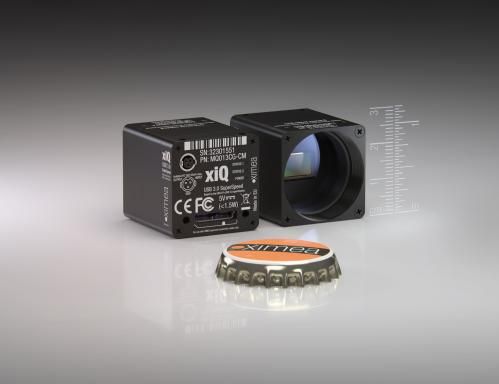
XIMEA coupled imec’s hyperspectral sensors to its xiQ camera product line which features exceptional form factor with unmet specification today for the hyperspectral imaging space: xiQ cameras feature 26.4 x 26.4 x 21.6 mm total dimension and weight of mere 27 grams. With its xiQ series cameras, XIMEA can proudly claim the title of world’s smallest industrial USB3 Vision and hyperspectral imaging camera. XIMEA achieves this ultra-compact footprint by using a single planar rigid board construction as opposed to competing multi-board and multifold flexi-rigid PCB construction, making the xiQ easier to integrate into specialized equipment and OEM designs. XiQ cameras consume only 1.8 W, easing the power and thermal management design challenges of UAVs for example.
For more detail: Imec bring smallest hyperspectral imaging camera to market
-
How does the integration remove the need for frame-grabbers?
The high-speed USB3.0 interface includes power supply over USB, which eliminates the requirement for expensive and bulky frame-grabbers and separate power supplies. -
What makes the imec sensor technology suitable for mass production?
Applying narrow-band spectral filters at the pixel level using semiconductor thin-film processing enables extreme compactness, low weight, high reliability, and low-cost volume manufacturing. -
What are the dimensions and weight of the xiQ camera?
The xiQ cameras have total dimensions of 26.4 x 26.4 x 21.6 mm and weigh only 27 grams. -
Does the camera consume less power than competitors?
Yes, XiQ cameras consume only 1.8 W, which eases power and thermal management design challenges for applications like UAVs. -
How is the ultra-compact footprint achieved in the xiQ series?
XIMEA achieves this by using a single planar rigid board construction instead of competing multi-board and multifold flexi-rigid PCB constructions. -
What types of standard spectral image sensor designs are available?
Three types are available: a 100 bands linescan design, a 32 bands snapshot tiled design, and a new snapshot mosaic design featuring 16 bands in a 4x4 matrix. -
Can partners use this technology to design compact solutions?
Yes, the combination enables partners to design and mass-produce extremely compact hyperspectral imaging camera solutions.
