
Summary of Hot Water Solar Boiler Project
A solar-boiler monitoring and control system warns when hot water falls below a threshold, lets you manually switch electric heating, displays current temperatures and heating status, and provides historical sensor, actuator, and power-consumption graphs. It uses an XBee wireless link between a boiler-side receiver and an Internet-connected controller acting as a gateway to the SmartLiving IoT Cloud.
Parts used in the Hot Water Solar Boiler Project:
- Standard Arduino board
- Grove shield for Arduino
- XBee Shield
- XBee wireless modules
- DS18B20 OneWire temperature sensors (2)
- Grove relay
- Electric heating resistor (in boiler)
- ITEAD IBoard (controller with Ethernet and XBee sockets)
- Internet connection / SmartLiving IoT Cloud access
A solar boiler is great because it gives you hot water using free-sun-energy, but what if there is not enough sun or someone already used all the hot water ? This project helps you take the right decision. It warns you when you run out of hot water and allows you to turn on the electric heating. It also let you know when you can take a bath or shower !
Goals :
- Alert me when the Hot Water goes below a certain threshold
- Manual Control heating (On/Off)
- Show current temp values,
- Heating status (on/off)
- Show historical Sensor/Actuator values (graphs)
- Show power consumption (historical graph)
Typically Hot Water Boilers are in a location within households where Internet connection is available. Therefore i opt for this project to use wireless technology based on Xbee to transfer sensors and actuator data from a receiver which is placed at the boiler side to a Wireless device (Controller) which is connected to the internet and acts as a ‘gateway’ to the SmartLiving IoT Cloud platform.
The Receiver Module :
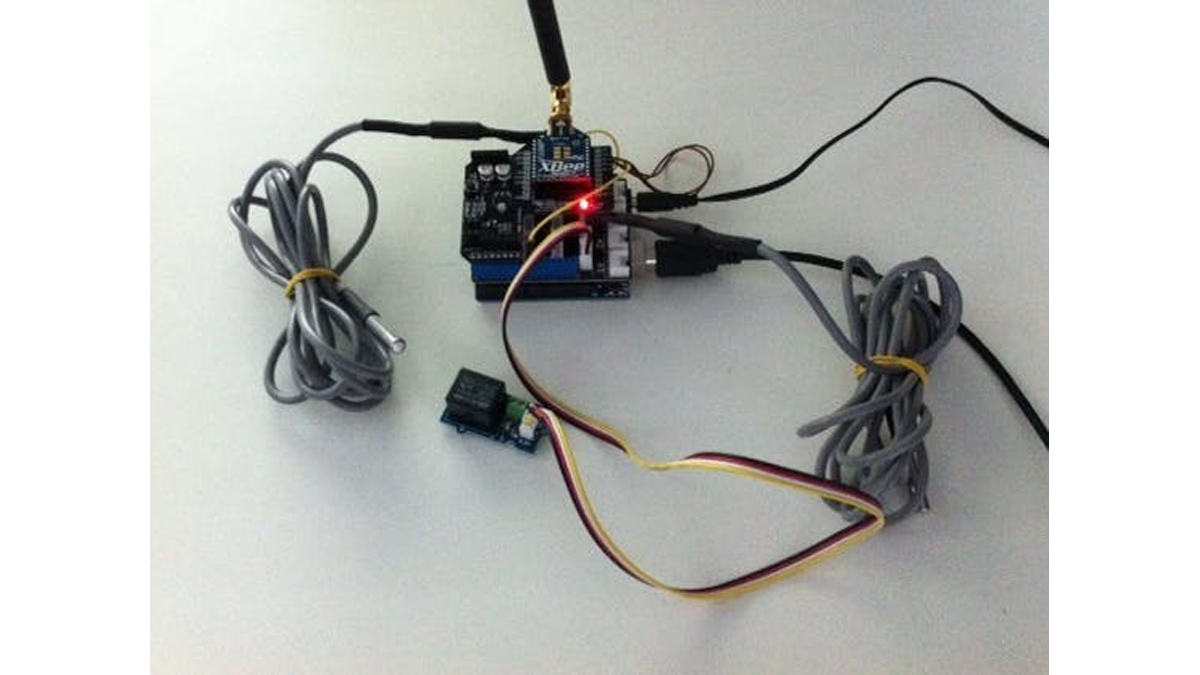
For the receiver module, i used a Standard Arduino board in combination with the Grove shield for arduino and an Xbee Shield.
For measuring the temperature i have added 2 Onewire Temperature sensors (DS18B20). These sensors are Digital Temperature sensors where multiple One-Wires sensors can be hooked up to 1 digital port on the Arduino. I use these type of sensors in this project because they give a good resolution for the temperature range we want to cover.
Features
- Requires only one wire for data interface
- Waterproof
- Grove compatible
- Accepts 3.0V to 5.5V power supply
- Wide temperature range: -55°C to +125°C
- High accuracy: ±0.5°C( -10°C to +85°C)
Further, i have added a Grove relay to control the electric heating resistor in the Solar boiler, which i can control remotely in case a need more hot water.
In the picture below, you find the complete setup of the receiver module.
The Controller module
For the Controller module, we made use of an Iboard of ITEAD. This is an alternative Arduino board with onboard Ethernet and XBee sockets, which is ideal for this project.
Read More: Hot Water Solar Boiler Project
- How does the system warn when hot water is low?
The system monitors temperature with DS18B20 sensors and alerts when values fall below a set threshold. - Can I manually control the electric heating?
Yes, a Grove relay on the receiver module allows remote manual on/off control of the electric heating resistor. - What temperature sensors are used?
DS18B20 OneWire digital temperature sensors are used, two in this project. - How are sensor and actuator data transmitted from the boiler?
Data are sent wirelessly using XBee modules from the receiver to the controller gateway. - What hardware acts as the gateway to the internet?
An ITEAD IBoard with onboard Ethernet and XBee sockets serves as the controller gateway to the SmartLiving IoT Cloud. - Does the system show historical data and power consumption?
Yes, it displays historical sensor and actuator values and a historical power consumption graph via the cloud platform. - Why choose DS18B20 sensors for this project?
They provide good resolution for the required range, are waterproof, OneWire capable, Grove compatible, and operate from 3.0V to 5.5V with high accuracy. - What components are on the receiver module?
The receiver uses an Arduino with a Grove shield, XBee shield, two DS18B20 sensors, and a Grove relay.
