
Summary of Final Hardware Design for Waste Management Using Arduino
The Arduino Mega-based Waste Management Using Arduino system collects weight and RFID data, logs to SD, and sends location/status via GSM/GPS for remote tracking. It uses the Adafruit PN532 for RFID, a Sparkfun 50 kg load cell with HX711 A/D for precise weighing, SD card storage over SPI, and an Adafruit FONA-808 for GSM/GPS. LEDs provide operator feedback; USB aids debugging. The system is battery-powered for standalone use, with the FONA requiring a larger battery and external antennas for reliable cellular and GPS performance.
Parts used in the Waste Management Using Arduino:
- Arduino Mega
- Adafruit PN532 RFID/NFC board
- Sparkfun 50 Kg disk load cell
- HX711 load cell amplifier and A/D converter
- Micro SD card (with SD card module wiring to SPI)
- Adafruit FONA-808 GSM/GPS module
- 2000 mAh lithium-ion battery (for GSM/GPS)
- 9V battery (system power)
- External GPS and GSM antennas (passive)
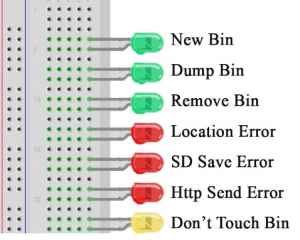
- LED status indicators (seven LEDs)
- Resistors for LED current limiting
- Pull-up resistors for SD SPI lines
The Arduino Mega serves as the system’s central controller in a project focused on Waste Management Using Arduino, managing communication with the load cell, RFID, SD card, and GSM/GPS modules via synchronous and asynchronous serial communication. It enables data acquisition, storage, and remote tracking, while LEDs provide user feedback and USB aids in debugging. Powered by a 9V battery for standalone use, the system operates independently, except for the GPS/GSM module, which requires separate power due to higher energy demands.

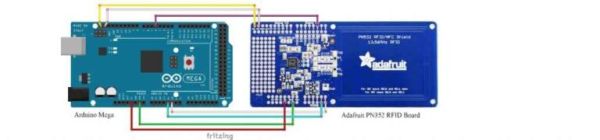
Adafruit PN532 Integration
This section covers the Adafruit PN532 RFID/NFC board used in the Waste Management Using Arduino system. The team selected it for its easy integration with the Arduino Mega, using I2C and IRQ for efficient RFID tag reading. Powered by the Mega’s 5V supply, it reads passive RFID tags at 13.56MHz for contactless identification and tracking.
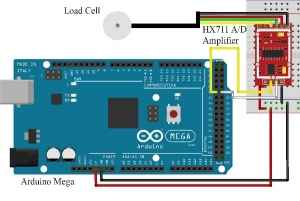
The use of a Sparkfun 50 Kg disk load cell in the Waste Management Using Arduino system is based on a Wheatstone bridge of strain gauge resistors mounted on a metallic disk. The load cell measures weight by detecting voltage changes caused by minute deformations from applied force. Its 50 Kg capacity suits typical household waste and standard bin loads. The setup is adaptable, with potential modifications based on waste company equipment and customer needs.
The HX711 load cell amplifier and A/D converter digitize the load cell’s analog signal for the Arduino Mega. It’s 24-bit resolution ensures precise weight measurement. Unlike SPI or I2C, it requires only two general digital I/O pins, simplifying wiring. Preassembled headers and available libraries further ease integration, needing only calibration and tuning for setup.
Micro SD Card Wiring
Integration of the SD read/write card into the Household Waste Tracking System focuses on its role in data storage. Arduino’s built-in SD library made implementation straightforward, with the main task being proper pin configuration. The SPI communication system uses MISO, MOSI, and SCK pins assigned by the SPI protocol, with the additional Chip Select (CS) pin assigned close by for easier wiring purposes. The external pull-up resistors were added to the communication, clock, and CS lines in order to set up stable operation and reliable logging of the data.
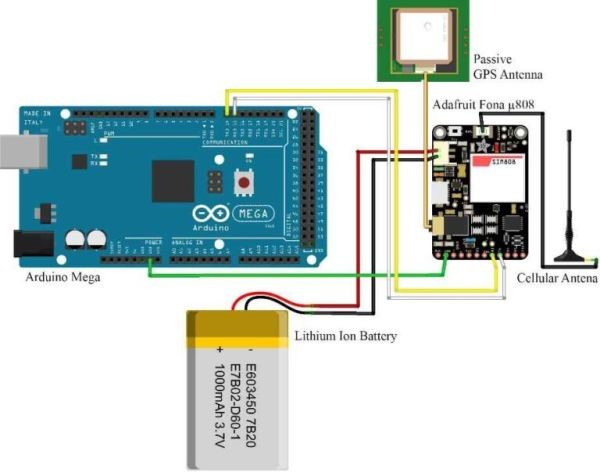
The integration of the GSM/GPS board plays a vital role in enabling remote communication and location tracking in the system. Initially, the Sparkfun MG2639 was considered, but poor documentation led to its replacement with the Adafruit FONA-808, which offered better support and library availability. This board uses a hardware serial UART interface to communicate with the Arduino. It gathers GPRS data via a prepaid T-Mobile SIM and transmits it through HTTP POST over the GSM network, while also receiving GPS signals from satellites. The system uses a 2000 mAh lithium-ion battery to meet high power demands and includes external passive antennas to ensure reliable GPS and GSM signal reception.
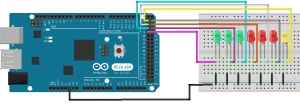
The LED status indicators provide real-time feedback during the waste reception process in the Waste Management Using Arduino system. Seven LEDs light up in sequence or specific patterns to show the system’s current status, offering a simple and effective user interface. Though not shown in diagrams, resistors are included to limit current and protect the LEDs. This setup ensures usability by keeping the operator informed without the need for a complex display.
Read more: Final Hardware Design for Waste Management Using Arduino
- What is the central controller in the system?
The Arduino Mega serves as the system's central controller, managing communication with sensors and modules. - How does the system read RFID tags?
It uses the Adafruit PN532 RFID/NFC board via I2C and IRQ to read passive 13.56 MHz tags. - Which load cell and amplifier are used for weight measurement?
A Sparkfun 50 Kg disk load cell is used with an HX711 24-bit load cell amplifier and A/D converter. - How is data logging implemented?
Data is stored on a micro SD card using Arduino's SD library over the SPI interface with a dedicated CS pin and pull-up resistors. - Which GSM/GPS module is used and why?
The Adafruit FONA-808 is used because it has better documentation and library support than the initially considered Sparkfun MG2639. - How does the system send location and data remotely?
The FONA-808 uses a hardware UART to the Arduino and transmits data via HTTP POST over the GSM network while receiving GPS signals. - What power supplies are required?
The system uses a 9V battery for standalone operation, and a separate 2000 mAh lithium-ion battery is used to meet the higher power demands of the GSM/GPS module. - Why are external antennas used?
External passive antennas are included to ensure reliable GPS and GSM signal reception for the FONA-808. - How are LEDs used in the project?
Seven LEDs provide real-time status feedback during waste reception, with resistors included to limit current. - What role does USB play in the system?
USB is used to aid in debugging the Arduino Mega during development and troubleshooting.
