
Summary of Arduino Earfingers-Hear With Your Hands
Earfingers is a wearable device that converts environmental sound into fingertip vibrations, enabling users—especially those with hearing impairments—to perceive audio via touch. It captures sound with a microphone, processes it on an Arduino using wavelet decomposition, and drives vibration motors (tactors) through transistor switches and protective diodes. The project combines DIY-built solenoid or motor tactors mounted on a glove, an amplifier, and software mapping frequencies to vibration patterns to allow recognition of music and speech through tactile feedback.
Parts used in the Earfingers:
- Arduino Uno (or similar microcontroller)
- Audio Sensor Module (e.g., KY-037)
- Vibration motors (one for each finger)
- Amplifier circuit
- Transistors for motor switching
- Diodes for back EMF protection
- Solenoids or motor coils for tactors
- Power supply for motors
- Powerful magnets
- Tubing and flexible membranes for tactor housing
- Glove or straps for mounting motors
Earfingers aims to offer an innovative way for individuals, especially those with hearing impairments, to experience sound. The circuit for Earfingers uses an Arduino to control the vibration motors. First and foremost, I must acknowledge that I am standing on the shoulders of giants—people whose open contributions to the community made this project possible. Without the countless individuals who freely share their knowledge, projects like this would be unthinkable.

What Are Earfingers?
Earfingers is a wearable device that allows users to “feel” sound through vibrations transmitted to the fingertips. This project leverages the fascinating relationship between touch and hearing, drawing inspiration from the auditory system, specifically the cochlea’s wavelet transformation process.
The Science Behind Earfingers
Human hearing involves a complex system of sensors in the cochlea that converts sound waves into neural impulses. This process is incredibly intricate, with the cochlea decomposing sound into a series of frequency components—a process known as wavelet transformation. Interestingly, the tactile sensory system operates within the same frequency range (50–250 Hz) as hearing, suggesting that the brain might be able to interpret sound through touch. This idea is the foundation of Earfingers.
How Earfingers Works
The device functions by converting audio signals into vibrational feedback, allowing users to “feel” the sound. The process involves:
- Microphone Input: Capturing environmental sound.
- Arduino Input Processing: Converting audio signals into vibration patterns.
- Tactile Feedback: Vibrations transmitted through motors placed on the fingers, allowing users to feel the sound.

Building Earfingers: A DIY Guide
To bring Earfingers to life, you’ll need:
- Arduino Uno (or similar microcontroller)
- Audio Sensor Module (e.g., KY-037)
- Vibration Motors (for each finger)
- Amplifier Circuit
- Glove or Strap for mounting motors
Building the Tactors
Creating tactors involves assembling solenoids (small electromagnets), winding motor coils, and placing them in a housing that can transmit vibrations to the skin. You’ll also need powerful magnets, tubing, and flexible membranes to create the correct vibration feedback.
The Circuit
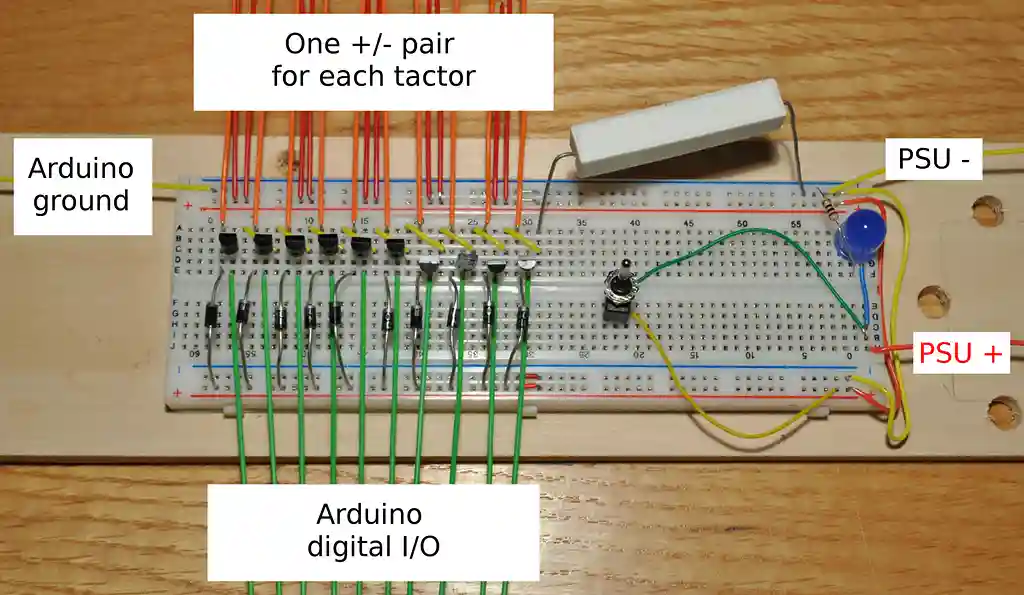
The circuit for Earfingers uses an Arduino to control the vibration motors. Since the motors require more power than the Arduino can supply directly, we use transistors to switch the motors on and off, along with diodes to protect the circuit from back electromagnetic forces.
Software Development
The software behind Earfingers processes audio data and decomposes it using wavelet transformation, breaking sound down into its component frequencies. These frequencies are then mapped to vibrational signals, allowing the device to simulate a tactile experience of sound.
Code

Testing and Results
Upon completing the device, users can test it by playing music or other audio content. The goal is for the user to recognize music and speech based on tactile feedback. While the system won’t replicate the full experience of hearing, it allows users to perceive and distinguish between sound patterns, offering a new way to “hear” through touch.
Impact and Future Possibilities
The primary motivation behind Earfingers was to help individuals with hearing impairments experience music and sound through tactile feedback. While it’s still early in development, the project demonstrates how sensory substitution can offer new ways to experience the world.
Quick Solutions to Questions related to Earfingers:
- What is Earfingers?
Earfingers is a wearable device that converts sound into fingertip vibrations so users can feel audio through touch. - How does Earfingers capture sound?
It captures environmental sound using a microphone or audio sensor module. - How are vibrations generated in Earfingers?
Vibrations are generated by vibration motors or solenoid-based tactors mounted on the fingers. - Can an Arduino control the vibration motors?
Yes; the Arduino controls the motors but uses transistors to switch them because motors need more power than the Arduino can supply directly. - Why are diodes used in the circuit?
Diodes are used to protect the circuit from back electromagnetic forces generated by the motors or solenoids. - What signal processing is done on the audio?
The software decomposes audio using wavelet transformation and maps frequency components to vibration signals. - What components are needed to build tactors?
Building tactors involves solenoids or motor coils, powerful magnets, tubing, flexible membranes, and appropriate housing to transmit vibrations to skin. - How is the device mounted to the user?
The vibration motors or tactors are mounted on a glove or straps worn on the fingers. - What are the testing goals for Earfingers?
The goal is for users to recognize music and speech patterns based on tactile feedback. - What is the main motivation behind Earfingers?
The primary motivation is to help individuals with hearing impairments experience music and sound through tactile sensory substitution.
