
Summary of A HIGH TORQUE 3D PRINTED HARMONIC DRIVE
[3DprintedLife] developed a custom 3D-printed high-torque strain wave gearbox to power a robotic camera arm with a cheap NEMA23 stepper motor. By replacing a rubber belt with a tunable 3D printed flex spline and adding a rigid output spline, the design achieved minimal backlash and 10 Nm of torque. An automated test rig using an Arduino and load cell facilitated rapid iteration and validation before finalizing the PLA-based components.
Parts used in the Custom 3D Printed High Torque Strain Wave Gearbox:
- NEMA23 stepper motor
- Flexible toothed spline (initially toothed rubber belt, later 3D printed flex spline)
- Rigid output spline
- Rotating elliptical part
- Outer spline
- Automated test rig
- 20 kg load cell
- Arduino
- Aluminum extrusions
- PLA filament
Actuators that are powerful, accurate, compact, and cheap are like unicorns. They don’t exist. Yet this is what [3DprintedLife] needed for a robotic camera arm, so he developed a custom 3D printed high torque strain wave gearbox to be powered by a cheap NEMA23 stepper motor.
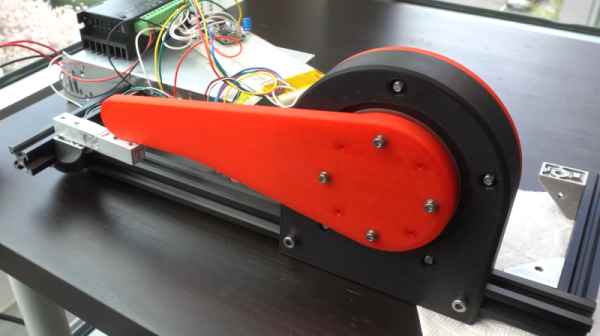
Strain wave gears, otherwise known as harmonic drives, are not an uncommon topic here on Hackaday. The work by deforming a flexible toothed spline with a rotating elliptical part, which engages with the internal teeth of an outer spline. The outer spline has a few more teeth, causing the inner spline to rotate slowly compared to the input, achieving very high gear ratios. Usually, the flexible spline is quite long to allow it to flex at one end while still having a rigid mounting surface at the other end. [3DprintedLife] got around this by creating a separate rigid output spline, which also meshes with the flexible spline.
At first, he used a toothed rubber belt for the flexible spline, which proved to be a bit too flexible and introduced unnecessary backlash. It was replaced with a 3D printed flex spline, which also allowed [3DprintedLife] to tune the tooth profile for maximum torque handling and minimum backlash. He also created an automated test rig with a 20 kg load cell, Arduino, and aluminum extrusions. This allowed each design iteration to be tested repetitively with no manual intervention, allowing design weaknesses to be rapidly identified and fixed as parts broke. The final version is capable of repeatedly producing 10 Nm of output torque, and [3DprintedLife] was only able to break it by putting almost his full body weight on the output arm.
All the parts were printed with PLA, but [3DprintedLife] plans to move to Nylon in the future. The robotic arm is still in the design phase, but we look forward to seeing it collect B-roll for future videos.
A camera arm doesn’t need to be motorized to work well. [Ivan Miranda] and [Alexandre Chappel] recently built large camera arms for their workshops, and both made heavy use of 3D printed parts.
Source: A HIGH TORQUE 3D PRINTED HARMONIC DRIVE
-
What is the purpose of the custom 3D printed gearbox?
To provide powerful, accurate, compact, and cheap actuation for a robotic camera arm. -
How does a strain wave gear achieve high gear ratios?
By deforming a flexible toothed spline with a rotating elliptical part that engages with an outer spline having slightly more teeth. -
Why was the initial toothed rubber belt replaced?
It proved too flexible and introduced unnecessary backlash compared to the 3D printed version. -
What advantage did the 3D printed flex spline offer?
It allowed tuning of the tooth profile for maximum torque handling and minimum backlash. -
How was the design validated during development?
An automated test rig with a 20 kg load cell and Arduino tested iterations repetitively without manual intervention. -
What is the maximum output torque of the final version?
The final version can repeatedly produce 10 Nm of output torque. -
What material was used to print all the parts initially?
All parts were printed with PLA. -
What material does the creator plan to use in the future?
[3DprintedLife] plans to move to Nylon for future prints.
