
Summary of Do-it-yourself PIN-diode counter
The article details DIY radiation detection projects, primarily focusing on the "Stuttgarter Geigerle" and its variants like the "Mini-Geigerle" and "Radon-Geigerle," which utilize PIN diodes. It also introduces the professional "Tino Kit" for Arduino, featuring a Teviso sensor shield. The text provides links to construction manuals, calibration guides, and specific applications such as measuring radon exhalation from granite or cigarette ash.
Parts used in the Stuttgarter Geigerle:
- PIN diode
- PC soundcard
- Thru hole components
- Soldering materials
- Housing
- Photodiodes (for Radon-Geigerle modification)
- Arduino microcontroller board
- Tino Shield PCB
- Teviso radiation sensor module
Still under construction
Sorry, only the green links are translated yet. Check this website soon for new translations.
Why this webpage?
Traditional versus PIN Diode Geiger Counter
Do-it-yourself PIN-diode counter
Intro to the basics (pdf-file)
Complete do-it-yourself instructions
- The “Stuttgarter Geigerle”
- The most simple and cheapest solution: The “Mini-Geigerle” used with the PC-soundcard
- The “Stuttgarter Geigerle” for thru hole assembly
- Construction manual for the “Stuttgarter Geigerle” (thru hole assembly, soldering and housing)
- MS Excel Bill of material for thruhole assembly (Farnell/Reichelt, Germany Stand Juli 2012)
DIY instructions for traditional Geiger-Muller tube geiger counters
Other DIY instructions
- Improved radiation meter. Elektor
- Gamma-Photon Radiation Detector, Maxim
- Funkschau 1986: Radioaktivitätsmesser im Miniformat (a German article)
Further infos on PIN-diode counter
- What does a PIN-diode counter really measure?
- Detection of alpha radiation with the PIN-diode counter
- Solar power for the “Stuttgarter Geigerle”
- Detection of weak radioactivity given the example of a potassium fizzy tablet
- Self-made alpha- beta- and gamma-sensitive radiation detectors on the basis of a low cost PIN-diode
- Comparison to an German army radiation dosemeter
- Comparison to a simple, commercial Geiger-Mueller counter
- Spectroscopy with the Mini-Geigerle
- Estimation of the effective body dose from the activity of radionuclides
- Effects of distance and shielding on alpha radiation measurements
- Radioctivity of cigarette ash
- Calibration of the „Stuttgarter Geigerle“ PIN-diode counter
- Measurements with the “Stuttgarter Geigerle” on regular granite building material
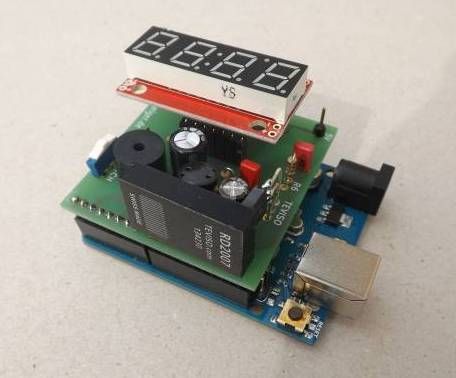
Arduino
The Tino Kit – now available for the interessted community
The Radiation Detection Shield “Tino” for the Arduino – professional calibrated measurement of radioactivity with the Teviso radiation sensor
The Tino Shield is a plug-on PCB stacked on an Arduino microcontroller board. With the Arduino it forms a real measurement instrument calibrated by Teviso, Switzerland, the manufacturer of the radiation sensor module. This shield is now available as kit for DIY assembly.
Arduino programs for the Tino shield can be found on the download page.
Ordering options, prices and shipment infos
Radon
Yes, it really works: You can measure the specific radon activity in a given air volume with a geiger counter. There are web pages that state the opposite.
This graph shows the measurement result of radon exhalation in a chamber which was filled with a granite stone from Menzenschwand (Black Forest area) at time zero. After ten days the stone was removed carefully and the chamber was closed again continuing the measurement. Finally, after 18 days the chamber was opened completely and the detector was kept on running. The pile-up of radon activity with the half-life constant of 3.8 days is clearly visible followed by disintegration with the same time constant. Well, it was not a normal geiger counter that was used for this measurement. It was the “Radon-Geigerle”, a modified version of the “Stuttgarter Geigerle” that was made sensitive to alpha radiation. However, the cost and effort was surprisingly small, it is only required to exchange the photodiodes. During further investigation it turned out that even regular granite building material exhales quite a lot of radon depending on the source of origin and the content of uranium. More in the follwing documents.
For more detail: Do-it-yourself PIN-diode counter
- What is the most simple and cheapest solution mentioned?
The Mini-Geigerle used with the PC-soundcard. - How can the device be modified to detect radon?
It requires exchanging the photodiodes to make it sensitive to alpha radiation. - Can regular granite building material exhale radon?
Yes, depending on the source of origin and the content of uranium. - What is the Tino Kit designed for?
Professional calibrated measurement of radioactivity with the Teviso radiation sensor. - Does the Tino Shield require assembly?
Yes, it is available as a kit for DIY assembly. - What component forms a real measurement instrument when stacked on an Arduino?
The Radiation Detection Shield Tino. - How long did the radon pile-up last in the chamber experiment?
The pile-up was clearly visible over ten days before the stone was removed. - What is the half-life constant of radon mentioned in the graph description?
3.8 days.
