
Summary of Atomically thin Piezo Material
Researchers at Columbia Engineering and Georgia Tech observed piezoelectricity in atomically thin molybdenum disulfide (MoS2). This discovery enables transparent, flexible devices for energy harvesting from body movement to power sensors or charge phones.
Parts used in the Atomically Thin Piezo Material:
- Molybdenum disulfide (MoS2)
- Wearable device
- Clothing
- Wearable sensors
- Medical devices
- Cell phone
Researchers at Columbia Engineering and the Georgia Institute of Technology have reportedly made the first experimental observation of piezoelectricity and the piezotronic effect in an atomically thin material, molybdenum disulfide (MoS2). The piezo effect is traditionally thought of as one property of hard crystalline quartz. Using this new material it would now be possible to manufacture electric generator and mechanosensation devices that are optically transparent, extremely light, flexible and elastic.
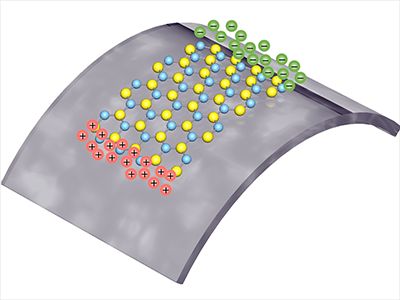
“This material—just a single layer of atoms—could be made as a wearable device, perhaps integrated into clothing, to convert energy from your body movement to electricity and power wearable sensors or medical devices, or perhaps supply enough energy to charge your cell phone in your pocket,” says James Hone, professor of mechanical engineering at Columbia and co-leader of the research.
For more detail: Atomically thin Piezo Material
- What is the first experimental observation made by researchers?
Researchers observed piezoelectricity and the piezotronic effect in molybdenum disulfide. - How can this material be manufactured into a device?
It can be made as a wearable device integrated into clothing. - Can this material convert energy from body movement?
Yes, it converts energy from body movement to electricity. - What properties does this new material possess?
The material is optically transparent, extremely light, flexible, and elastic. - Does this material replace hard crystalline quartz?
No, it offers similar piezo effects but with flexibility and transparency unlike traditional quartz. - What applications are possible with this technology?
Applications include powering wearable sensors, medical devices, and charging cell phones. - Who led the research team mentioned in the article?
James Hone, a professor of mechanical engineering at Columbia, co-led the research.
