
Summary of Scientists Have Captured the Sound One Atom Makes
Researchers at Columbia and Chalmers universities successfully captured the sound of a single excited atom, known as a phonon. This achievement marks the first time scientists have recorded the softest physically possible sound. The experiment utilized a semiconducting circuit to create an artificial atom. Metallic fingers on the chip detected acoustic waves generated by the atom's vibrations and converted them into microwaves for measurement using low-temperature amplifiers.
Parts used in the Single Atom Sound Capture Project:
- Semiconducting circuit
- Artificial atom
- Metallic fingers
- Low-temperature microwave amplifiers
- Superconducting qubits technology
f an atom gets excited in a laboratory, does it make a sound? Turns out that it absolutely does, albeit it’s the softest sound that scientists say is physically possible.
Researchers at Columbia University and Sweden’s Chalmers University of Technology say that they have, for the first time, “captured” the sound a single atom makes when it moves around—a single “phonon,” as it were. It’s an achievement that could eventually be used as the basic science for new quantum computing devices.
Like everyone is taught in elementary school, anytime something moves or vibrates, it makes a sound. Scientists now know for sure that that principle extends down to the lowly atom.
“The sound amplitude, or strength, is very weak,” said Göran Johansson, a co-author of the paper published today in Science. “Basically, when you excite the atom, it creates a sound, one phonon at a time, according to theory. It’s the weakest possible sound possible at the frequency [that it vibrates].”
Ordinarily, this is the part in the story where we’d link to a clip of the atom’s audio, but it’s so soft that it’s not even audible, and the researchers weren’t able to actually hear it.
So, sorry about that. Instead, using a semiconducting circuit (similar to those used to make small quantum computers), Johansson and his team created an artificial atom (like those used in quantum experiments) and excited it.
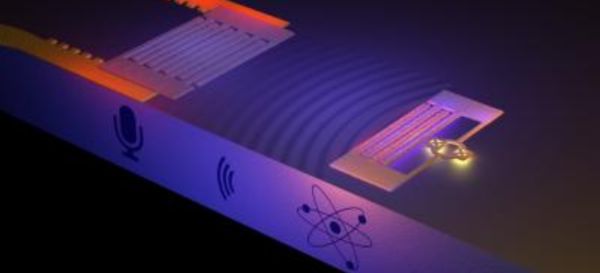
Johansson told me that on the chip was a series of long metallic “fingers” that capture and measure the acoustic waves made by the atom’s vibrations. These are too small to see, so the waves—which look just like waves on a water’s surface, he told me—propagate to a second set of fingers that transform them into microwaves.
“These can then be detected using low-temperature microwaving amplifiers. It’s the same technology we use to read out superconducting qubits,” which are used in quantum communications, he said
For more detail: Scientists Have Captured the Sound One Atom Makes
- Does an excited atom make a sound?
Yes, an excited atom creates a sound, specifically one phonon at a time. - Is the sound of a single atom audible to humans?
No, the sound is too soft to be heard even by researchers. - What institution conducted this research?
The study was performed by researchers at Columbia University and Sweden's Chalmers University of Technology. - How did the team measure the atomic sound?
They used metallic fingers on a chip to capture acoustic waves and transform them into microwaves. - What device was used to detect the transformed microwaves?
Low-temperature microwave amplifiers were used to detect the signals. - Can this technology be applied to quantum computing?
Yes, this achievement could serve as basic science for new quantum computing devices. - What publication reported these findings?
The paper was published in Science. - What does a phonon represent in this context?
A phonon represents a single unit of sound created when an atom moves or vibrates.
