
Summary of FPGA boards under $100: Introduction
This article explores the emerging market of affordable FPGA development boards, now available for under $100, making them accessible to hobbyists and educators. The author plans to review these boards by building specific projects, including sound generators, signal generators, oscilloscopes, and stress tests. While specific board models are not listed in this introductory text, the focus is on comparing various manufacturers' offerings to facilitate low-cost FPGA prototyping and learning.
Parts used in the Affordable FPGA Projects:
- Low-cost FPGA devboards (under $100)
- Bleep-bloop box components
- Dual-modulus divider circuitry
- Simple oscilloscope hardware
- AM/FM/frequency-hopping signal generator modules
- Chip melter stress test setup
Whether engineer, hobbyist, or maker, we’ve happily watched as chipmakers and third parties alike have come to their senses in recent years and cooked up a smorgasbord (smorgasboard?) of low-cost microcontroller devboards – in some cases, very low cost, like TI’s $4.30 MSP430 board. More recently, we’ve seen ARM Cortex kits for $10-$50, the flowering of the whole Arduino ecosystem, and of course, the Raspberry Pi, starting at $25. It’s microcontroller heaven.
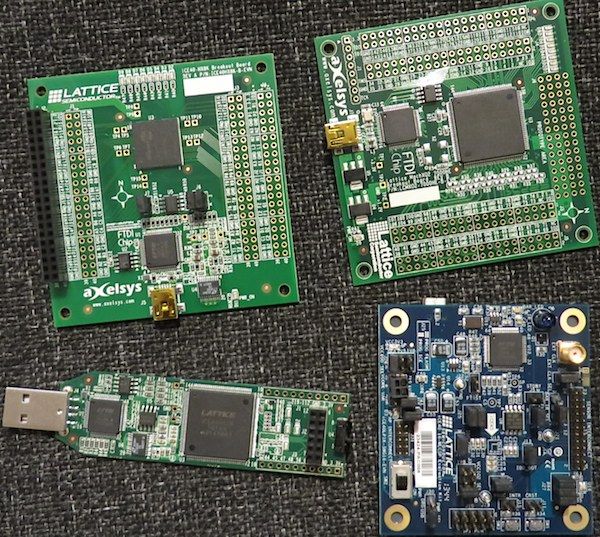
Those of us wanting a cheap “in” to the FPGA world have been less lucky. But the times, they are a changin’. Many FPGA devkits, from both chipmakers and third parties, have broken – or downright shattered – the $100 barrier, opening the door to low-cost FPGA prototyping, education, hobby projects, and so on.
Follow me as I explore this brave new world of affordable FPGA learning and design. I’ve acquired a representative selection of bargain-priced boards, and will be reviewing each, not just on paper, but by actually creating projects with it.
Are you excited yet? I am!
You’ll find a summary of the boards below, but first, we need to come up with fun, interesting, maybe even (gasp!) challenging projects to port to each board in turn. Here are a few of my ideas, but I’m hoping you can suggest some more:
- A bleep-bloop box, creating strange and complex sounds in response to user input
- A dual-modulus divider
- A very simple oscilloscope
- An AM/FM/frequency-hopping signal generator
- A “chip melter” project that does nothing except exercise as much of the FPGA as possible at as high a frequency as possible. Will the IC overheat or the PSU fail? Stay tuned.
Here’s a summary of <$100 devboards, organized by FPGA manufacturer. The ones in [brackets] are not in my pile, but are included for your reference:
For more detail: FPGA boards under $100: Introduction
- What is the current price range for many FPGA devkits?
Many FPGA devkits have broken or shattered the $100 barrier. - Can hobbyists access low-cost FPGA prototyping now?
Yes, the opening of the sub-$100 market has opened the door to low-cost FPGA prototyping. - How will the author review the selected boards?
The author will review each board not just on paper but by actually creating projects with it. - What project idea involves creating strange sounds?
A bleep-bloop box creates strange and complex sounds in response to user input. - What does the chip melter project do?
The chip melter project exercises as much of the FPGA as possible at the highest frequency to test overheating or PSU failure. - Which signal types can the proposed generator create?
The proposed generator can create AM, FM, and frequency-hopping signals. - Is a simple oscilloscope part of the planned projects?
Yes, a very simple oscilloscope is one of the ideas ported to the boards. - Who is the target audience for these new FPGA boards?
The boards are intended for education, hobby projects, and low-cost prototyping.
