
Summary of The Nanite 85
The author presents the Nanite, a custom ATtiny85 development board designed for mini-breadboards. Claimed to be smaller than the recently announced Olimexino 85s, the Nanite features a compact design with the controller mounted perpendicularly on the bottom. It includes a reset button and utilizes a circuit trick to share a pin between the LED and reset function, offering flexibility in configuration while maintaining a narrow profile of 0.4 inches.
Parts used in the Nanite:
- ATtiny85 microcontroller
- USB bootloader
- Mini-breadboard compatible PCB
- Reset button (push button)
- LED indicator
Recently, Olimex anncounced the Olimexino 85s, claimed to be the “World’s smallest Arduino ever“. Now, that looks like a challenge. I guess it is about time to show off what has been on my desk since some time last year: The Nanite, pictured below.
I designed this board for fun after the Digispark and, subsequentally, the Adafruit Trinket were announced. The motivation was to have my own ATtiny85 based development board based on a USB bootloader and optimized for the ubiquitous 170 point mini-breadboards. In contrast to the Digispark it even sports a reset button. However, it lacks an integrated voltage converter as it is supposed to be powered by USB.
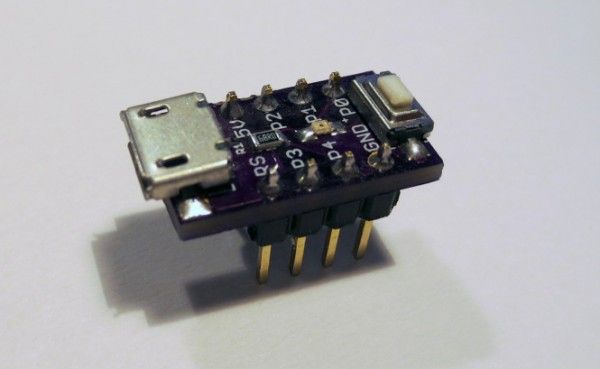
As you can see below, the Nanite is very narrow, wasting no space on the breadboard. It is only 0.4″ wide in contrast to the 0.5″ or 0.6″ of the Trinket or Olimexino. In fact the pin configuration is exactly the same as that of a DIP ATtiny85. You can use the board for development and replace it with a DIP ATtiny85 when you are done.
So, how does it compare to the Olimexino 85s? The table below lists the size of both boards. Looks like the Nanite is almost 20% smaller. Yay! So much about worlds smallest. Removing the reset button from the Nanite could reduce the length further. But who wants a board without reset button?
Why is it that small? The picture below shows the main idea behind this: The controller is mounted on the bottom of the board in a 90 degree orientation.
Apart from the size considerations, the Nanite also uses a neat circuit trick to share a single pin with the LED and the reset button. The circuit of the board is shown below, the circuit attached to the reset pin, PB5, is to the right.
If PB5 is configured as reset (this is the standard configuration), the push button will simply act as a reset button and the LED acts as pull up for the reset button. It will of course light up while the button is pushed.
If reset is disabled and PB5 is configured as a normal I/O pin, the state of the button can be polled by simply reading from the port. The LED can be turned on by setting the output to ‘low’, and is turned off by configuring the output into a high impedance state. It is not advised to set the output ‘high’, since in that case the pushbutton could short the output to ground.
For more detail: The Nanite 85
- What is the main motivation behind designing the Nanite?
The goal was to create an ATtiny85 based development board with a USB bootloader optimized for 170 point mini-breadboards. - How wide is the Nanite compared to the Trinket or Olimexino?
The Nanite is 0.4 inches wide, whereas the Trinket and Olimexino are 0.5 or 0.6 inches wide. - Does the Nanite have an integrated voltage converter?
No, it lacks an integrated voltage converter as it is intended to be powered by USB. - How is the size reduction achieved in the Nanite design?
The controller is mounted on the bottom of the board in a 90 degree orientation. - Can the Nanite be replaced with a DIP ATtiny85 after development?
Yes, the pin configuration matches that of a DIP ATtiny85, allowing for direct replacement. - What happens if PB5 is configured as a normal I/O pin instead of reset?
The button state can be polled by reading from the port, and the LED can be controlled by setting the output low or high impedance. - Why is it not advised to set the output high when PB5 is an I/O pin?
Setting the output high could cause the pushbutton to short the output to ground. - How does the LED behave when the reset button is pushed?
The LED acts as a pull-up for the reset button and lights up while the button is pushed.
