
Summary of HOMEMADE SAWSTOP ATTACHMENT IS JUST ABOUT AS SKETCHY AS IT SOUNDS
Most woodworkers know SawStop table saws, which detect conductive contact and stop the blade to prevent amputations. Ruth Amos built a DIY prototype using an Arduino-mounted sensing system (likely capacitive) attached to a contractor saw. She experimented with above-table arresting mechanisms, finding most impractical. An electromagnetic clutch from a lawnmower ultimately halted the blade rapidly in tests, though it required heavy saw modifications, increased angular momentum, and did not drop the blade below the table. The project is a proof of concept and is explicitly not recommended for practical use.
Parts used in theDIY SawStop Prototype:
- Contractor-style table saw (base saw)
- Arduino microcontroller
- Sensing electrodes or circuitry (capacitive coupling implied)
- Above-table arresting gizmos (experimental attachments)
- Electromagnetic clutch from an electric lawnmower
- Wiring and mounting hardware
- Blade (existing saw blade)
Most of us have probably by now seen the SawStop brand of self-stopping table saw, which detects when something meatier than wood has the bad taste to touch the spinning blade, more or less instantly stopping it and preventing sudden traumatic amputations. It’s an outstanding idea, and we’d love to see the technology built into all table saws. But alas, SawStop saws are priced out of reach for many woodworkers, which left [Ruth Amos] to roll her own DIY version of the system.
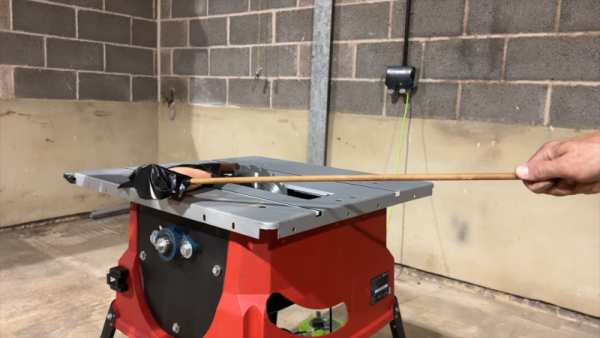
It should be stated right off the bat that none of what [Ruth] does here is a good idea, and that everything shown is really just a proof of concept. The basis for her build was a somewhat flimsy-looking contractor-style saw, to which [Ruth] attached an Arduino set up to detect when something conductive touches the blade. She shares no particulars on the sensing method, but our guess is capacitive coupling. She then sets about experimenting with a series of above-table gizmos to arrest the blade, with limited success, plus all the attachments would make the saw essentially useless. But working above the table does make sense in the prototyping phase, and allowed her to figure out what wouldn’t work.
In the end, it was an electromagnetic clutch from an electric lawnmower that seemed to do the trick, albeit at the expense of heavy mods to the saw and a considerable increase in the system’s angular momentum. Nonetheless, the blade stops pretty close to instantly in the old hot dog test. It doesn’t drop the blade below the table, of course, and the hot dog is a little worse for the wear, but it’s still pretty impressive.
We’ve discussed SawStop’s technology before and why it isn’t perhaps as widely available as it should be, if you’re curious.
Source: HOMEMADE SAWSTOP ATTACHMENT IS JUST ABOUT AS SKETCHY AS IT SOUNDS
- What is the purpose of Ruth Amos's DIY SawStop project?
The purpose is a proof of concept for a self-stopping table saw that detects conductive contact and arrests the blade to prevent injury. - What sensing method does the project use to detect contact?
The article does not specify details, but suggests the sensing is likely capacitive coupling. - What microcontroller did Ruth use in the build?
She used an Arduino microcontroller. - What arresting mechanism ultimately worked best in the tests?
An electromagnetic clutch from an electric lawnmower proved effective in stopping the blade quickly. - Does the DIY system drop the blade below the table like commercial SawStop systems?
No, the DIY system does not drop the blade below the table. - Is the DIY SawStop attachment recommended for practical use?
No, the article states the project is sketchy, experimental, and not a good idea for practical use. - Did the arresting attachments affect the saw's usability?
Yes, the attachments would make the saw essentially useless and required heavy modifications. - Did the successful clutch add any drawbacks to the saw's operation?
Yes, it considerably increased the system's angular momentum and required heavy mods.
