
Summary of Fluid In.Flux_3D Wax Printing In Water
Fluid In.Flux is an experimental 3D printing machine developed at California College of the Arts that prints wax in water. It utilizes hot liquid wax ejected into cool water, leveraging buoyancy and rapid phase change to create abstract forms through precise digital operations. The project explores autonomous underwater construction systems for architectural applications.
Parts used in the Fluid In.Flux:
- Wax Reservoir and Tower
- Machine Armature made from 1/4" thick plywood
- Water Tank made from 1/4" thick acrylic
- Electric Components and Tower
- Stainless steel rods
- Gears
- Timing belts
- Stepper motors
Fluid In.Flux is a 3D printing experimental machine which prints wax in water. The Machine was a semester-wide exploration as part of the Advanced Architecture Studio called “Creative Architecture Machines” by Professor Jason Kelly Johnsonand Michael Shiloh at the California College of the Arts, in San Francisco.
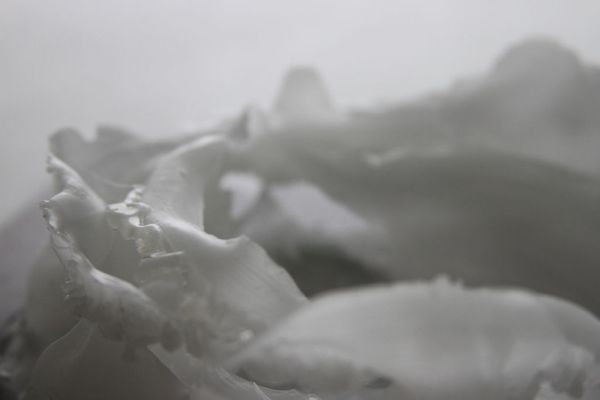 Fluid In.Flux is about exploring material behavior in different conditions and developing an innovative method of digital fabrication. The project aims at abstracting the input geometry and creating imprecise abstract forms through precise machine operations. These imprecise abstractions are the result of the material system of the project. The material system involves the articulated ejection of hot liquid wax in cool water, taking advantage of wax’s buoyancy, rapid phase change and wax’s ability to fuse and bond to itself and other materials. Water is used as a catalyst to solidify wax rapidly and fabricate additively in the process.The scope of the project is a form generator, to develop digitally controlled construction systems. Projecting it onto an architectural scale, autonomous machines can be deployed onto fresh water basins to create buildings, cities possibly, under water opening up to a wide range of potential applications.
The machine was designed, assembled and calibrated by Architecture students at California College Of The Arts – Darshini Shah, Ibrahim AlGwaiz and Swetha Kopuri. Please feel free to contact us with any comments, questions or feedback. Happy to share and help!
Step 1: Building the machine
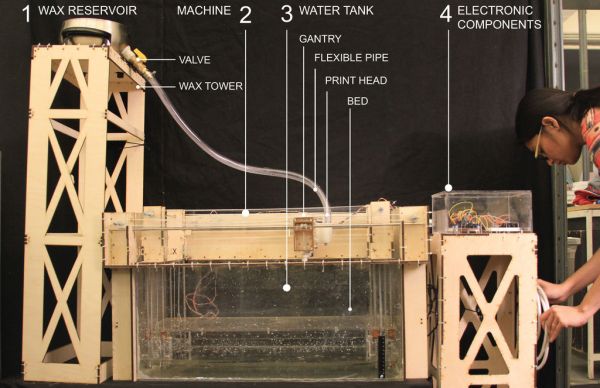
1. The machine essentially has 4 components –
1.1 Wax Reservoir and Tower
1.2 Machine Armature – 1/4″ thk Plywood
1.3 Water Tank – 1/4″ thk Acrylic
1.4 Electric Components and Tower.
Step 2: Making the Machine Armature
1. Laser cut the following components out of 1/4″ thk plywood.
2. Follow the diagram for assembly.
3. Zip tie the plywood components of the machine.
4. Insert the stainless steel rods into the prescribed holes in the plywood components. While inserting the rods, at appropriate points, fix the gears onto the rod using a ranch.
5. After the armature of the machine has been fixed, position the timing belts accordingly.
6. The prescribed motion is therefore produced by powering the Stepper motors, that directly bring about rotation in the gears, that in turn displace the respective components such as either the Gantry, Print Head or Bed, through the interconnecting Timing Belts.
Download Rhino File Below
https://www.dropbox.com/s/r7jjo0o5bvyzqpi/Fluid%20In%20Flux%20-%20Rhino%20Model.3dm
For more detail: Fluid In.Flux_3D Wax Printing In Water
- What is the primary function of the Fluid In.Flux machine?
The machine is designed to print wax in water by exploring material behavior and developing an innovative method of digital fabrication. - How does the machine solidify the wax during the printing process?
Water acts as a catalyst to rapidly solidify the hot liquid wax through rapid phase change. - Can this machine be scaled up for architectural purposes?
Yes, the scope includes deploying autonomous machines onto fresh water basins to potentially create buildings or cities underwater. - Who designed and assembled the machine?
Architecture students Darshini Shah, Ibrahim AlGwaiz, and Swetha Kopuri designed, assembled, and calibrated the machine. - What materials are used for the Machine Armature and Water Tank?
The Machine Armature is made from 1/4 inch thick plywood and the Water Tank is made from 1/4 inch thick acrylic. - Which components drive the motion of the Gantry, Print Head, or Bed?
Stepper motors power the gears which displace components like the Gantry, Print Head, or Bed through interconnecting timing belts. - What properties of wax are utilized in this system?
The system takes advantage of wax's buoyancy, rapid phase change, and its ability to fuse and bond to itself and other materials. - Where can I download the Rhino model file for this project?
The Rhino file is available via a Dropbox link provided in the article text.
