
Summary of Tiny FM Transmitter uses Voltage Controlled Graphene Resonator
This article details a new electro-mechanical resonator developed by Columbia Engineering researchers using graphene. The device features a suspended graphene strip acting as a frequency-determining element in an RF feedback oscillator. By applying voltage to a gate electrode, the graphene's resonance shifts, enabling FM signal generation at 100 MHz. This innovation promises to drastically reduce mobile RF equipment size by allowing chip integration, replacing bulky quartz crystals.
Parts used in the Graphene Resonator Project:
- Graphene strip
- Metal gate electrode
- RF feedback oscillator circuit
- Voltage source for the gate electrode
- iPhone
- FM radio
A team of Columbia Engineering researchers, led by Mechanical Engineering Professor James Hone and Electrical Engineering Professor Kenneth Shepard, exploring the properties of graphene have demonstrated a new electro-mechanical resonant component.
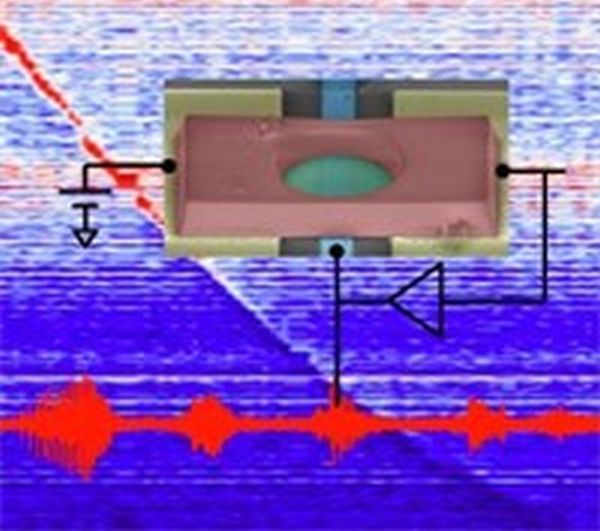
The resonator’s structure consists of a 2-4 micrometer long strip of graphene suspended over a metal gate electrode. The strip of graphene has a natural resonance governed by its physical dimension and is used in the demonstration as the frequency determining element in an RF feedback oscillator circuit. Applying a voltage to the gate electrode stresses and deflects the graphene strip changing its resonant frequency. The team applied baseband audio and tones to the gate electrode to produce a 100 MHz FM signal.
This tiny resonant element looks set to dramatically reduce the size of mobile RF equipment. Traditional discrete quartz crystals have a relatively large PCB footprint but this resonator design will allow it to be integrated within the chip. To test it under extreme conditions the team played the now classic K-pop song ‘Gangnam Style’ on an iPhone and fed it into the graphene FM oscillator. It didn’t break although many wished otherwise. They were able to pick up the signal on an FM radio that Hone had brought in from home.
For more detail: Transmitter uses Voltage Controlled Graphene Resonator
- What is the primary function of the graphene strip in this project?
The graphene strip serves as the frequency determining element in an RF feedback oscillator circuit. - How does the resonant frequency change?
Applying a voltage to the gate electrode stresses and deflects the graphene strip, changing its resonant frequency. - What signal was produced during the demonstration?
The team produced a 100 MHz FM signal by applying baseband audio and tones to the gate electrode. - Can this technology replace traditional quartz crystals?
Yes, this design allows integration within the chip, reducing the PCB footprint compared to discrete quartz crystals. - How did the researchers test the device under extreme conditions?
They fed a K-pop song called Gangnam Style from an iPhone into the graphene FM oscillator. - Did the device survive the stress test?
Yes, the resonator did not break despite the intense input signal. - How was the output signal verified?
The signal was picked up on an FM radio brought in by Professor Hone. - Who led the research team at Columbia Engineering?
The team was led by Mechanical Engineering Professor James Hone and Electrical Engineering Professor Kenneth Shepard.
