
Summary of BUILDING A CHAOTIC OSCILLATOR FROM COMMON COMPONENTS
Sometimes you find things you have not even been looking for. The author discovered chaotic, nonperiodic oscillations while experimenting with resistor-transistor-logic (RTL) ring oscillators. Using LEDs in series with transistor bases and PMBT3904 transistors produced oscillations that jumped between widely different frequencies and showed unpredictable behavior near a threshold. The phenomenon proved easy to reproduce, prompting further investigation and documentation of the effect and its possible principles.
Parts used in the Chaotic Oscillator project:
- PMBT3904 transistors
- LEDs (used in series with transistor bases)
- Resistors (for RTL logic and biasing)
- Supply voltage source (variable)
- Inverter stages arranged as a ring oscillator
- Wiring and prototyping board or breadboard
Sometimes you find things you have not even been looking for…
A chaotic oscillator is an electronic circuit that can exhibit “chaotic“, nonperiodic behavior. A commonly cited example is Chua’s circuit, but there are many others.
I always regarded these as carefully designed, rather academic, examples. So I was a bit surprised to observe apparently chaotic behavior in a completely unrelated experiment.
A while ago a took an interest in recreating an ancient logic style based on discrete transistors, resistor-transistor-logic (RTL), with todays components. I discussed some of my findings earlier and continued to work on transistor selection and circuit optimization afterwards in collaboration with Yann from Hackaday TTLers. The tool of choice to evaluate the switching speed of different logic gate designs is to build ring-oscillators from chains of inverters.
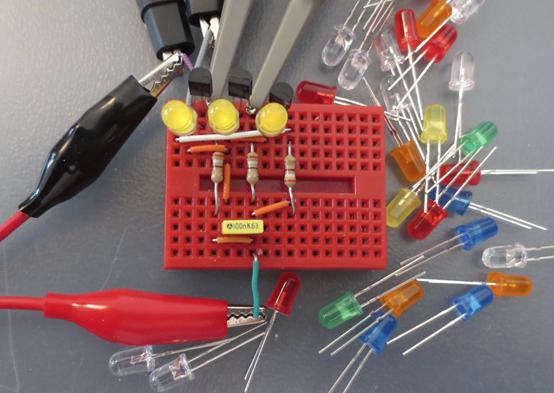
One random variation I tried, was to use LEDs in series with the base of the transistor. In combination with PMBT3904 transistors, this surprisingly yielded an oscillator that switched between frequencies that were several orders of magnitude apart when varying the supply voltage. A closer look revealed a region with unpredictable behavior close to the switching voltage. You can find the chronological investigation, including my (limited) understanding of the principles, in this log entry.
One question of interest was how easy it is to recreate these results. Was it just a random fluke? It turns out, it is extremely simple.
Read more: BUILDING A CHAOTIC OSCILLATOR FROM COMMON COMPONENTS
- What unexpected behavior was observed in the experiment?
The oscillator switched between frequencies several orders of magnitude apart and showed unpredictable behavior near a switching voltage. - What component variation led to the chaotic behavior?
Using LEDs in series with the transistor base in combination with PMBT3904 transistors led to the behavior. - Which transistor model was used in the experiment?
The PMBT3904 transistor was used. - Was the chaotic behavior difficult to reproduce?
No, the author reports it is extremely simple to recreate. - What circuit topology was being experimented with?
Ring oscillators built from chains of inverters in resistor-transistor-logic (RTL) style. - Where did the author document the investigation?
The author documented the chronological investigation in a log entry linked in the article. - What question did the author want to answer about the results?
The author wanted to know whether the chaotic result was a random fluke or reproducible.
