
Summary of TINY FIDI BOARD FOR SUPER-FAST PROTOTYPING WITH CIRCUITPYTHON
FIDI is a tiny open-source CircuitPython development board by Omzlo for rapid prototyping. It uses an ATSAMD21 ARM Cortex M0+ microcontroller, offers 6 terminal block connectors, a qwiic connector, JST and Micro USB connectivity, a user-controlled RGB LED, and six flexible GPIOs configurable for I2C, SPI, UART, PWM, analog or digital I/O. FIDI is compatible with the earlier SERPENTE board and targets fast microcontroller-based prototyping and simple applications.
Parts used in the FIDI:
- ATSAMD21E18A 32-bit Arm Cortex M0+ microcontroller
- Micro USB connector
- 6x 3.5mm terminal block connectors
- qwiic connector
- JST connectors
- User-controlled RGB LED
- PCB measuring 25.4mm x 22mm
- 3.3V power regulation circuitry
As Adafruit’s CircuitPython becomes increasingly popular as one of the basics for rapid microcontroller-based prototyping and development, several development boards are beginning to show up on the makers’ space to help fast track project prototype and production. One of such is the recent open-source CircuitPython development board by Omzlo called FIDI.
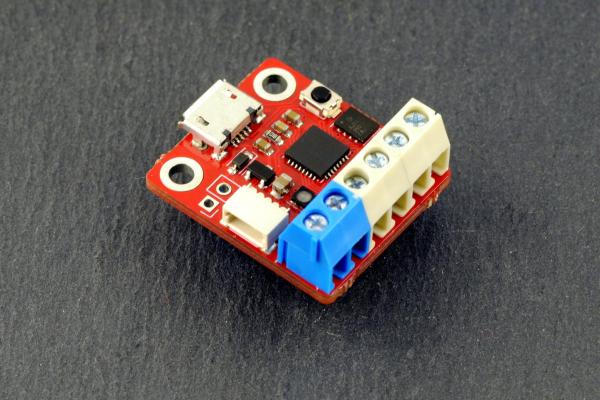
“FIDI is a small development board running Adafruit’s CircuitPython, featuring 6 terminal block connectors and a qwiic connector, designed for fast prototyping. It runs on the ATSAMD21 microcontroller, a 32-it ARM Cortex M0+ clocked at 480 MHz, as found on many popular Arduino-compatible boards”, says the open-source hardware designer
The tiny FIDI board is a derivative of the earlier released SERPENTE by Arthuro182, also aimed at rapid prototyping and producing quick projects. The two boards have quite a number of features in common but FIDI features 3.5mm terminal blocks, JST connectors, and a Micro USB connector that enhances its connectivity. FIDI is however fully compatible with the SERPENTE, even though there is no affiliation between the two designers.
The board measures 25.4mm by 22mm (about 1 x 0.86 inch) and has other technical features which include:
- ATSAMD21E18A 32-bit Arm Cortex M0+ running at 48 MHz, fast enough for prototyping and simple applications.
- 256 KB flash memory and 32KB RAM
- 6x highly customizable GPIOs, that can be configured as 12C, SPI, UART, PWM, analog and digital I/O or a combination thereof
- Micro USB connection to PC
- RGB LED (user-controlled)
- 3.3V logic level and power
Read more: TINY FIDI BOARD FOR SUPER-FAST PROTOTYPING WITH CIRCUITPYTHON
- What microcontroller does FIDI use?
FIDI uses the ATSAMD21E18A 32-bit Arm Cortex M0+ microcontroller running at 48 MHz. - How many GPIOs does FIDI provide?
FIDI provides six highly customizable GPIOs. - Can the GPIOs be used for I2C, SPI, and UART?
Yes, the GPIOs can be configured as I2C, SPI, UART, PWM, analog, and digital I/O or combinations thereof. - What connectors are included on the FIDI board?
FIDI includes 3.5mm terminal blocks, JST connectors, a qwiic connector, and a Micro USB connector. - Is FIDI compatible with the SERPENTE board?
Yes, FIDI is fully compatible with the SERPENTE board despite having no affiliation between designers. - What is the board size of FIDI?
The board measures 25.4 mm by 22 mm (about 1 x 0.86 inch). - What voltage logic level does FIDI use?
FIDI uses a 3.3V logic level and power. - How much flash and RAM does the ATSAMD21 on FIDI provide?
The microcontroller provides 256 KB flash memory and 32 KB RAM.
