
Summary of HDMI FROM YOUR ARDUINO
Modern microcontrollers can generate HDMI video signals using an Arduino shield. The project combines an RA8876 MIPI TFT controller for digital RGB output and a CH7035B HDMI encoder to convert that signal into HDMI. This setup allows SPI-controlled graphics on standard microcontrollers without needing complex FPGA hardware, proving the classic Arduino form factor remains viable for advanced applications.
Parts used in the Arduino HDMI Shield:
- RA8876 MIPI TFT controller
- CH7035B HDMI encoder
- SPI control input interface
- Digital RGB output pathway
- HDMI output port
Creating a video signal from a computer, a job that once required significant extra hardware, is now a done deal with a typical modern microcontroller. We’ve shown you more NTSC, PAL, and VGA projects than you can shake a stick at over the years. Creating an HDMI video signal however is not so straightforward. It’s not a loosely defined analogue standard but a tightly controlled digital one upon which the clever hacks that eke full colour composite video from a single digital I/O pin will have little effect. Surely creating them from a simple microcontroller will be impossible! Not according to [techtoys], who has created an Arduino shield that creates an HDMI output from an SPI control input.
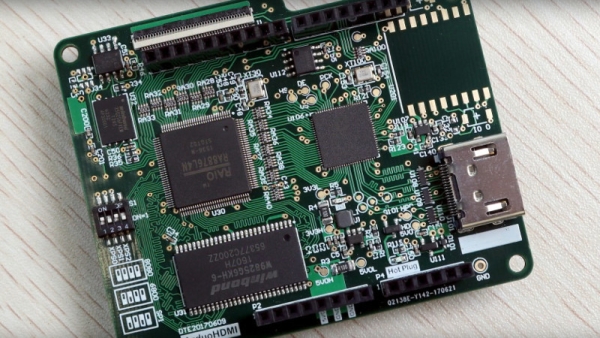
At its heart are two interesting integrated circuits that give us a little bit of insight into creating graphics at this level. First up is an RA8876 MIPI TFT controller which is a full graphics engine that produces a digital RGB output, followed by a CH7035B HDMI encoder that produces an HDMI output from the RGB. This combination of chips is particularly interesting one, because the RA8876 supports a variety of different interfaces that between them should be able to talk to most microcontrollers. In the Arduino world the only other HDMI options come via the use of an FPGA.
This is a project that seems to have been around for a couple of years, but which is still an active one. The classic Arduino shield form factor may now seem a little past its zenith, but as this board shows it’s still capable of being used for interesting new applications.
Source: HDMI FROM YOUR ARDUINO
- How does this project create an HDMI signal?
The project uses an RA8876 controller to produce digital RGB output, which is then converted to HDMI by a CH7035B encoder. - Can a typical modern microcontroller generate HDMI video?
Yes, according to the article, creating an HDMI signal is now possible with a typical modern microcontroller. - What makes HDMI creation different from NTSC or VGA projects?
HDMI is a tightly controlled digital standard unlike loosely defined analogue standards like NTSC or VGA. - Does this project require an FPGA?
No, this specific Arduino shield solution works without an FPGA, unlike other HDMI options in the Arduino world. - What type of interface does the RA8876 support?
The RA8876 supports a variety of different interfaces that should be able to talk to most microcontrollers. - What is the input method for this Arduino shield?
The shield creates an HDMI output from an SPI control input. - Is this project still active after a couple of years?
Yes, the project has been around for a couple of years but remains an active one.
