
Summary of HARDKERNEL ODROID-H2 WITH INTEL CELERON J4105 TO LAUNCH SOON
Hardkernel's ODROID-H2, launching in November 2017, is the first x86 board from the company. Powered by an Intel Celeron J4105 processor, it features two SO-DIMM slots, dual SATA ports, an M.2 NVMe slot, and two Gigabit Ethernet ports. Performance tests on Ubuntu 18.04 show efficient thermal management under heavy loads and significant speed improvements with dual-channel RAM. While lacking built-in WiFi, it supports video transcoding and gaming emulation like Wii games via Dolphin. The board is expected to retail around $180-$200 as a barebone unit, positioning it competitively against similar mini-PCs.
Parts used in the ODROID-H2:
- Intel Celeron J4105 Gemini Lake processor
- Two SO-DIMM memory slots
- Two SATA ports
- M.2 NVMe slot for storage
- Two Gigabit Ethernet ports
- USB 3.0 and USB 2.0 ports
- 20-pin GPIO connector
- Large heatsink
- Power management IC
- Real-time clock
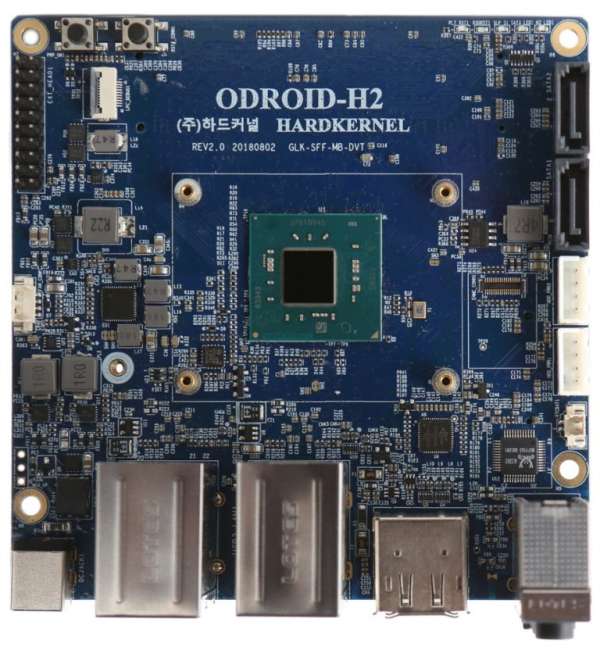
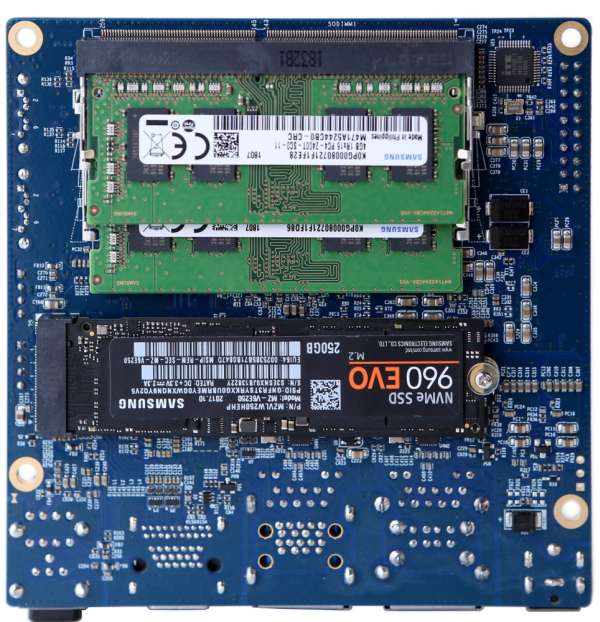
Hardkernel started working on an ODROID x86 board since last year, and the board was slated to launch later in 2017 according to the CEO in an interview published in ODROID magazine. After several repetitions, procedures, and processors considerations, the ODROID-H2 is set to become available by November as the first ODROID x86 board. The ODROID-H2 has an Intel Celeron J4105 Gemini Lake processor, two SO-DIMM slots for memory, two SATA ports, M.2 NVMe slot for storage and two Gigabit Ethernet ports. The Odroid-H2 is equipped with a pair each of USB 3.0 and 2.0 ports, as well as a rather scanty 20-pin GPIO connector. Obviously, this is less of an IoT tinkering board than it is of a media and gaming platform.
ODROID-H2 is in the final stage of development and shipment is expected later in November. A series of performance tests were carried out, like the thermal design and power consumption testing of the board with Ubuntu 18.04. The board can stay cool (under 70°C) under heavy load, it consumes 4 watts at idle mode, and up to 22 Watts during a CPU+GPU stress test and 4K 60fps H.265 to 720p H.264 video transcoding can be done faster in real-time with performance improving by 25% when using dual channel RAM configuration. There’s no WiFi, so if you use the M.2 slot for storage, you’ll need to tap one of the four USB ports. There’s a wide-range 14-20V DC input, a power management IC, and a real-time clock. A large heatsink keeps the CPU running smoothly at 2.3GHz even at 70°C. Since the heatsink is high, the design is able to stack the coastline ports in towers like a mini-PC. So what you get has a compact footprint, but also a high profile.
The company also released a video that shows the board runs Ubuntu 18.10 with Kernel 4.18 from eMMC storage. They ran Dolphin emulator accelerated by Vulkan GPU driver and were capable of smoothly playing Wii games with three players . The price for the device is not known yet, but with LattePanda Alpha board as a competitor, we can get an idea of the price of the Hardkernel ODROID-H2.
The LattePanda board comes with a similar Celeron N4100 processor, but different to the Hardkernel board, it includes a RAM soldered on the board. The LattePanda Alpha 800 model price is listed as $298 on DFRobot, which includes 8GB LPDDR3 RAM, and active cooling. Based on this price information, and the typical price for Celeron J4105 mini PCs, it is expected the barebone version of ODROID-H2 board to sell for around $180-$200 without accessories due to the fact that it also includes extra features like dual Ethernet, dual SATA, NVMe SSD support, etc, which is not often found in lower cost mini PCs.
Read More: HARDKERNEL ODROID-H2 WITH INTEL CELERON J4105 TO LAUNCH SOON
- When is the ODROID-H2 expected to launch?
The board is set to become available by November. - What processor does the ODROID-H2 use?
It uses an Intel Celeron J4105 Gemini Lake processor. - Does the ODROID-H2 have built-in WiFi?
No, there is no WiFi, requiring the use of USB ports for connectivity if needed. - How much power does the board consume at idle?
The board consumes 4 watts at idle mode. - Can the ODROID-H2 run Wii games smoothly?
Yes, it can play Wii games smoothly using the Dolphin emulator accelerated by Vulkan GPU drivers. - What is the estimated price of the ODROID-H2?
The barebone version is expected to sell for around $180-$200 without accessories. - How does dual channel RAM affect performance?
Using dual channel RAM configuration improves performance by 25% during tasks like video transcoding. - What operating system was used for performance testing?
Ubuntu 18.04 was used for thermal design and power consumption testing.
