
Summary of Simple Relay Shield for Arduino
This article describes a shield designed to control six relays, six digital inputs, and six analog inputs when used with Arduino Duemilanove or UNO boards. The circuit includes status LEDs for both digital inputs and relay outputs. Digital inputs are protected by diodes, while analog inputs use Zener diodes for protection. The project provides schematics, PCB files, and a comprehensive Bill of Materials (BOM) detailing all necessary resistors, capacitors, diodes, LEDs, transistors, relays, and connectors.
Parts used in the Simple Relay Shield:
- Arduino - IN/OUT
- Resistors R1 through R30 (various values)
- Capacitors C1 (100 µF) and C2 (100 nF)
- Diodes D1 through D12 (1N4148)
- Zener Diodes DZ1 through DZ6 (5.1V 400 mW)
- LEDs LD1 through LD12 (Red and Green 3 mm)
- Transistors T1 through T6 (BC547)
- Relays RL1 through RL6 (mini 12V)
- Screw connectors (2 via and 3 via)
- Strips (8 via and 6 via)
- PCB
Shield to control 6 relay, 6 digital input and 6 analog input with Arduino Duemilanove, Arduino UNO. The digital inputs and relay outputs are equipped with an LED that indicates the status.
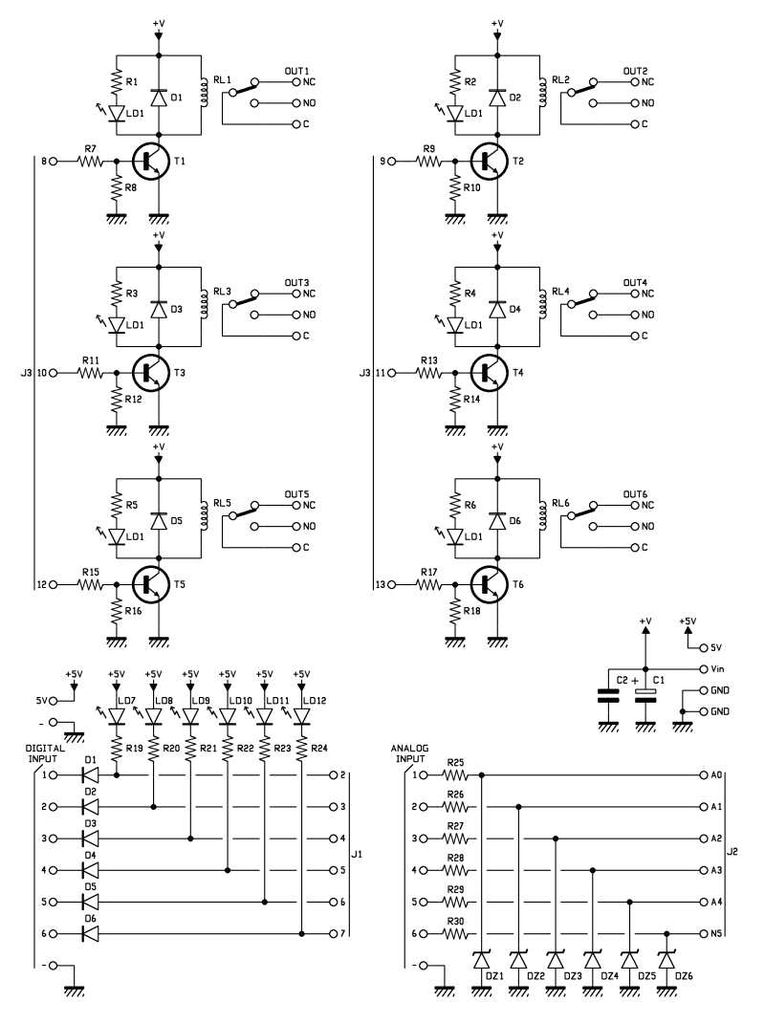
The circuit diagram is very simple:
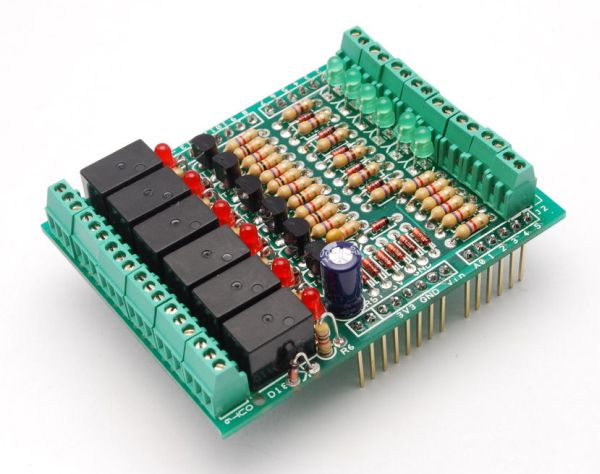
Step 1: Schematics and PCB
In this step you can find the circuit diagram and the PCB file.
All the digital input are protected by a diode, the analog input are protected by a zener diode.
BOM Arduino – IN/OUT
R1: 1 kohm
R2: 1 kohm
R3: 1 kohm
R4: 1 kohm
R5: 1 kohm
R6: 1 kohm
R7: 4,7 kohm
R8: 10 kohm
R9: 4,7 kohm
R10: 10 kohm
R11: 4,7 kohm
R12: 10 kohm
R13: 4,7 kohm
R14: 10 kohm
R15: 4,7 kohm
R16: 10 kohm
R17: 4,7 kohm
R18: 10 kohm
R19: 470 ohm
R20: 470 ohm
R21: 470 ohm
R22: 470 ohm
R23: 470 ohm
R24: 470 ohm
R25: 4,7 kohm
R26: 4,7 kohm
R27: 4,7 kohm
R28: 4,7 kohm
R29: 4,7 kohm
R30: 4,7 kohm
C1: 100 µF 25 VL el
C2: 100 nF
D1: 1N4148
D2: 1N4148
D3: 1N4148
D4: 1N4148
D5: 1N4148
D6: 1N4148
D7: 1N4148
D8: 1N4148
D9: 1N4148
D10: 1N4148
D11: 1N4148
D12: 1N4148
DZ1: Zener 5,1V 400 mW
DZ2: Zener 5,1V 400 mW
DZ3: Zener 5,1V 400 mW
DZ4: Zener 5,1V 400 mW
DZ5: Zener 5,1V 400 mW
DZ6: Zener 5,1V 400 mW
LD1: Led 3 mm red
LD2: Led 3 mm red
LD3: Led 3 mm red
LD4: Led 3 mm red
LD5: Led 3 mm red
LD6: Led 3 mm red
LD7: Led 3 mm green
LD8: Led 3 mm green
LD9: Led 3 mm green
LD10: Led 3 mm green
LD11: Led 3 mm green
LD12: Led 3 mm green
T1: BC547
T2: BC547
T3: BC547
T4: BC547
T5: BC547
T6: BC547
RL1: mini relay 12V
RL2: mini relay 12V
RL3: mini relay 12V
RL4: mini relay 12V
RL5: mini relay 12V
RL6: mini relay 12V
Misc:
– Screw connector 2 via 2,54 mm (8 pz.)
– Screw connector 3 via 2,54 mm (6 pz.)
– Strip 8 via 12 mm (3 pz.)
– Strip 6 via 12 mm
– PCB
For more detail: Simple Relay Shield for Arduino
- Which Arduino boards are compatible with this shield?
The shield works with Arduino Duemilanove and Arduino UNO. - How many relays can this shield control?
This shield is designed to control six relays. - What components protect the digital inputs?
All digital inputs are protected by a diode. - How are the analog inputs protected?
The analog inputs are protected by a zener diode. - Do the digital inputs have status indicators?
Yes, the digital inputs are equipped with an LED that indicates the status. - Do the relay outputs have status indicators?
Yes, the relay outputs are equipped with an LED that indicates the status. - What type of transistors are used in the project?
The project uses BC547 transistors. - What voltage rating do the mini relays have?
The mini relays used are rated at 12V. - Are screw connectors included in the parts list?
Yes, the list includes 2 via and 3 via screw connectors.
