
Summary of ElectroFried electronic shock game using Arduino
ElectroFried is a 2011 Global Game Jam project where players control an electron using a hacked mouse to reach a proton without colliding with other electrons. The game delivers real electric shocks via a transformer from a disposable camera, controlled by an Arduino that communicates with a Java-based game interface.
Parts used in the ElectroFried:
- Hacked old computer mouse
- Transformer from a disposable camera
- Power NPN BD139 transistor
- 5 LEDs
- Arduino controller
- Batteries
- Pull-down resistors
- Java game software
The ElectroFried is a game with a shocking fun level.
ElectroFried is developed for the Global Game Jam 2011 in Antwerp in design center the winkelhaak.
The Team Jekkos/ Cinezaster decided to make a simple game based on colliding electrons.
With a nasty side effect, a electro shock.
As a input devised I hacked a old computer mouse to control the electron and bring it to the proton without colliding with the other free spinning electrons.
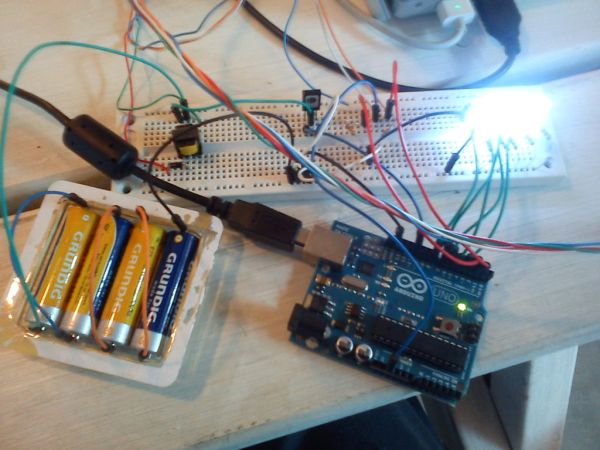
A transformator of a disposable camera is used to generate high voltages on the input mouse.
5 leds are used to show witch level you are and show animations in between.
A arduino controls everything.
Step 1: The controller
The controller is a old mouse. I removed almost everything inside and soldered my wires on the switches of the buttons.
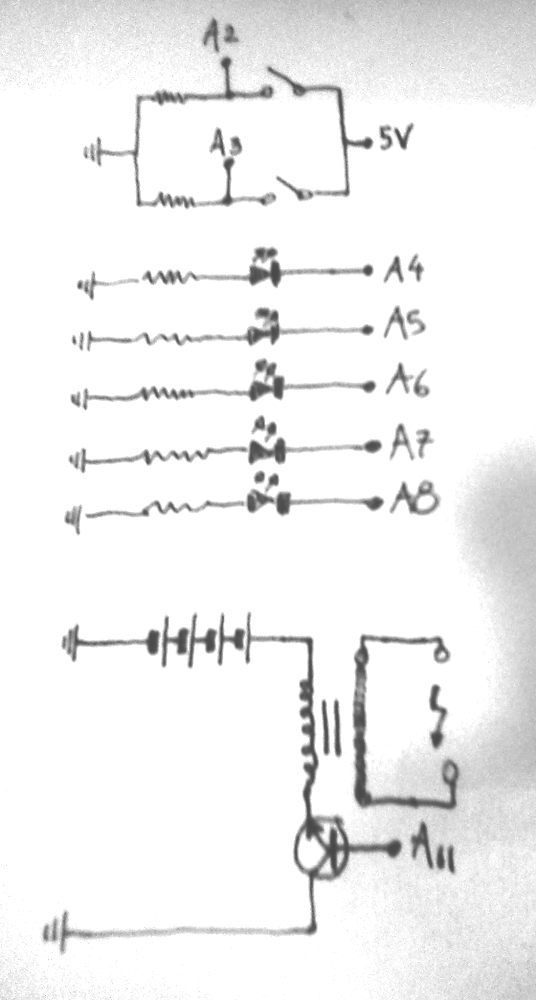
On the arduino side there are pull-down resistors to keep the input level LOW when no switch is triggered.
Step 2: The shocking device
For the shocks I gutted a disposable camera and sourced the transformer out of it.
The transformer is a step up transformer.
I used a power NPN BD139 to generate some kind of alternating current through the transformer. After messing around with the components that came from the camera. I switched to a more software generated alternation.
I used the tone function of arduino to generate a 50000 Hrz signal, this delivers about 1000 Volts.
I used batteries to power because the frequencies could interfere with the arduino.
Step 3: 5 leds
5 leds to animate, I used 5 digital outs to interface.
Step 4: Arduino Code
The zip file contains the java game.
 electrofried.pde1 KB
 electrofried.zip3 MB
5 leds
An arduino
For more detail: ElectroFried electronic shock game using Arduino
-
What is the main goal of the ElectroFried game?
The player must bring an electron to a proton without colliding with other free spinning electrons. -
How is the input device modified for this project?
An old computer mouse was hacked by removing internal components and soldering wires directly to the button switches. -
Which component generates the high voltage shock?
A transformer sourced from a disposable camera is used to generate high voltages. -
How does the system produce the alternating current for the transformer?
The Arduino uses its tone function to generate a 50000 Hz signal which delivers about 1000 Volts. -
Why are batteries used to power the shocking device?
Batteries are used because the frequencies generated could interfere with the Arduino. -
What role do the 5 LEDs play in the game?
The 5 LEDs show which level the player is on and display animations between levels. -
How does the Arduino communicate with the game interface?
The Arduino code is serial connected over USB to talk to the Java game. -
What is the purpose of the pull-down resistors on the Arduino side?
They keep the input level LOW when no switch is triggered on the mouse.
