
Summary of New power inverter could make EVs more powerful and efficient
The Oak Ridge National Laboratory developed a compact, high-performance power inverter for electric vehicles using 3D printing and silicon carbide semiconductors. This 20 kW device achieves over 99% efficiency while weighing only 1.75 kg and occupying 1,500 cc of volume. Its design aims to significantly improve EV power density and energy efficiency compared to current standards.
Parts used in the New Power Inverter:
- Silicon carbide wide-band semiconductor
- 3D printed components
- Battery pack (DC source)
- Electric motor (AC load)
- DC-link circuit
A new power inverter developed at the Oak Ridge National Laboratory (ORNL) marries advances in 3D printing and wide-band semiconductor technology to deliver significantly improved performance in a smaller, lighter package. With further development, it could go a long way toward helping build electric cars that are more powerful and energy-efficient.
Power inverters are an essential part of any electric vehicle, as they take the direct current stored in the battery pack and turn it into AC that feeds the motor. Making them as small and light as possible is an area well worth focusing on. Even Google’s in on it, having recently instituted a US$1 million prize for the best inverter designed to take DC from solar arrays and wind turbines and convert it into AC for domestic use. Of course, reducing that footprint becomes even more important when room is at a premium, such as aboard an electric car.
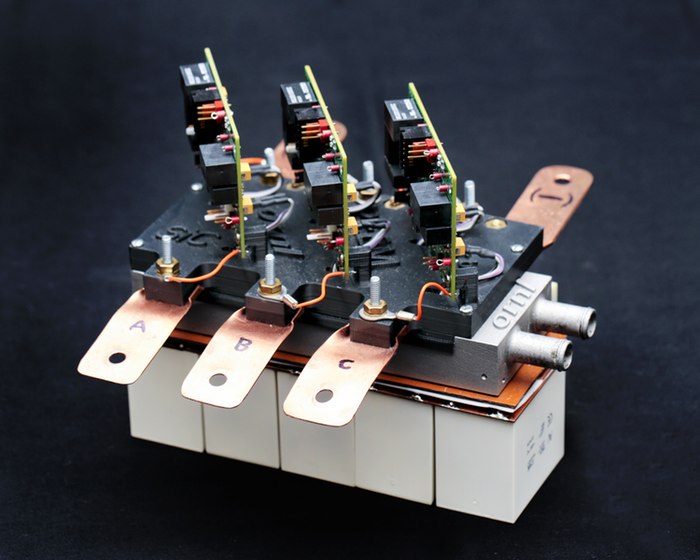
The inverter designed at ORNL achieves a very significant improvement in terms of power density, weight and volume. As lead investigator Dr. Madhu Chinthavali tells us, the 20 kW device that his team designed has a total volume of only around 1,500 cc (91 cubic inches) and weighs around 1.75 kg (3.85 lb). For reference, this is over four times the already aggressive power density requirements for Google’s prize.
“20 kW was the highest rating that the inverter was tested up to,” Chinthavali tells Gizmag. “This is actually more than a 30 kW inverter by design; we are being conservative because of the voltage levels that the DC-link can boost up to for automotive applications.”
This advance was achieved in great part because of the properties of silicon carbide, a so-called “wide-band semiconductor.” These are high-grade materials that are very well-suited for high power applications and for working under a wider range of temperatures, which is especially relevant in EVs. As a result, the device is achieving a higher levels of efficiency, to the order of 99 percent, though this number will fluctuate depending on actual operating conditions.
For more detail: New power inverter could make EVs more powerful and efficient
- What technology does the new ORNL inverter use?
The inverter marries advances in 3D printing and wide-band semiconductor technology. - How efficient is the new power inverter?
The device achieves efficiency levels to the order of 99 percent. - What material makes the inverter suitable for high power applications?
Silicon carbide, a wide-band semiconductor, is used because it works well under a wider range of temperatures. - How much does the 20 kW inverter weigh?
The device weighs around 1.75 kg or 3.85 lb. - What is the total volume of the designed inverter?
The total volume is only around 1,500 cc or 91 cubic inches. - Why was the 20 kW rating chosen for testing?
This was the highest rating tested up to, though the design supports more than 30 kW conservatively due to voltage limits. - Can this inverter help build better electric cars?
Yes, with further development, it could help build electric cars that are more powerful and energy-efficient. - Does Google have a prize for inverter design?
Yes, Google instituted a US$1 million prize for the best inverter designed to convert DC from solar arrays and wind turbines into AC.
