
Summary of Does your op amp oscillate
Summary (under 100 words): The article reviews common causes of real-world op amp oscillation and remedies. It contrasts non-rail-to-rail and rail-to-rail amplifier topologies, explains how compensation capacitor Cc and gm set frequency response and GBW, and describes dominant pole compensation producing a phase shift to roughly -270° above certain frequencies. It notes feedback network design, load types, supply bypassing, and one-port input/output behaviors as practical sources of instability.
Parts used in the Op Amp Stability Project:
- Operational amplifier (non-rail-to-rail or rail-to-rail as described)
- Transconductance stage (gm block)
- Compensation capacitor Cc
- Output buffer/transistors
- Current coupler (for rail-to-rail outputs)
- Power supply rails (positive and negative supplies)
- Feedback network components (resistors, capacitors as implied)
- Supply bypass capacitors
We analog designers take great pains to make our amplifiers stable when we design them, but there are many situations that cause them to oscillate in the real world. Various types of loads can make them sing. Improperly designed feedback networks can cause instability. Insufficient supply bypassing can offend. Finally, inputs and outputs can oscillate by themselves as one-port systems. This article will address common causes of oscillation and their remedies.
Some Basics
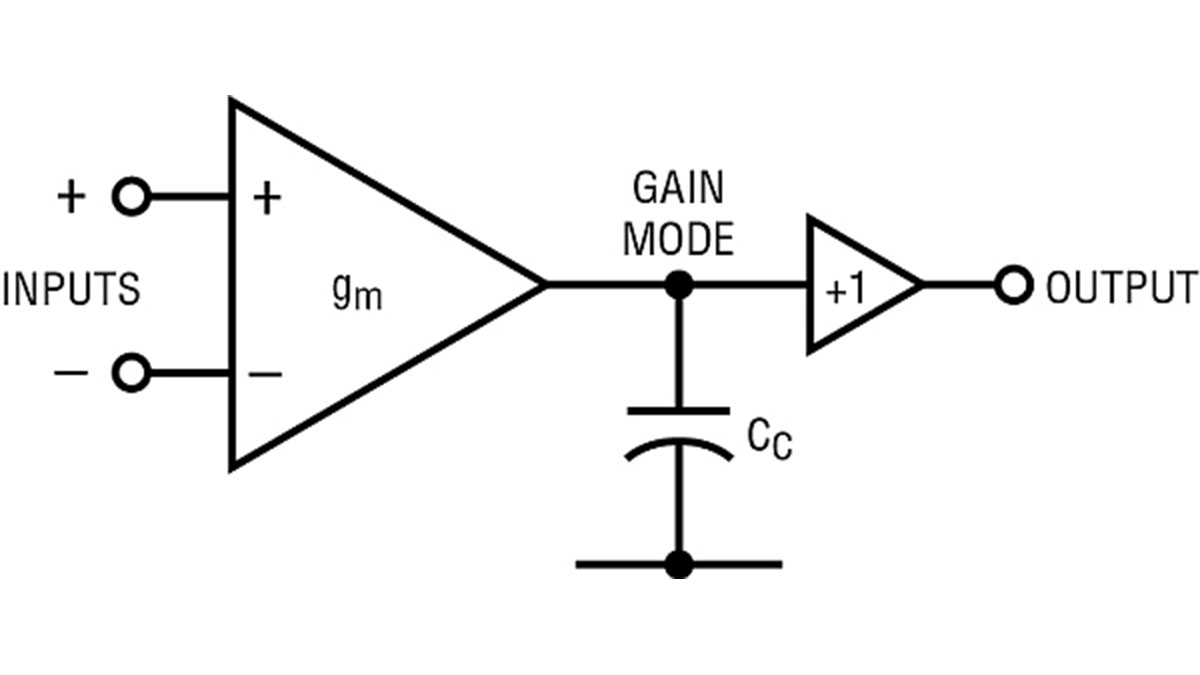
Figure 1a shows the block diagram of a non-rail-to-rail amplifier. The inputs control the gm block which drives the gain node and is buffered at the output. The compensation capacitor Cc is the dominant frequency response element. The return of Cc would go to ground if there were such a pin; however op amps traditionally have no ground and the capacitor current will return to one or both supplies.
Figure 1b is a block diagram of the simplest amplifier with rail-to-rail output. The input gm’s output current is sent through a “current coupler” that splits the drive current between the output transistors. Frequency response is dominated by the two Cc /2s, which are effectively in parallel. These two topologies describe the vast majority of op amps that use external feedback.
Figure 1c shows the frequency responses of our ideal amplifiers, which display similar behavior although they are electrically different. The single-pole compensation created by gm and Cc gives a unity-gain-bandwidth product frequency of GBF=gm/(2p Cc). The phase lag of these amplifiers drops from -180 to -270° around GBF/Avol, where Avol is the open-loop amplifier DC gain. The phase hangs in at -270° for frequencies well above this low frequency. This is known as “dominant pole compensation,” where the Cc pole dominates the response and hides various frequency limitations of the active circuitry.
For more detail: Does your op amp oscillate
- What common situations cause amplifiers to oscillate?
Various loads, improperly designed feedback networks, insufficient supply bypassing, and inputs or outputs oscillating as one-port systems. - How does the compensation capacitor Cc affect frequency response?
Cc is the dominant frequency response element and together with gm sets the unity-gain-bandwidth GBF = gm/(2p Cc). - Where does the return current of Cc go in a non-rail-to-rail op amp?
The capacitor current returns to one or both supplies because op amps traditionally have no ground pin. - How does a rail-to-rail output amplifier split drive current?
The input gm output current is sent through a current coupler that splits the drive current between the output transistors, with two effective Cc/2 compensation elements. - What phase behavior is associated with dominant pole compensation?
The phase lag drops from -180 to -270 degrees around GBF/Avol and hangs at about -270 degrees at higher frequencies. - How is GBF calculated for the described amplifiers?
GBF equals gm divided by 2p times Cc, GBF = gm/(2p Cc). - Can inputs and outputs oscillate by themselves?
Yes; inputs and outputs can oscillate as one-port systems independently of the closed-loop amplifier. - What role does supply bypassing play in stability?
Insufficient supply bypassing can cause oscillation, so proper bypassing is required to prevent instability.
