
Summary of Series-connected MOSFETs increase voltage & power handling
This article describes a robust method for charging large capacitor banks by connecting power MOSFETs in series. This configuration increases the breakdown voltage beyond that of a single MOSFET, effectively managing high inrush currents from rectified AC mains without exceeding safe operating areas.
Parts used in Series-Connected MOSFET Capacitor Charger:
- Power MOSFETs
- Large capacitor banks
- Rectified AC mains power supply
This Design Idea presents a simple, proven, reliable, and robust method for charging large capacitor banks, using a series connection of power MOSFETs to raise the breakdown voltage over that of an individual MOSFET.
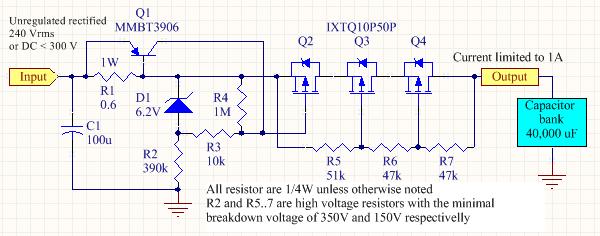
When a power supply drives a large capacitive load, inrush current, if not limited, can reach tens or hundreds of amps for a high voltage power supply. In general, maximal ratings of a power supply could be transiently exceeded by many times, but this is generally acceptable when the transient lasts a few AC-line cycles. This is typical for load capacitances up to a couple of hundred microfarads, but for load capacitances in thousands of microfarads, an inrush current limiter is a must. Using MOSFETs as voltage controlled current elements is very suitable to capacitor-charging circuit design. Consider though: If a task specifies charging a capacitor bank with 1A from rectified AC mains of 240V, a design with a single P-MOSFET would require that at power-on, the MOSFET pass 1A when its drain-to-source voltage |VDS| is about 330V, which exceeds the safe operating area of most parts.
For more detail: Series-connected MOSFETs increase voltage & power handling
- How does this design handle large capacitor banks?
It uses a series connection of power MOSFETs to raise the breakdown voltage over that of an individual MOSFET. - What problem occurs when a power supply drives a large capacitive load?
Inrush current can reach tens or hundreds of amps if not limited. - Why is a single P-MOSFET insufficient for 240V applications?
A single P-MOSFET would need to pass 1A at about 330V drain-to-source voltage, which exceeds the safe operating area of most parts. - When is an inrush current limiter a must?
An inrush current limiter is required for load capacitances in thousands of microfarads. - What makes MOSFETs suitable for capacitor-charging circuit design?
MOSFETs act as voltage controlled current elements which are very suitable for this application. - What is the primary benefit of using series-connected MOSFETs?
The series connection increases both voltage and power handling capabilities. - Can transient ratings be exceeded by many times?
Yes, maximal ratings of a power supply could be transiently exceeded by many times if the transient lasts only a few AC-line cycles. - What is the maximum typical load capacitance for standard transient handling?
This is typical for load capacitances up to a couple of hundred microfarads.
