
Summary of Single layer Planar spiral coil inductor calculator
This article discusses three mathematical expressions for calculating the inductance of planar spiral air core inductors, noting their high accuracy (2–3% error) and simplicity. It explains that inductor thickness has a negligible effect on inductance and categorizes various planar coil shapes like square, rectangular, hexagonal, and octagonal spirals used in high-frequency applications. The text defines air core inductors as those lacking ferromagnetic materials and mentions construction methods involving bobbins made of bakelite, plastic, or ceramic.
Parts used in the Planar Spiral Air Core Inductor:
- Planar spiral coils
- Flat spiral coils
- Planar square spiral coils
- Planar rectangular spiral coils
- Planar hexagonal spiral coils
- Octagonal spiral coil
- Circuit board tracks
- Bakelite bobbin
- Plastic bobbin
- Ceramic bobbin
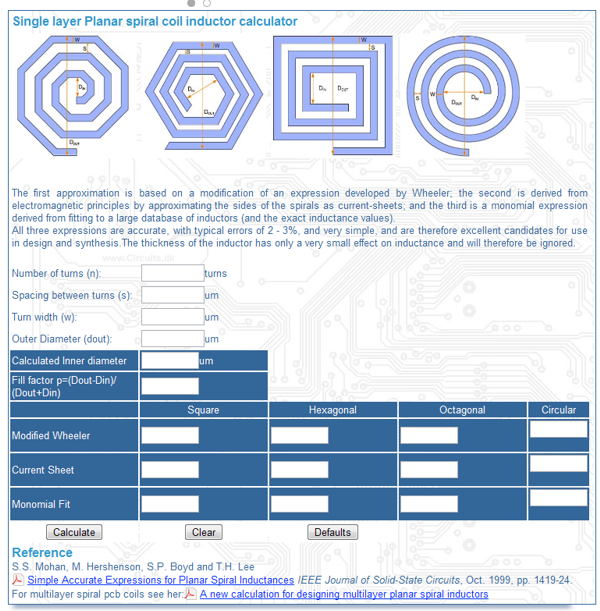
The first approximation is based on a modification of an expression developed by Wheeler; the second is derived from electromagnetic principles by approximating the sides of the spirals as current-sheets; and the third is a monomial expression derived from fitting to a large database of inductors (and the exact inductance values).
All three expressions are accurate, with typical errors of 2 – 3%, and very simple, and are therefore excellent candidates for use in design and synthesis.The thickness of the inductor has only a very small effect on inductance and will therefore be ignored.
More about planar spiral air core inductors
In the same category as the flat spiral coils we have planar spiral coils, planar square spiral coils, planar rectangular spiral coils, planar hexagonal spiral coils and octagonal spiral coil. Planar coils are mostly used in high frequency applications and designed as tracks on a circuit board.
What is an air core inductor?
An “air core inductor” is an inductor that does not depend upon a ferromagnetic material to achieve its specified inductance. Some inductors are wound without a bobbin and just air as the core. Some others are wound on a bobbin made of bakelite, platsic, ceramic etc.
For more detail: Single layer Planar spiral coil inductor calculator
- How accurate are the proposed inductance expressions?
All three expressions are accurate with typical errors of 2 - 3%. - Does the thickness of the inductor affect inductance significantly?
The thickness has only a very small effect on inductance and will be ignored. - What is an air core inductor?
An air core inductor does not depend upon a ferromagnetic material to achieve its specified inductance. - Can air core inductors be wound without a bobbin?
Yes, some inductors are wound without a bobbin and just use air as the core. - What materials can be used for inductor bobbins?
Bobbins can be made of bakelite, plastic, ceramic, etc. - Where are planar coils mostly used?
Planar coils are mostly used in high frequency applications. - Are planar coils designed as tracks on a circuit board?
Yes, they are designed as tracks on a circuit board. - What types of planar spiral coils are mentioned?
The article mentions planar square, rectangular, hexagonal, and octagonal spiral coils.
