
Summary of MEET THE TIGARD BOARD; A NEW FT2232H-BASED USB SERIAL ADAPTER/DEBUGGERS
SecurityHardware.com is launching Tigard, an open-source FTDI FT2232H-based multi-protocol, multi-voltage hardware hacking board. Tigard targets developers needing more than a basic USB-UART debugger, offering dual serial interfaces (one dedicated UART with flow control), shared headers for SPI, JTAG, I²C, and SWD, bidirectional level shifting for 1.8–5.5V, selectable on-board or target power (1.8, 3.3, 5.0V), mode selection between I²C/SWD and SPI/JTAG, a logic analyzer port, and indicator LEDs for debugging.
Parts used in the Tigard:
- FTDI FT2232H USB-to-serial IC
- Dual serial interface headers (UART + shared SPI/JTAG/I2C/SWD)
- Bidirectional level shifters supporting 1.8–5.5V
- Power supply selection circuitry (on-board 1.8V, 3.3V, 5.0V and off-board vTarget)
- I2C/SWD and SPI/JTAG operation mode switch
- Logic analyzer port header
- Indicator LEDs for debugging
- USB connector for host connection
SecurityHardware.com is set to take FT2232H-based USB Serial Adapters and Debuggers to the Next Level.
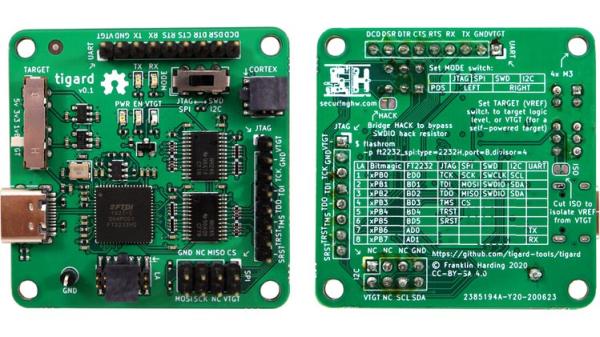
The Portland-based company will soon be launching a Crowdfunding campaign for its latest design, an open-source FTDI FT223H-based multi-protocol, multi-voltage hardware hacking device called Tigard.
Tigard is a one-stop board for developers looking for something a little more than the average USB-UART debugging tool. Speaking on the idea behind the product, the team behind Tigard said
“There are plenty of -232H series breakout boards, but they are generally designed to be an easy way to adapt it to a specific use, and not designed for regularly plugging into all different target systems. The two exceptions are the Exodus Intelligence Hardware Interface Board which is not open hardware or commercially available, and TIMEP which is the origin and heritage of this project.”
A look at some of its hardware features:
- Dual serial interfaces; one completely dedicated to UART, with access to flow control signals and the other shared among dedicated headers for SPI, JTAG, I²C and SWD.
- Bi-directional level shifters for operations between 1.8 – 5.5V
- Power supplier switchable between on-board 1.8, 3.3 and 5.0 V and off-board vTarget supplies
- Switch to choose between I²C/SWD and SPI/JTAG operations,
- Logic analyzer port to quickly access the device-level signals, and,
- Some indicator lights to help in the debugging process
Read more: MEET THE TIGARD BOARD; A NEW FT2232H-BASED USB SERIAL ADAPTER/DEBUGGERS
- What is Tigard?
Tigard is an open-source FTDI FT2232H-based multi-protocol, multi-voltage hardware hacking and USB serial adapter/debugger. - What serial interfaces does Tigard provide?
Tigard provides dual serial interfaces: one dedicated UART with flow control, and another shared among SPI, JTAG, I2C and SWD headers. - What voltage ranges does Tigard support?
Tigard supports bidirectional level shifting for operations between 1.8 and 5.5 volts. - Can Tigard be powered from the target board?
Yes; Tigard can switch between on-board 1.8, 3.3 and 5.0 volt supplies and off-board vTarget supplies. - How do you select between I2C/SWD and SPI/JTAG modes?
Tigard includes a switch to choose between I2C/SWD and SPI/JTAG operations. - Does Tigard include a logic analyzer connection?
Yes; Tigard provides a logic analyzer port to access device-level signals quickly. - Are there visual indicators for debugging on Tigard?
Yes; Tigard includes indicator lights to assist in the debugging process. - Is Tigard open hardware?
The article describes Tigard as open-source, indicating it is open hardware.
