
Summary of LED DRIVER IC BCR431U GIVES MORE FREEDOM IN DESIGNING LOW CURRENT LED STRIPS
Infineon’s BCR431U is a constant-current linear LED driver IC for low-current designs up to 37 mA, offering an industry-leading low voltage drop (as low as 105 mV at 15 mA). It supports 6–42 V supply, adjustable current via a high-value resistor, and includes thermal over-temperature control. Typical uses include LED strips, channel letters, architectural lighting, displays, emergency, retail, and appliance lighting, enabling longer strips, fewer feed points, and improved efficiency.
Parts used in the BCR431U project:
- BCR431U constant current linear LED driver IC
- High-value resistor for setting LED current
- LEDs (series string)
- Power supply (6 V to 42 V)
- PCB or LED strip substrate
- Thermal management/heat dissipation materials (implicit for reliability)
Infineon Technologies AG releases the BCR431U. The constant current linear LED driver IC provides low-voltage drop performance for regulating LED current. It is the second device released in the new generation BCR family with low voltage drop focusing on low current designs of up to 37 mA.
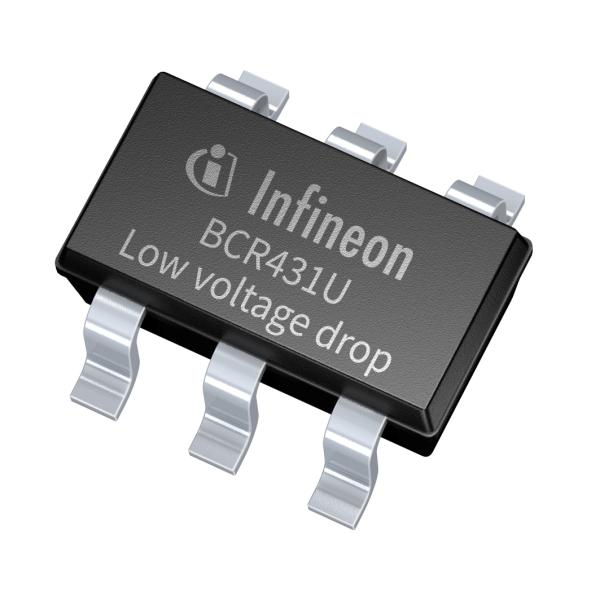
Typical applications for the new BCR431U include LED strips, channel letters, architectural LED lighting, LED displays, as well as emergency, retail, and appliance lighting.
The voltage drop at the integrated driver IC can go down to 105 mV at 15 mA. This is unmatched in the industry and provides far more flexibility in lighting applications. It improves the overall efficiency and provides the voltage headroom required to compensate for the LED forward voltage tolerances and variances in the supply voltage. The BRCU431U allows either to add additional LEDs to lighting designs, for example, seven instead of six LEDs in series driven by one IC. Or it can be used to increase the overall length of a LED strip design from, for example, 5 to 7 m. Overall, longer LED strips mean fewer feeding points and less efforts in installation.
The LED current is easily adjustable via a high ohmic resistor on a dedicated pin with an IC supply voltage ranging between 6 V and 42 V. For safe and reliable operation and to extend the overall LED system’s lifetime, a smart over-temperature controlling circuit keeps the current constant even at rising temperature.
Read more: LED DRIVER IC BCR431U GIVES MORE FREEDOM IN DESIGNING LOW CURRENT LED STRIPS
- What is the maximum LED current supported by the BCR431U?
The BCR431U supports low current designs of up to 37 mA. - How low can the voltage drop of the BCR431U get?
The voltage drop can go down to 105 mV at 15 mA. - What supply voltage range does the BCR431U support?
The IC supports an IC supply voltage ranging between 6 V and 42 V. - How is the LED current adjusted on the BCR431U?
The LED current is adjusted via a high ohmic resistor on a dedicated pin. - Does the BCR431U include thermal protection?
Yes. It has a smart over-temperature controlling circuit that keeps the current constant as temperature rises. - What applications are typical for the BCR431U?
Typical applications include LED strips, channel letters, architectural LED lighting, LED displays, and emergency, retail, and appliance lighting. - How does the low voltage drop benefit LED strip design?
The low voltage drop improves efficiency and provides voltage headroom to add additional LEDs in series or increase LED strip length, reducing feeding points and installation effort. - Can the BCR431U enable longer LED strips?
Yes. The device can increase overall LED strip length, for example from 5 to 7 m, by providing lower voltage drop and more headroom.
