
Summary of Digital sound recorder with AVR and DataFlash
Summary:
This article details a digital sound recorder project using an AVR microcontroller with an A/D converter, AT45DB161B DataFlash memory, and Pulse Width Modulation (PWM) for playback. It explains recording via the A/D Converter, storage through SPI, and playback using PWM. Applications include temperature loggers, telephone answering machines, and voice recorders.
Parts used in the Digital Sound Recorder:
- AVR microcontroller
- A/D converter
- AT45DB161B DataFlash memory
- Pulse Width Modulation (PWM)
- Serial Peripheral Interface (SPI)
This application note describes how to record, store and play back sound using any AVR microcontroller with A/D converter, the AT45DB161B DataFlash memory and a few extra components.
This application note shows in detail the usage of the A/D Converter for sound recording, the Serial Peripheral Interface – SPI – for accessing the external DataFlash memory and the Pulse Width Modulation – PWM – for playback.
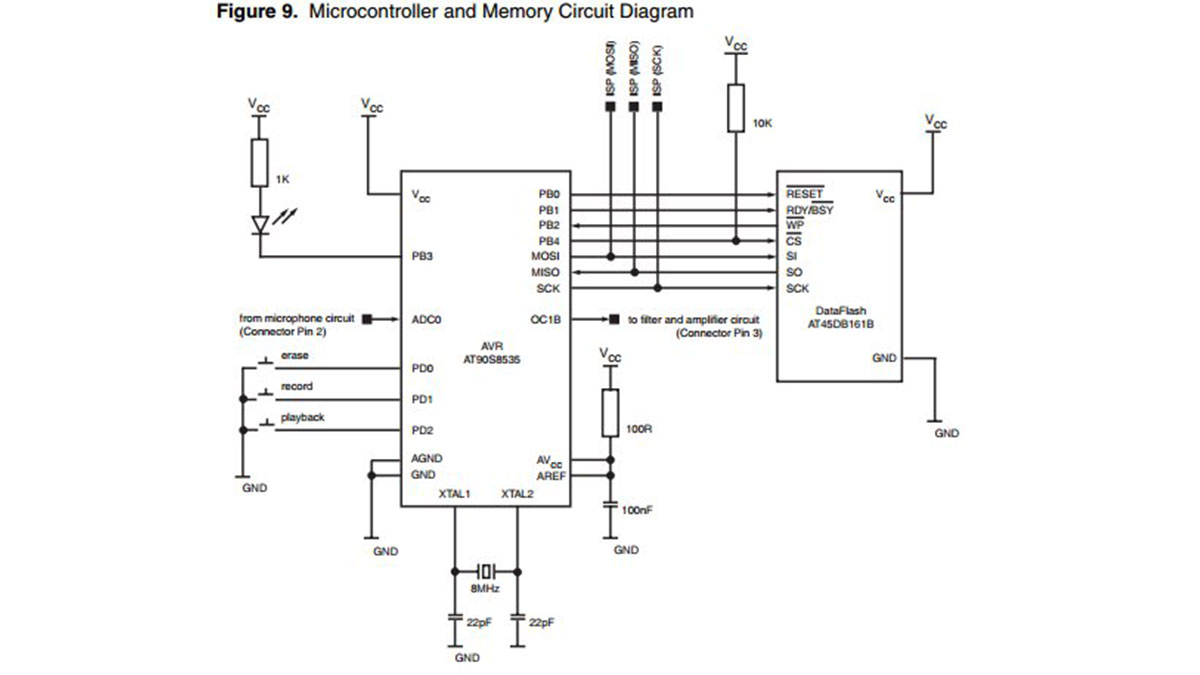
Typical applications that would require one or more of these blocks are temperature loggers, telephone answering machines, or digital voice recorders.
For more detail: Digital sound recorder with AVR and DataFlash
- What components are required for this sound recording project?
The project requires an AVR microcontroller with an A/D converter, the AT45DB161B DataFlash memory, and extra components. - How is sound recorded in this application?
Sound is recorded by utilizing the A/D Converter within the AVR microcontroller. - How does the system store audio data?
The system stores audio data by accessing the external DataFlash memory using the Serial Peripheral Interface or SPI. - What method is used for playing back sound?
Pulse Width Modulation or PWM is used for the playback of recorded sound. - Can this design be used for temperature logging?
Yes, typical applications requiring these blocks include temperature loggers. - Is this suitable for creating a telephone answering machine?
Yes, telephone answering machines are listed as a typical application that would require one or more of these blocks. - Does the project support digital voice recording?
Yes, digital voice recorders are identified as a standard application for this setup.
