
Summary of Arduino 2-axis servo solar tracker
A solar tracker optimizes panel efficiency by maintaining a perpendicular angle to sunlight, potentially doubling power output. This project utilizes an Arduino Uno, servos, and light sensors to automate this alignment. The system employs a two-axis mechanism with specific components like CDS cells and a ball-bearing tilt switch to detect light intensity and prevent ground contact, ensuring maximum energy capture through precise mechanical adjustments controlled by code.
Parts used in the Arduino 2-Axis Servo Solar Tracker:
- Arduino Uno
- Breadboard
- 2 axis tracking mechanism
- 2 continuous rotation servos
- Ball bearing tilt switch
- 10k resistors
- 5V breadboard power supply
- Cadmium sulfide light sensitive resistors
- Wires
- Solder
- Soldering iron
What is a solar tracker?
A solar tracker can increase the efficiency of a solar panel by up to 100%! It does this by always keeping the panel perpendicular to the incoming rays of sunlight.
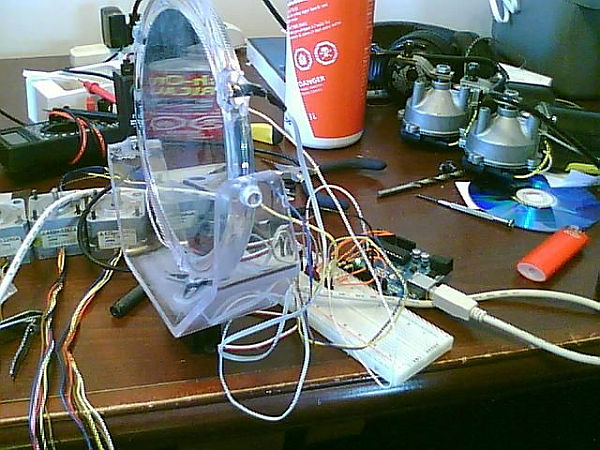
here’s an equation to prove this:
P = AW sin θ
P = power generated by the solar panel
A = Area of the solar panel
W = is the solar constant, which is equal to 1340 watts per square meter
θ = the angle of the incoming light
Since sin(90) = 1 you get the best performance out of the panel when it is totally perpendicular.
Materials:
1 – Arduino Uno w/ ability to program it
1 – Breadboard
1 – 2 axis tracking mechanism (i used a magnifying mirror that swiveled up and down)
2 – 360 deg continuous rotation servos
1 – ball bearing tilt switch or similar
5 – 10k resistors
1 – 5V breadboard power supply
3 – cadmium sulfide light sensitive resistors
wires
solder
soldering iron
vice (optional)
Step 1: The Y-axis
I marked the approximate center of the base and drilled a hole large enough to screw the setscrew for the servo armature in. I then hot glued the armature to the underside of the base making sure not to get glue in the hole i drilled.
Once the glue was dry, I attached the servo and screwed in the setscrew.
Step 3: The sensors
I used 3 light sensors and 1 tilt sensor. You can substitute LEDs or photo-transistors for the CDS cells, and/or mercury switches for the ball bearing tilt sensor but your code will have to reflect the change(s).
I soldered wires from a scrap ribbon cable to the leads of each light sensor and a 2 pin header on the opposite end to connect easily to the breadboard. Use electrical tape / heat shrink / liquid insulator on the bare parts of the wire so that they don’t short out.
Once that’s done, hot glue the sensors at equal intervals around the circumference of the mirror. I placed the sensors so that the flat collecting side of the sensor was parallel with the plane of the mirror and angled out from the center just slightly.
The tilt sensor that I found was a plastic box with 4 contacts running through it and a ball bearing inside. This sensor prevents the tracker from pointing at the ground and also gives the y-axis an end-stop.
Solder wires onto the 4 pins of the tilt sensor then glue it on the back side of the mirror with the leads running horizontally. With the mirror pointing straight upward, the BB should be resting on the 2 middle leads.
The image I have uploaded is similar but not exactly the same as the tilt sensor I have. The one I used has only 4 leads.
Step 4: Wiring it up
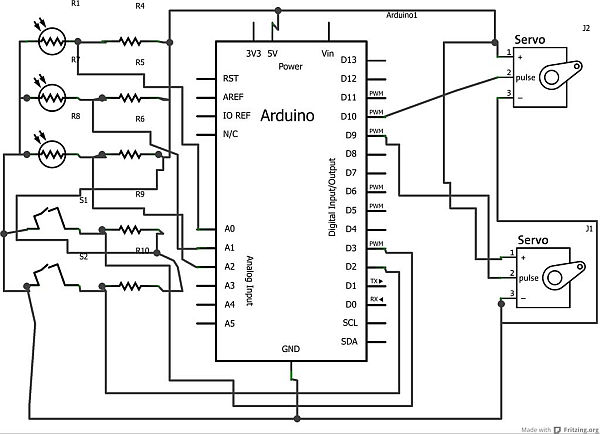
EDIT (04/03/13)*** Changed the images to reflect the proper wiring and cleaned it up a bit.
For more detail: Arduino 2-axis servo solar tracker
- How does a solar tracker increase efficiency?
It increases efficiency by up to 100 percent by keeping the panel perpendicular to incoming sunlight rays. - What is the best way to calculate power generation for a solar panel?
Use the equation P equals A times W times sin theta where theta is the angle of incoming light. - Can I substitute LEDs for the CDS cells in this project?
Yes you can substitute LEDs or photo-transistors for the CDS cells but your code must reflect the change. - Does the tilt sensor prevent the tracker from pointing at the ground?
Yes the tilt sensor prevents the tracker from pointing at the ground and acts as an end-stop for the Y-axis. - How should the light sensors be positioned on the mirror?
Place the sensors so the flat collecting side is parallel with the plane of the mirror and angled slightly out from the center. - What is required if I use mercury switches instead of a ball bearing tilt sensor?
Your code will have to reflect the changes made when substituting mercury switches for the ball bearing tilt sensor. - Why is hot glue used on the servo armature?
Hot glue is used to attach the armature to the underside of the base while avoiding getting glue in the drilled hole. - How do you protect the bare parts of the wires connecting the sensors?
You should use electrical tape heat shrink or liquid insulator on the bare parts of the wire to prevent short circuits.
