
Summary of Quantifying Access to your Mind using Arduino
The author, a creative technology lab manager at California College of the Arts, created an Arduino-based system to track student questions during finals week chaos. Facing mental exhaustion and tool theft, they built a wearable device with momentary buttons to log three question categories: "why isn't it working?", "where is the object?", and "how do I make this?". The system used an SD card to record data, helping quantify access to their mind amidst the semester's end stress.
Parts used in the Quantifying Access to your Mind using Arduino:
- Arduino Uno
- Adafruit's Data Shield
- 6 AA Battery Holder
- 3 Normally Closed Momentary Switches
- 3 10K Resistors
- SD Card
- Toggle Switch
So, I manage a creative technology lab at California College of the Arts. It’s essentially an educational hackerspace for art and design students. Pretty awesome, right?
After graduating from the University of Minnesota with a degree in mechanical engineering, I was desperately trying to find a job that would allow me to use my technical skills in a creative way. It’s a hard job to find and I ended up getting lucky. I love my job but that doesn’t mean that it’s easy. It’s mentally exhausting.
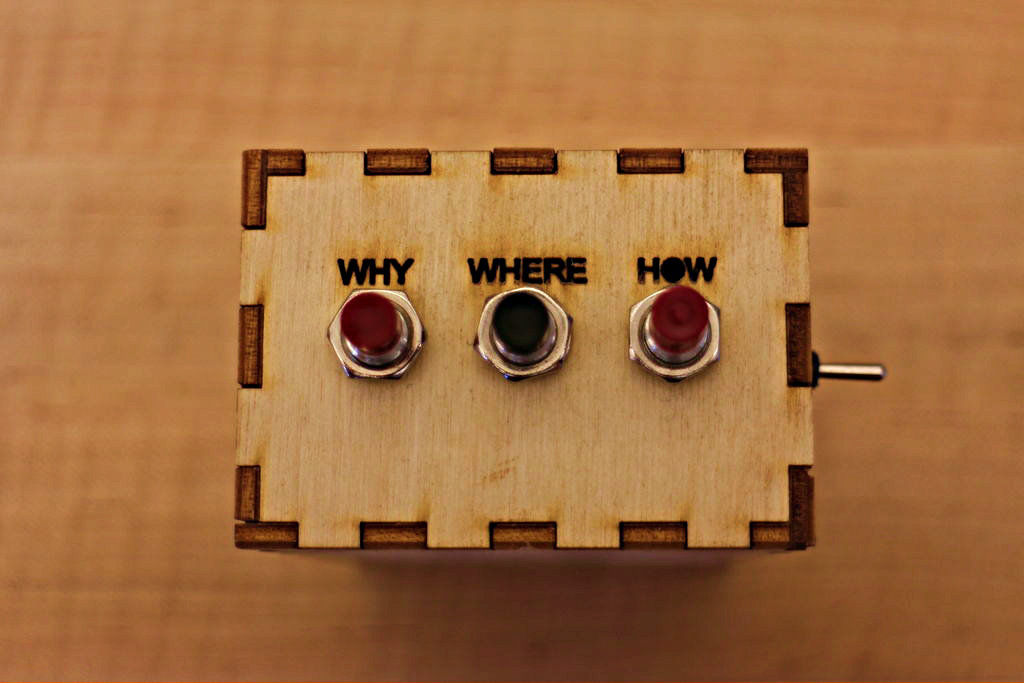
Last week was finals week. If you have ever witnessed a design school towards the end of the semester, you know that it is complete chaos. Students don’t sleep. They are always on campus, pushing as hard as they can to finish their projects. Traditional expectations of what it is to be human starts to break down. They need to finish their projects and they will do whatever it takes to finish their project. The last few days, students lose all empathy. Materials disappear in huge quantities. They steal tools and bring it to their studio. I have to deal with students in the lab looking for a tool and I have no idea where it has gone. “I’m sorry, it’s the end of the semester. Someone must have taken it.” Human-centered design turns into self-centered design.
The semesters end with the entire campus looking like a horde of zombies came through. Part of my role is to help students bring their projects into reality and troubleshoot issues with them. Towards the end of the semester, this feels like all I am doing. The lab is constantly filled with students. I would turn around and there would be four students standing right behind me, looking at me with panicked eyes. It’s mentally exhausting. Troubleshooting electronics is difficult and when I’m working with a student, my brain is in overdrive trying to determine what is the culprit. Sometimes it’s simple and it only takes a few seconds to figure out. Sometimes it’s a bad jumper wire and it can take an hour.
After I closed the lab on the Friday before finals week, I was thinking, “I wonder how often a student asks me a question?”. Wait… I can determine this! I’m surrounded by technology development tools!
Step 1: Types of Questions
I thought of all the questions I get asked. After some thought, here is what I came up with.
“Andrew, why isn’t it working?”
“Andrew, where is the (insert object here)?”
“Andrew, how do I make (insert some concept here)?”
Step 2: Quantified Andrew
I had one day to make the system for finals week. Saturday I was on campus all day for an architecture review, so on Sunday I got to work. I decided to go with an Arduino with a Data Shield and three momentary buttons for each question category. I would wear the system on my belt and anytime I was asked a question, I would press a button and log it onto the SD card on the shield. If the battery died midway through the day, it would still have the backlog of data.
Step 3: Assemblying Electronics
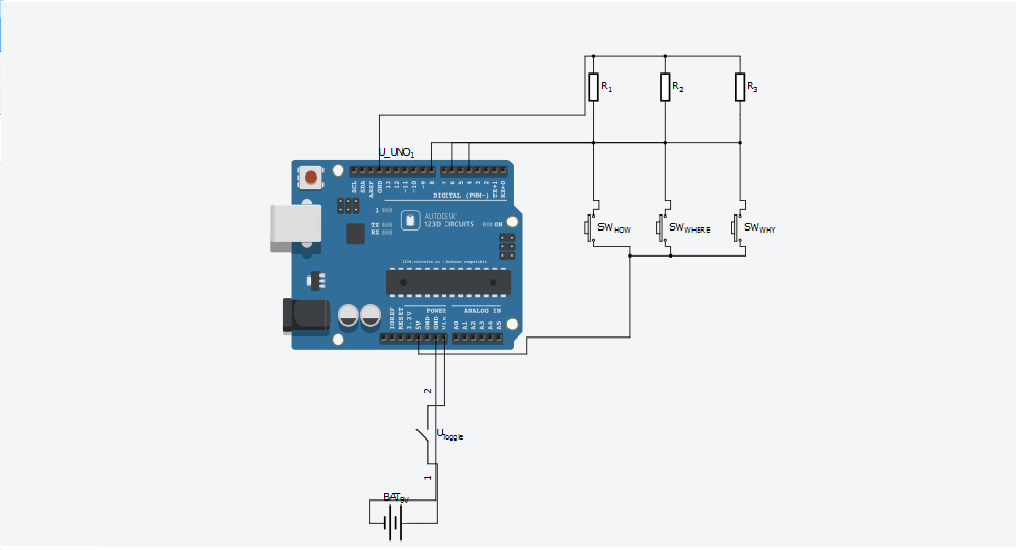
Components used:
Arduino Uno
Adafruit’s Data Shield
6 AA Battery Holder
3 Normally Closed Momentary Switches (would’ve used N.O. but this is what I had)
3 10K Resistors
SD Card
Toggle Switch
The momentary switches are connected to pins 4, 6, and 8. The data shield has small area for prototyping that is perfect to solder everything together.
For more detail: Quantifying Access to your Mind using Arduino
- Why did the author build this system?
To track how often students ask questions and quantify access to their mind during finals week chaos. - What are the three question categories tracked by the system?
The system tracks why things aren't working, where objects are located, and how to create specific concepts. - How does the system store the logged data?
The system logs data onto an SD card attached to the Adafruit Data Shield. - What components connect to pins 4, 6, and 8?
The three momentary switches are connected to pins 4, 6, and 8. - Why did the author choose normally closed momentary switches?
The author used normally closed switches because that was what they had available instead of normally open ones. - Where were the electronic components soldered together?
The components were soldered on the small prototyping area of the Adafruit Data Shield. - How long did the author have to build the system?
The author had one day to complete the system before finals week began. - What happens if the battery dies during the day?
If the battery dies, the system retains the backlog of data already stored on the SD card. - What role does the toggle switch play in the circuit?
The toggle switch is included as part of the assembly but its specific function is not detailed beyond being a component used.
