
Summary of The Edison is not a Raspberry Pi
The article clarifies that the Intel Edison is a deeply embedded IoT module, not a single-board computer like the Raspberry Pi. It explains that limitations such as lack of video ports, limited USB connectivity, and lower processor speeds are intentional design choices for power efficiency in wearables and robots. While the base cost is higher, adding necessary peripherals to a Raspberry Pi narrows the price gap significantly.
Parts used in the Edison Project:
- Edison with mini breakout board
- Raspberry Pi (for comparison)
- SD card
- Wi-Fi dongle
- Bluetooth dongle
The above dimensions and prices reflect the Edison with the mini breakout board.
I’ve been watching lots of comment channels regarding the Edison, and I see a lot of people slamming the Edison as compared to the Raspberry Pi over a few of the lines above:
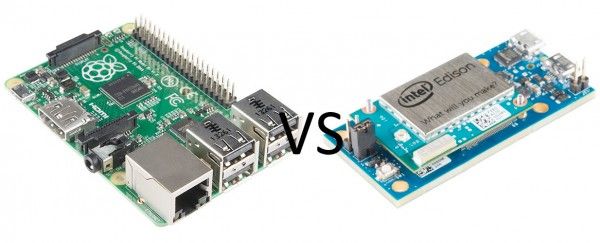
- lack of USB (“Where am I going to plug in my keyboard and mouse?”)
- lack of video
- processor speed
- cost
- the I/O connector is impossible to use without an extra board
All five of those points would be valid criticisms if the Edison were a single board computer like the Raspberry Pi. The Raspberry Pi is, and always has been, aimed at providing a low-cost computing terminal that can be deployed to as a teaching tool. Any hardware hackability on the platform has been purely incidental, a bonus feature.
The Edison, on the other hand, is meant to be a deeply embedded IoT computing module. There’s no video because your Wi-Fi enabled robot doesn’t need video. There’s only one USB port because wearables don’t need a keyboard and mouse. The processor speed is lower because for portable applications power consumption is important (and you can see above just how much better the Edison is than the Raspberry Pi on that front).
As for cost, yes, the Edison loses big time, until you add the cost of an SD card, a Wi-Fi dongle, and a Bluetooth dongle. That brings the prices much closer to parity, although still definitely not equal.
For more detail: The Edison is not a Raspberry Pi
- Why does the Edison lack video output?
The Edison has no video because Wi-Fi enabled robots do not need video capabilities. - Does the Edison have multiple USB ports?
No, there is only one USB port because wearables do not require a keyboard and mouse. - Is the processor speed on the Edison fast?
The processor speed is lower to prioritize power consumption for portable applications. - How does the cost of the Edison compare to the Raspberry Pi?
The Edison loses on cost initially, but prices become closer when adding an SD card, Wi-Fi dongle, and Bluetooth dongle to the Raspberry Pi. - What is the primary purpose of the Edison?
The Edison is meant to be a deeply embedded IoT computing module. - Can the I/O connector be used without an extra board?
No, the I/O connector is impossible to use without an extra board. - Why do critics compare the Edison to the Raspberry Pi?
Critics compare them based on points like lack of USB, lack of video, processor speed, cost, and I/O usability.
