
Summary of Simple pulse oximetry for wearable monitor
This design introduces a simple, functional pulse oximetry system for continuous heart activity monitoring and oxygen saturation measurement. It features an ultra-bright red LED, an infrared LED, and a photodiode sensitive to both wavelengths. The signal processing relies on two operational amplifiers: one configured as a transimpedance amplifier to convert current to voltage, and another as an inverting amplifier with a gain of 30, enabling versatile body placement.
Parts used in Simple Pulse Oximetry:
- Ultra-bright red LED (KA-3528SURC)
- Infrared LED (VSMB3940X01-GS08)
- Photodiode (VBP104SR)
- Operational amplifier IC1 (LT6003) as transimpedance amplifier
- Operational amplifier IC2 (LT6003) as inverting amplifier
Continuous monitoring of heart activity permits measurement of heart rate variability (HRV), a basic parameter of heart health and other diseases.
This Design Idea is a new design of pulse oximetry that excels in its simplicity and functionality. Due to its capabilities, it can be used as a standalone device, able to monitor heart rate and oxygen saturation.
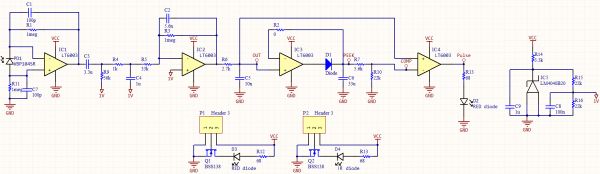
The core of the system is composed of the ultra-bright red LED (KA-3528SURC), infrared LED (VSMB3940X01-GS08), and a photodiode (VBP104SR) sensitive to both wavelengths of light at the same level.
The basic building block of the system is operational amplifier LT6003, which is used in several stages. IC1 is used as a transimpedance amplifier, converting the current generated by the photodiode to a voltage. This stage provides high gain and allows the use of the sensor on almost every part of the body. Op-amp IC2 is connected as an inverting amplifier with a gain of 30.
For more detail: Simple pulse oximetry for wearable monitor
- What is the primary function of this design?
This design serves as a standalone device to monitor heart rate and oxygen saturation. - How does the system measure heart health?
It permits continuous monitoring of heart activity to measure heart rate variability. - Which LEDs are used in the core of the system?
The system uses an ultra-bright red LED and an infrared LED. - Can the sensor be used on different parts of the body?
Yes, the high gain provided by the first stage allows use on almost every part of the body. - What role does IC1 play in the circuit?
IC1 acts as a transimpedance amplifier converting photodiode current to voltage. - What is the gain of the second operational amplifier?
Op-amp IC2 is connected as an inverting amplifier with a gain of 30. - Does the photodiode respond to both light wavelengths equally?
Yes, the VBP104SR photodiode is sensitive to both red and infrared wavelengths at the same level. - Why is the LT6003 chosen for this project?
The LT6003 is used because it serves effectively in multiple stages including transimpedance and inverting configurations.
