
Summary of Mixed-signal asics are good even for smaller volume products
This article discusses the use of mixed-signal ASICs for smaller volume industrial controllers. It highlights how these chips handle sensor data in harsh environments, offering longevity and obsolescence protection. While advanced 22nm or 14nm nodes exist, they favor digital designs; thus, industrial mixed-signal projects typically utilize 350nm to 110nm geometries. These older nodes support high digital integration like DSPs and microprocessors while maintaining necessary analogue flexibility and power device capabilities.
Parts used in the Mixed-Signal ASIC Project:
- Mixed signal ASIC
- Sensors (Positional, Temperature, Pressure, Gas detection)
- Signal conditioning circuits
- Analogue-to-digital conversion components
- DSPs (Digital Signal Processors)
- Microprocessors
- Power devices
Traditionally, asic developments are thought to be the domain of high volume applications. Whilst these designs grab the headlines there are many designs that are successfully undertaken for smaller volume product markets.
An example of this is the mixed signal asic for industrial controllers. These controllers cover many industries and come in many forms. The basic premise, though, is for a system to monitor and react to a defined set of performance parameters. This usually incorporates some sort of feedback loop which the control system will act upon.
It is here, in the measurement and sensing part of the system that the mixed signal asic has become prevalent as tighter constraints and less hysteresis becomes desirable. Input signals can be anything from positional information to temperature, pressure, gas detection etc.
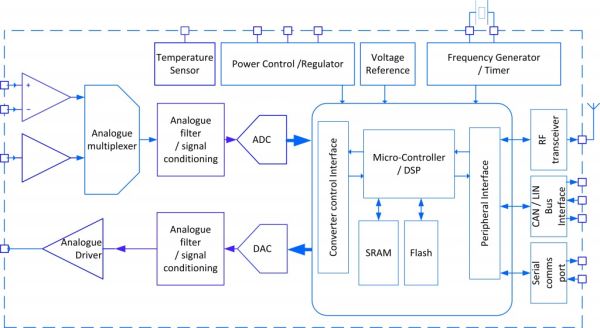
Today, the world is thought of as digital, however in reality the sensors are analogue and there is signal conditioning and conversion to the digital domain to be performed to allow them to interface with the control systems. Due to the nature of where the sensors are placed (often in confined and difficult environments) it becomes an obvious conclusion to design and deploy an asic. These systems are typically in operation for many years and again the additional benefit of obsolescence protection by using an asic becomes an important factor for lifetime maintenance and spares.
Today, it is possible to integrate substantial functionality into an asic, especially at the smaller 22nm and even 14nm CMOS geometries.
However, these geometries are best suited for predominately digital designs because analogue design becomes more challenging as the voltage can be reduced and the area benefits for the analogue part quickly tail-off. So for industrial mixed signal designs the favoured geometries tend to be in the 350nm to 110nm range.
These can still achieve a high level of digital integration, including DSPs and microprocessors as well as offering the flexibility for the analogue part of the design. Power devices and high temperature solutions are also possible, opening up new application areas for integration onto the asic.
For more detail: Mixed-signal asics are good even for smaller volume products
- Why are mixed-signal ASICs suitable for smaller volume products?
They provide obsolescence protection which is critical for lifetime maintenance and spares in systems operating for many years. - What types of input signals do these controllers monitor?
Input signals include positional information, temperature, pressure, and gas detection. - Which CMOS geometries are best suited for industrial mixed-signal designs?
The favored geometries tend to be in the 350nm to 110nm range. - Why are 22nm or 14nm nodes less ideal for analogue parts?
Analogue design becomes more challenging as voltage reduces, and area benefits for the analogue part quickly tail-off at these sizes. - Can digital integration be achieved in 350nm to 110nm processes?
Yes, these processes can achieve a high level of digital integration including DSPs and microprocessors. - What additional features are possible with 350nm to 110nm technologies?
Power devices and high temperature solutions are possible, opening up new application areas. - What is the primary function of the control system described?
The system monitors and reacts to a defined set of performance parameters using a feedback loop.
