
Summary of BJT In Reverse Avalanche Mode
This article explores using bipolar junction transistors (BJTs) in reverse avalanche mode, known as "negistors," to create fast pulse generators. The author tests various transistors in a simple LED flasher circuit to determine their specific reverse avalanche breakdown voltages. The circuit operates on negative differential resistance principles: a capacitor charges until the transistor avalanches, discharging rapidly through an LED to create a blink before resetting.
Parts used in the BJT Reverse Avalanche Flasher:
- Bipolar Junction Transistors (tested for reverse avalanche)
- Capacitor
- Current limiting resistor
- LED (specifically 5mm white)
Transistors operating in their avalanche regions are often used to generate fast rise pulses (seeavalanche pulse generator using 2N3904). Many transistors can also avalanche when the connections to collector and emitter are reversed. When operating in reverse avalanche region, these transistors are sometimes referred to as negistors.
Because the asymmetry and doping differences between the base-emitter and base-collector junctions, the avalanche voltages for reversely connected BTJs are usually magnitudes lower than their normal avalanche voltages. Here, I decided to test a few different transistors and see at what voltages the reverse avalanche occur.
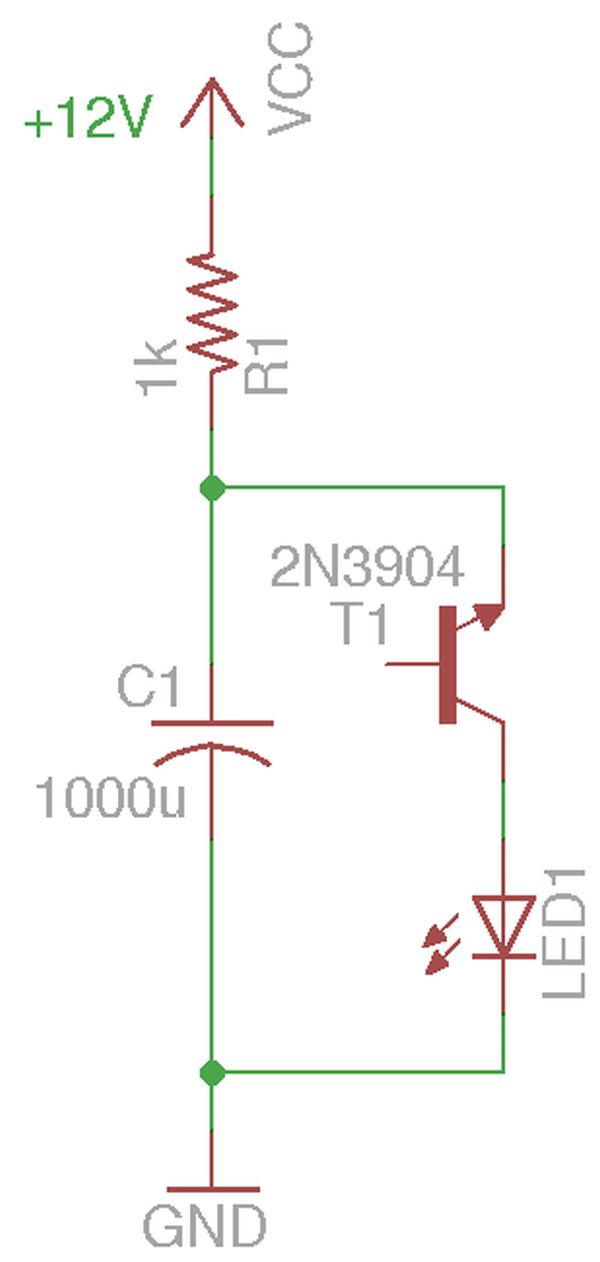
The circuit I used is a simple LED flasher, similar to what was described here. As with any circuit that exhibits negative differential resistance, the principle of operation is quite simple. The capacitor is charged via a current limiting resistor. When the voltage is low, the current that flows between the emitter and collector is roughly the reverse current of a diode which is negligible. When the voltage across the capacitor reaches a certain level, the transistor enters the avalanche breakdown mode. In its avalanche breakdown region, the transistor exhibits negative resistance (i.e. the higher the current, the lower the resistance) so the capacitor discharges rapidly through the LED and the voltage across drops until the avalanche mode can no longer be sustained. At such point, the transistor enters its normal operation mode and becomes non-conductive again. Thus the cycle continues. The rapid discharging through the LED manifests itself as short blinks. The blinking frequency largely depends upon the RC constant and the transistor breakdown characteristics.
Depending on the LED you use, you may need to add a current limiting resistor to protect the LED during discharge. But for a typical 5mm white LED, no resistor is needed as the duration of the current flow is extremely short.
Using the RC values in the schematic above, I measured the minimum voltages required for the circuit to oscillate using different transistors and the results are listed below:
For more detail: BJT In Reverse Avalanche Mode
- What are transistors called when operating in the reverse avalanche region?
They are sometimes referred to as negistors. - How does the blinking frequency of the circuit depend on its components?
The frequency largely depends upon the RC constant and the transistor breakdown characteristics. - Why do reversely connected BJTs have lower avalanche voltages than normal ones?
This is due to the asymmetry and doping differences between the base-emitter and base-collector junctions. - Can a typical 5mm white LED be used without a current limiting resistor?
Yes, no resistor is needed because the duration of the current flow is extremely short. - What happens when the voltage across the capacitor reaches a certain level?
The transistor enters the avalanche breakdown mode and exhibits negative resistance. - How does the capacitor discharge during the avalanche breakdown region?
The capacitor discharges rapidly through the LED until the voltage drops enough to sustain the avalanche mode no longer. - What occurs after the avalanche mode can no longer be sustained?
The transistor enters its normal operation mode and becomes non-conductive again. - Why might you need to add a current limiting resistor depending on the LED used?
You may need one to protect the LED during discharge if it is not a typical 5mm white LED.
