
Summary of Designing active analog filters in minutes
Active analog filters are essential in audio, communication, and data-acquisition systems for frequency selection, noise reduction, and preventing aliasing. The article highlights using Texas Instruments' WEBENCH Filter Designer software to efficiently create low-pass, high-pass, band-pass, or band-stop filters. This tool optimizes designs, selects appropriate operational amplifiers, and offers SPICE simulation capabilities while replacing older TI and National Semiconductor tools.
Parts used in the Active Analog Filters Design:
- WEBENCH Filter Designer software
- Texas Instruments (TI) operational amplifiers (op amps)
- Analog-to-digital converter (ADC)
- Digital-to-analog converter (DAC)
Active analog filters can be found in almost every electronic
circuit. Audio systems use filters for frequency-band limit
ing and equalization.
Designers of communication systems
use filters for tuning specific frequencies and eliminating
others. To attenuate high-frequency signals, every data-
acquisition system has either an anti-aliasing (low-pass)
filter before the analog-to-digital converter (ADC) or an
anti-imaging (low-pass) filter after the digital-to-analog
converter (DAC). This analog filtering can also remove
higher-frequency noise superimposed on the signal before
it reaches the ADC or after it leaves the DAC. If an input
signal to an ADC is beyond half of the converter’s sampling
frequency, the magnitude of that signal is converted reli
–
ably; but the frequency is modified as it aliases back into
the digital output.
A low-pass, high-pass, band-pass, or band-stop filter can
be efficiently designed with the WEBENCH
®
Filter
Designer software from Texas Instruments (TI). This
application replaces TI’s FilterPro™ and the former
National Semiconductor’s WEBENCH Active Filter
Designer software. It uses the approach of these programs
and formulas verbatim when generating active filters. But
it goes beyond these two programs by allowing in-depth
adjustments to filter variables, optimizing the filter, finding
appropriate TI operational amplifiers (op amps) for the
filter circuits, and providing SPICE simulation capability.
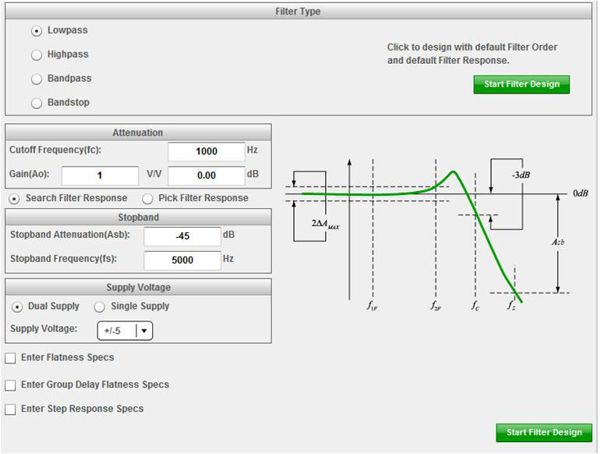
Key design parameters for a low-pass analog filter
The frequency-domain specifications of a low-pass analog
filter include four fundamental parameters:
•
fc, the filter’s –3-dB cutoff frequency
•
Ao, the gain of the filter
•
Asb, the stop-band attenuation
•
fs, the frequency of the intercept to the stop-band
attenuation
These parameters are shown in WEBENCH Filter
Designer’s Filter Type window in Figure 1. The frequency
span from DC to the cutoff frequency (fc) is the pass-band
For more detail: Designing active analog filters in minutes
- What is the primary purpose of anti-aliasing filters in data-acquisition systems?
To attenuate high-frequency signals before they reach the analog-to-digital converter. - How does an input signal beyond half the sampling frequency affect digital output?
The magnitude converts reliably but the frequency aliases back into the digital output. - Which software replaces TI's FilterPro and the former National Semiconductor WEBENCH Active Filter Designer?
It is replaced by the WEBENCH Filter Designer software from Texas Instruments. - What advantage does WEBENCH Filter Designer offer over its predecessors?
It allows in-depth adjustments, optimization, op amp selection, and SPICE simulation. - What are the four fundamental parameters for a low-pass analog filter?
The cutoff frequency, gain, stop-band attenuation, and the frequency of the intercept to the stop-band attenuation. - Can designers use WEBENCH to design different types of active filters?
Yes, it can efficiently design low-pass, high-pass, band-pass, or band-stop filters.
