
Summary of XTENDLORA MESH-CAPABLE LORA DATA RADIO SUPPORTS AT COMMANDS & MODBUS
XTendLoRa is a mesh-capable LoRa data radio operating in the 915 MHz ISM band, offering long-range, interference-resistant multi-hop communication. It supports simple AT commands and a MODBUS register map for configuring and controlling its mesh stack, plus RS485 serial interfacing. Features include field-configurable repeater via IO pin, virtual network allocation, unicast/multicast/broadcast messaging, sink node gateway settings, UART DFU, hardware OTA readiness, wide input voltage, extended temperature range, up to +17 dBm output, -12 dBm sensitivity at SF8, AES-128 CBC encryption, and MUI-64 modem identity.
Parts used in the XTendLoRa:
- XTendLoRa mesh-capable LoRa radio module
- RS485 serial interface
- IO pins for repeater configuration
- UART interface for DFU
- Power supply supporting 4.5 V to 30 V
- 915 MHz ISM-band RF front-end
- AES-128 CBC encryption hardware
- MUI-64 modem identity implementation
A Crowdfund campaign is set to be launched soon for the XTendLoRa, which is a mesh-capable LoRa data radio with support for AT commands & MODBUS.
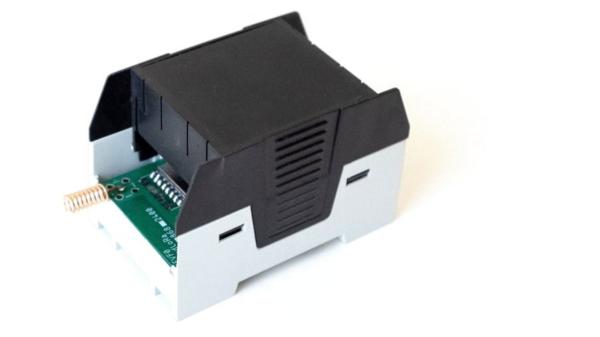
Operating over the 915 MHz, license-free Industrial, Scientific and Medical (ISM) bands, the xTendLoRa capitalizes on the spread-spectrum modulation of LoRa to derive reliable, long-range, high-sensitivity communication—over a multi-hop mesh—even when faced with significant RF or physical interference. You can use basic AT commands or a MODBUS register map to configure and control its complete wireless mesh stack. This combination of simplicity and flexibility is important to reducing development and deployment times for projects that depend on robust communication in harsh environments.
The device features a multi-hop mesh stack and RS485 serial interface. It enables simple AT commands, compatible with a MODBUS Remote Terminal Unit (RTU) profile, and has Good interference immunity. Repeater functionality is field configuration via IO pin. Devices can be allocated to different virtual networks, and it offers Unicast, multicast, and broadcast messaging.
It also offers a flexible sink node setting for gateway Device and enables device Firmware Upgrade (DFU) over UART. The device is hardware competent for OTA, and supports 915 MHz ISM-band operation, 4.5 v to 30 V operating volt, and operation temperature from -20° C to 85° C. It has a fixable output power up to +17 dBm, with receiver sensitivity down to -12dBm at SF 8. Finally, it enables AES- 128 CBC packet encryption, and MUI – 64 modem identity
Read more: XTENDLORA MESH-CAPABLE LORA DATA RADIO SUPPORTS AT COMMANDS & MODBUS
- What frequency band does XTendLoRa operate on?
It operates on the 915 MHz license-free ISM band. - Can XTendLoRa be controlled with AT commands?
Yes, it supports basic AT commands to configure and control its mesh stack. - Does XTendLoRa support MODBUS?
Yes, it is compatible with a MODBUS RTU profile via a register map. - Is there RS485 support on the device?
Yes, the device features an RS485 serial interface. - Can the device act as a repeater?
Yes, repeater functionality can be field configured via an IO pin. - Does the XTendLoRa support over-the-air firmware upgrades?
It is hardware competent for OTA and supports device firmware upgrade over UART. - What are the operating voltage and temperature ranges?
Operating voltage is 4.5 V to 30 V, and temperature range is -20°C to 85°C. - What output power and receiver sensitivity are supported?
Output power is up to +17 dBm and receiver sensitivity down to -12 dBm at SF 8. - Does the device provide encryption?
Yes, it enables AES-128 CBC packet encryption. - Can devices be placed in separate virtual networks?
Yes, devices can be allocated to different virtual networks and support unicast, multicast, and broadcast messaging.
