
Summary of Blink led example arduino with python
Summary (under 100 words): This article explains how to blink an LED on an Arduino using Python and PySerial. It covers wiring (LED positive to a digital output, negative to ground), installing PySerial, and sending serial commands from Python to toggle a pin. It provides a Python example that writes on/off commands to digital pin 13 and notes adjusting time.sleep for blink timing. It also gives step-by-step (IDE Library Manager) instructions for installing PySerial on Windows.
Parts used in the Blink LED with Arduino and Python:
- Arduino board (example: Arduino Uno)
- LED
- Resistor (appropriate value for the LED)
- USB cable to connect Arduino to computer
- Computer with Python and PySerial installed
To blink an LED with an Arduino using Python, you will need to:
- Connect the LED to the Arduino board. You will need to connect the positive leg of the LED (the longer leg) to a digital output pin and the negative leg (the shorter leg) to a ground pin.
- Install the PySerial library, which allows Python to communicate with the Arduino over a serial connection.
- Use PySerial to send a command to the Arduino to turn the LED on and off. You can do this by opening a serial connection to the Arduino and sending a string with the command you want to execute.
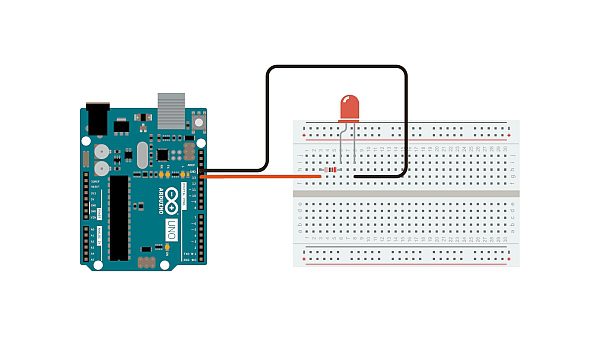
Here’s an example of how to blink an LED connected to digital pin 13 on an Arduino Uno using Python:
import serial
import time

# Set up the serial connection to the Arduino
ser = serial.Serial('/dev/ttyACM0', 9600)

# Blink the LED on and off
while True:
ser.write(b'13H') # Turn the LED on
time.sleep(1) # Wait 1 second
ser.write(b'13L') # Turn the LED off
time.sleep(1) # Wait 1 second

# Close the serial connection
ser.close()
This code will turn the LED on for 1 second and then off for 1 second, creating a blinking effect. You can adjust the delay between turning the LED on and off by changing the time.sleep() duration.
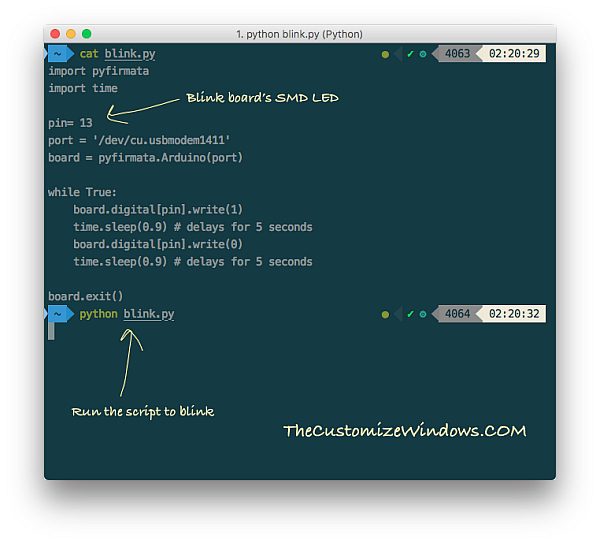
How to Install the PySerial library in Arduino in windows:
To install the PySerial library on an Arduino board running Windows, you will need to follow these steps:
- Connect the Arduino board to your computer via a USB cable.
- Open the Arduino Integrated Development Environment (IDE) and go to the “Tools” menu.
- Under the “Tools” menu, select “Manage Libraries…” to open the Library Manager.
- In the search bar at the top of the Library Manager, type “pyserial” and press Enter.
- Scroll down to the “PySerial” library and click the “Install” button to the right of the library name.
This will download and install the PySerial library onto your Arduino board, allowing you to use Python scripts to communicate with the Arduino over a serial connection.
- How do I wire the LED to the Arduino?
Connect the LED positive leg (longer) to a digital output pin and the negative leg (shorter) to a ground pin. - Can I control the LED from Python?
Yes, by using PySerial to send serial commands from Python to the Arduino to turn the LED on and off. - What Python code example blinks an LED on pin 13?
Open a serial connection with serial.Serial('/dev/ttyACM0', 9600) then repeatedly write b'13H', sleep 1, write b'13L', sleep 1. - How do I change the blink speed?
Adjust the time.sleep() duration in the Python loop to change the on/off delay. - How do I install PySerial on Windows using the Arduino IDE?
Connect the Arduino to the computer, open the Arduino IDE, go to Tools > Manage Libraries..., search for pyserial, and click Install. - What serial settings are used in the example?
The example opens the serial port at 9600 baud. - Do I need a resistor with the LED?
The article implies using a resistor by listing it in parts; a resistor appropriate for the LED should be used.
