
Summary of Over the Counter Kitchen Radio using Arduino
This project creates a compact, hidden kitchen radio using an Arduino and Si470x FM receiver. The system plays pre-selected news and music stations via a toggle button mounted under cabinets on plywood. It integrates with Logitech speakers and uses a simple push-button interface for station switching, offering a space-saving solution for listening to the radio in the kitchen without cluttering the counter.
Parts used in the Over the Counter Kitchen Radio:
- Arduino Uno
- Si470x breakout board
- Logitech computer speakers
- 5V wall wart power supply
- Scrap plywood
This project used the Si470x FM radio receiver and an ardurino to make an over the counter kitchen radio. These parts had been purchased for a different build that unfortunately met a premature end.
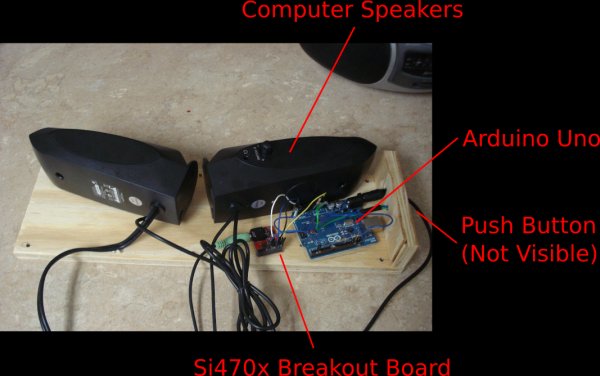
The concept for this project is simple. Play my favorite news and music radio stations while having a form factor that does not take up space on the kitchen counter. I have a small push button that toggles between pre-selected news and music stations built into the side of the radio.
Electrical Connections (Arduino/Si470x)
- 3.3V / Vcc
- GND / GND
- A5 / SCLK
- A4 / SDIO
- D2 / RST
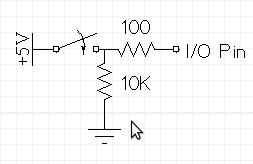
Electrical connections for the push button that toggles through the different radio stations is shown in the figure below. The I/O pin is connected to arduino D7.
All of the components were hot glued to a small piece of 1/2″ plywood.
The project was completed by mounting the plywood to the under side of the kitchen cabinets. I used a paper template to lay out the hole pattern on the under side of the cabinets. The final result can barely be seen when standing in the kitchen.
Here is the arduino code that makes it all tick.
/*
Modified by Ryan Lowe y12m05d26

1-6-2011
Spark Fun Electronics 2011
Nathan Seidle

This code is public domain but you buy me a beer if you use this and we meet someday (Beerware license).

To use this code, connect the following 5 wires:
Arduino : Si470x board
3.3V : VCC
GND : GND
A5 : SCLK
A4 : SDIO
D2 : RST
A0 : Trimpot (optional)

Look for serial output at 57600bps.

The Si4703 ACKs the first byte, and NACKs the 2nd byte of a read.

1/18 - after much hacking, I suggest NEVER write to a register without first reading the contents of a chip.
ie, don't updateRegisters without first readRegisters.

If anyone manages to get this datasheet downloaded

http://wenku.baidu.com/view/d6f0e6ee5ef7ba0d4a733b61.html

Please let us know. It seem to be the latest version of the programming guide. It had a change on page 12 (write 0x8100 to 0x07)
that allowed me to get the chip working..
Parts List
- Arduino Uno
- Si470x breakout board
- Logitech computer speakers
- 5V wall wart power supply
- Scrap plywood
For more detail: Over the Counter Kitchen Radio using Arduino
- How does the user switch between radio stations?
A small push button built into the side of the radio toggles between pre-selected news and music stations. - What is the best way to mount the radio to save counter space?
The plywood base was mounted to the underside of the kitchen cabinets so it can barely be seen when standing in the kitchen. - Does the code require reading registers before writing to them?
Yes, the guide suggests never writing to a register without first reading the contents of the chip to ensure it works correctly. - What serial output speed should I look for when testing the code?
You should look for serial output at 57600bps. - Which Arduino pins connect to the Si470x SCLK and SDIO lines?
SCLK connects to A5 and SDIO connects to A4. - Can I add volume control to this project?
Yes, a trimpot can be connected to pin A0 as an optional component. - How were the components physically secured together?
All components were hot glued to a small piece of 1/2 inch plywood. - What license applies to the provided Arduino code?
The code is public domain but includes a Beerware license request if you use it and meet the author someday.
