
Summary of Sensing Humidity With The SHT15
The SHT15 is a digital, fully calibrated humidity sensor that includes an onboard thermometer (needed because relative humidity depends on temperature). It uses a two-wire, non-I2C serial protocol usable on any two Arduino digital pins (example uses pins 2 and 3). The breakout must not be washed—use no-clean solder and avoid moisture. After soldering, the sensor requires re-hydration: store at >75% humidity for 12 hours or at >40% humidity for 5+ days (a ziplock with a wet towel separated from the board was suggested).
Parts used in the SHT15 humidity sensing project:
- SHT15 humidity and temperature sensor breakout
- Arduino (any model)
- Two Arduino digital wires (example uses pins 2 and 3)
- Soldering iron
- No-clean solder
- Ziplock bag (for re-hydration)
- Wet towel (for re-hydration, not touching the sensor)
The SHT15 is a digital humidity sensor that outputs a fully calibrated humidity reading. And… because what we are measuring is actually relative humidity, and relative humidity being relative to temperature, the SHT15 has a builtin digital thermometer. This makes things much easier to work with than sensors without a thermometer onboard. You can pick one up from sparkFun here.
Hooking it up
The SHT15 uses a two-wire connection for communication that is similar to, but not, I2C. So we wont be able to use the Arduino’s dedicated lines for this. The down side is it is a bit slower to get readings from, the plus side is that you can connect it to any 2 digital pins you want. We are using pins 2 and 3 on our arduino.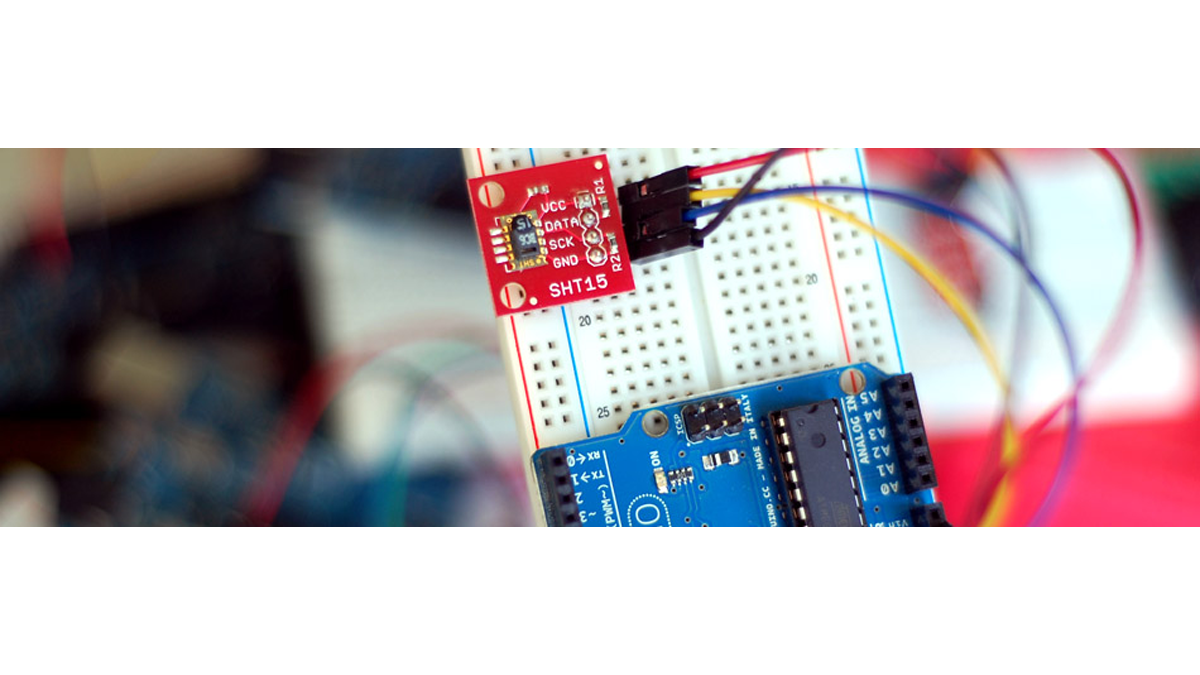
BEFORE YOU SOLDER IT UP… Note that this board can not be washed! So if you are using flux, or solder that you normally clean up, don’t (They actually recommend to use “no-clean” solder just so you don’t have to worry about it). And be extremely careful not to get it wet at all.
AFTER YOU SOLDER IT UP… To get a clean reading, the sensor needs to be stored at >75% humidity for at least 12 hours to allow the polymer to re-hydrate (just what the doc says). If you don’t, your SHT15 may read an offset that slowly disappears if exposed to ambient conditions. Alternatively the re-hydration process may be performed at ambient conditions (>40% Humidity) for 5 + days.
Im not exactly sure how you do that… But someone noted that they put it in a ziplock with a wet towel (not touching) for 12H.
Read More: Sensing Humidity With The SHT15
- How does the SHT15 provide humidity readings?
The SHT15 outputs a fully calibrated digital relative humidity reading and includes a built-in digital thermometer. - Can I use any Arduino digital pins to communicate with the SHT15?
Yes; the SHT15 uses a two-wire non-I2C protocol so you can connect it to any two digital pins (example uses pins 2 and 3). - Does the SHT15 use the Arduino I2C dedicated lines?
No; its two-wire protocol is similar to but not I2C, so you should not use the Arduino I2C dedicated lines. - Can the SHT15 board be washed after soldering?
No; the board cannot be washed and must be kept dry. - What type of solder is recommended for the SHT15 breakout?
No-clean solder is recommended so you do not have to clean flux that could damage the board. - How long and at what humidity must the SHT15 be stored after soldering for accurate readings?
Store at greater than 75% humidity for at least 12 hours for re-hydration; alternatively at greater than 40% humidity for 5 or more days. - What can I do to re-hydrate the SHT15 quickly?
The article notes a suggestion of placing the sensor in a ziplock bag with a wet towel (not touching) for 12 hours.
