
Summary of HALLOWEEN PROJECT: the Candied Dead Baby
The Candied Dead Baby is an Arduino-controlled interactive Halloween decoration that uses an ultrasonic sensor to detect approaching people, triggering a servomotor to reveal a beheaded baby doll inside a box that appears full of candy while a piezo buzzer emits an unsettling sound. Designed and built by three industrial design engineering students, the project uses a clear methacrylate box with a false bottom housing an Arduino, breadboard, wiring, and power source; a wooden platform and stick translate the servo motion to open the lid and pull the reveal string.
Parts used in the Candied Dead Baby:
- Arduino Board
- Piezoelectric buzzer
- Ultrasonic sensor
- Clear methacrylate box
- 400 Tie Points Breadboard
- Female to male Dupont wires
- Breadboard jumping wires
- Doll (beheaded baby doll)
- Servomotor SG90
- Wooden box
- Wooden stick (one)
- Cardboard
- Screws (two pairs)
- Insulating tape
- USB cable compatible with Arduino
- DC Cable PPBAT Battery Clip (for 9V battery)
- 9V battery (optional)
The Candied Dead Baby is an Arduino-controlled interactive halloween decoration. It has been designed, created and assembled by three industrial design engeneering students from Elisava.
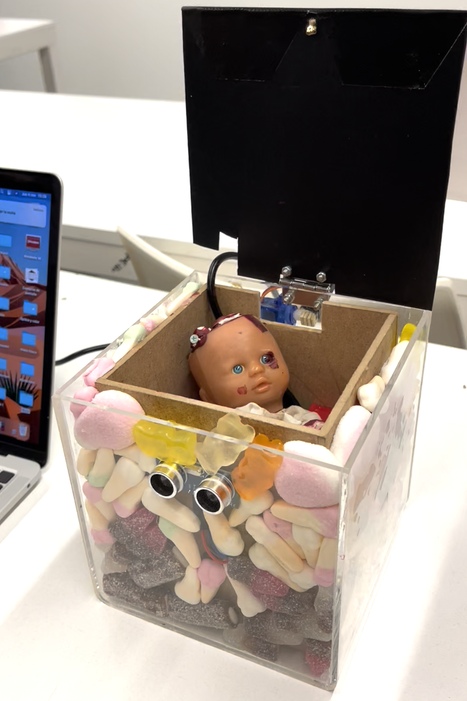
Using servomotors and ultrasonic distance sensors as well as a buzzer, we’ve designed a product that when an ultrasonic sensor catches movement in front of it, activates a servomotor and a buzzer turns on. the project consists on a box that is “full of candy” with a sign that encourages you to get some.
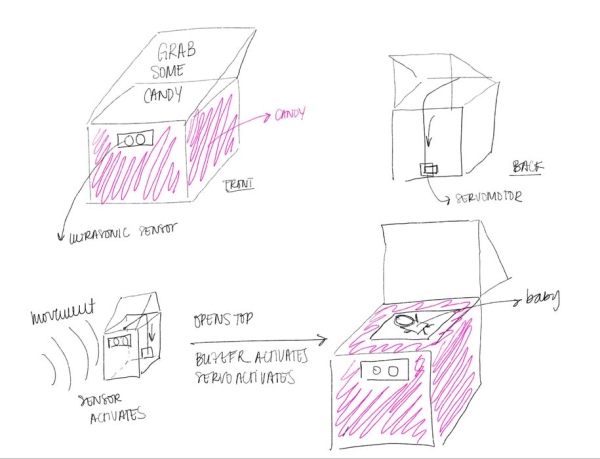
When someone approaches to get some candy, the ultrasonic sensor activates the servomotor and the buzzer. The servomotor opens the box that appears as full of candy, but inside there’s a beheaded baby doll, and at the same time the buzzer starts making a repeatedly uncomfortable noise.
So this is how we achieved this scary experience:
Step 1: Supplies
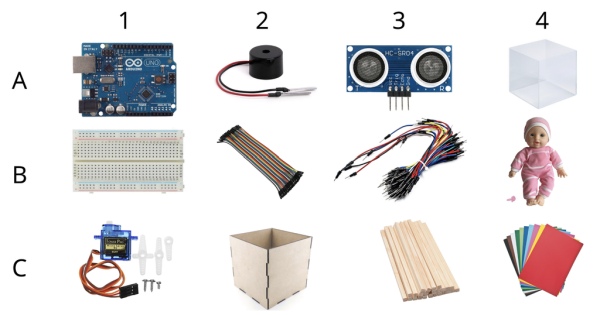
Essential Elements
A1 – Arduino Board
A microcontroller board used as the brain of the project to control sensors, motors, and other components.
A2 – Piezoelectric buzzer
A small electronic device that produces sound or beeps when powered, often used for alerts or alarms.
A3 – Ultrasonic sensor
A distance sensor that uses sound waves to detect how far an object is from it.
A4 – Clear methacrylate box
A transparent plastic case used to hold or protect electronic components while allowing visibility inside.
B1 – 400 Tie Points Breadboard
A board for connecting electronic components without soldering, useful for testing circuits.
B2 – Female to male Dupont wires
Connector wires used to link components and modules to the breadboard or Arduino.
B3 – Breadboard jumping wires
Small wires used to make circuit connections on the breadboard.
B4 – Doll
A decorative or thematic element included for the project’s design and concept.
C1 – Servomotor SG90
A small motor that can rotate to precise angles, commonly used for movement control.
C2 – Wooden Box
A container used to house or support different project parts.
C3 – Wooden stick (only one)
A structural support or moving arm for attaching parts in the project.
C4 – Cardboard
A lightweight material used for building, covering, or shaping parts of the project.
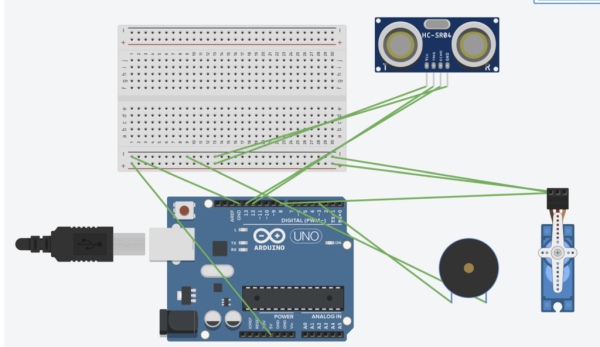
Step 2: Connect the Servomotor, the Piezoelectric Buzzer and the Ultrasonic Sensor
Step 3: Sketch the Prototype
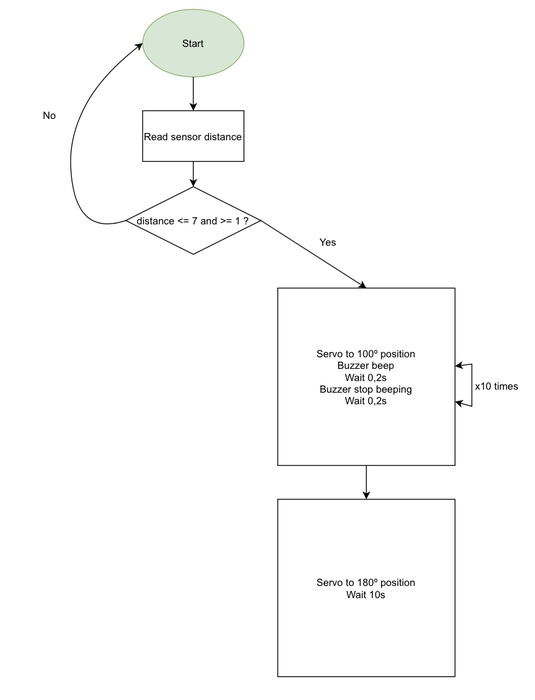
Step 4: Arduino Flowchart
Step 5: Create the Prototype

Our prototype at this stage consist on a wooden box with a false bottom to put the Tie Points BreadBoard and the Arduino Board, that goes inside the clear methacrylate box. Between these two boxes there’s a space of about 1 cm so we can place the candy to create the illusion of a box full of sweets. We build as well the sign that said ” GRAB SOME CANDY”. On both of the boxes we made all the necessary holes and cuts so the wires could go through and out of them as needed.
We used two pair of screws to attach the top part , made out of cardboard, to the clear box.
Step 6: Attach the Servomotor
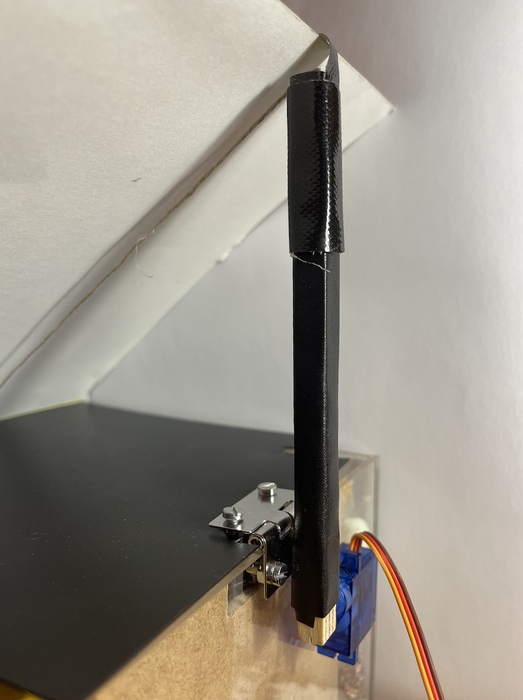
As seen on the pictures this is how we attached the Servomotor to the box. We sticked a Wooden stick to the blade of the Servomotor to increase the strength when it activated. The string that pulled the top was attached form the black cardboard to the highest part of the wooden stick.
Step 7: Incorporate the Electrical Part and the Sensor
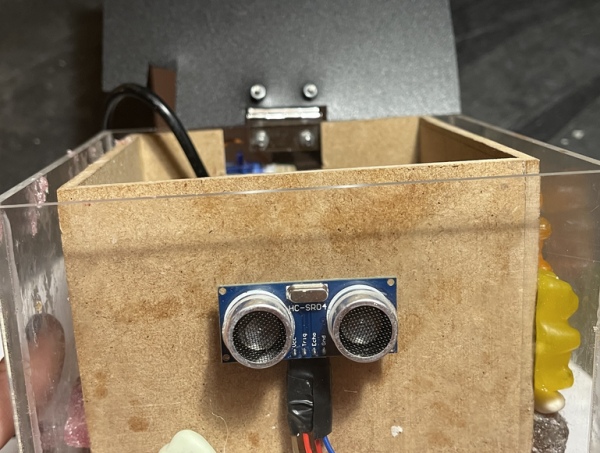
We placed the Tie Points BreadBoard, the Arduino Board and all the wires connected to them on the false bottom. Once al was connected we reenforced the wires so nothing unplugged with insulating tape and redirected the through the holes to attach them to the ServoBoard and the Ultrasonic sensor.
Step 8: Build in the Baby
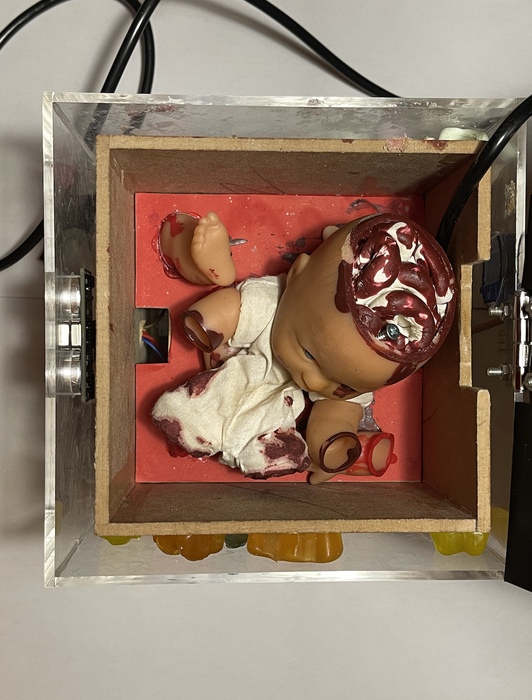
The last part of the creation of the prototype is to place the middle wooden platform that holds the beheaded baby that is revealed when the mechanism is activated
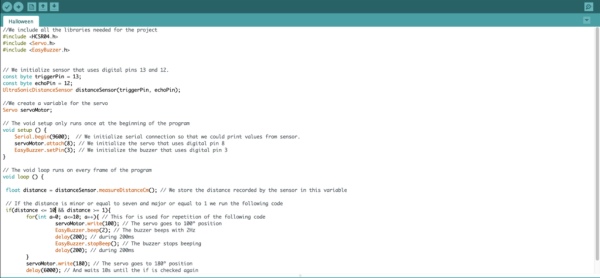
Step 9: Upload Code to Arduino
Step 10: Connect Arduino to Battery or Computer
The last step is to upload to code from the Arduino Software to the Arduino Board, and connect the Board to a power source (9V battery or computer).
To connect it to the computer you will need a USB cable compatible with Arduino.
To connect it to a battery you will need a DC Cable PPBAT Battery Clip and a 9V battery.
Both options are equally valid. In our case we used a computer connected with the USB to Arduino cable.
Step 11: Final Experience and Conclusions
Doing this project, we’ve been able to extend our knowledge in many different fields such as: Arduino, Arduino coding, prototyping, choosing materials according to the necessities and much more. During all this process, several times, we’ve find ourselves in situations where things did not go as planned, and so we had to reinvent ourselves and bring out our most creative side. In these situations we improved as a group, learning how to cooperate in the best way and binging out the best of each of us. We’re very grateful that this project reaches so many fields therefor we have been able to learn plenty of things. This skills that we’ve acquired will be of great use for upcoming projects and is has been a great introduction to Arduino, coding and all the elements that we used.
Lastly a big thanks to our teacher that helped and supported us, and made The Candied Dead Baby.
Source: HALLOWEEN PROJECT: the Candied Dead Baby
- What happens when the ultrasonic sensor detects movement?
The servomotor activates to open the box and the piezoelectric buzzer starts making a repeatedly uncomfortable noise. - How is the servomotor connected to the box lid?
A wooden stick is glued to the servomotor blade and a string attached from the cardboard top to the highest part of the wooden stick pulls the top open. - Where are the Arduino and breadboard placed?
They are placed on a false bottom inside the wooden box which sits inside the clear methacrylate box, with about 1 cm space for candy. - How is the prototype powered?
The Arduino can be powered by a computer via USB cable or by a 9V battery using a DC Cable PPBAT Battery Clip. - What is used to secure and manage wires?
Insulating tape is used to reinforce and prevent wires from unplugging, and holes/cuts are made in the boxes to route wires as needed. - How is the beheaded baby revealed?
A middle wooden platform holds the beheaded baby and the servomotor mechanism pulls the top to reveal it when activated. - What materials form the illusion of a candy-filled box?
A clear methacrylate box with a wooden box and a 1 cm gap between them is filled with candy to create the illusion of a full box while electronics sit below. - How did the team improve their skills through this project?
They extended knowledge in Arduino, coding, prototyping, material selection, problem solving, and teamwork.
