
Summary of Convert Your Old Phone to a Remote Switch
This article details a project to repurpose an old basic mobile phone into a remote switch for controlling appliances like water pumps. By interfacing the phone's vibration motor with an Arduino Nano, users can trigger a relay via calls or SMS from anywhere with cellular coverage. The guide covers disassembly, circuit assembly on a perf board, and code logic to activate switches based on signal detection.
Parts used in the Remote Switch Project:
- Old basic phone (specifically Nokia 3310)
- Soldering Iron
- Wires
- Arduino Nano microcontroller
- 5V 10A Relay module
- LEDs
- 16x2 display (optional)
- Perf board
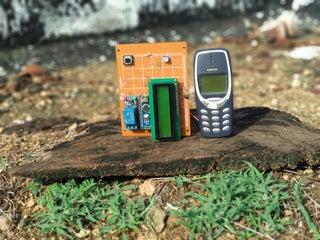
Ever wondered what to do with your old basic phones? The advent of a smartphone in last decade made all the basic phones obsolete. Even though they had good battery life and decent look they are less when compared to big smartphones which have big screens and lots of features. Even I had lots of these phones lying around. I did this project long back i.e 5 years back when I was in 11th grade. Here I did slight advancement when I saw this old project. In this instructable, I’ll use an old basic phone as a remote switch which can be turned on and off from practically anywhere in the world. ( P.S: Where there is cellphone network)
In India, the power supply is not 24×7 in many rural areas. Farmers in the rural area have to supply water to their fields consistently otherwise there might be the loss of crops due to water shortage. The fields are situated far away from their houses. Therefore this project aims to provide a solution for switching pump set remotely to help farmers. But this can be used to switch anything.
Step 1: Get the Parts
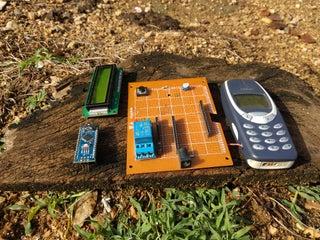
1. Old basic phone (I’m using legendary nokia 3310)
2. Soldering Iron
3. Wires
4. Arduino Nano ( Any microcontroller is fine)
5. A relay module (5V 10A)
6. Some LEDs
7. 16×2 display (optional)
8.Perf board
Step 2: Disassembly
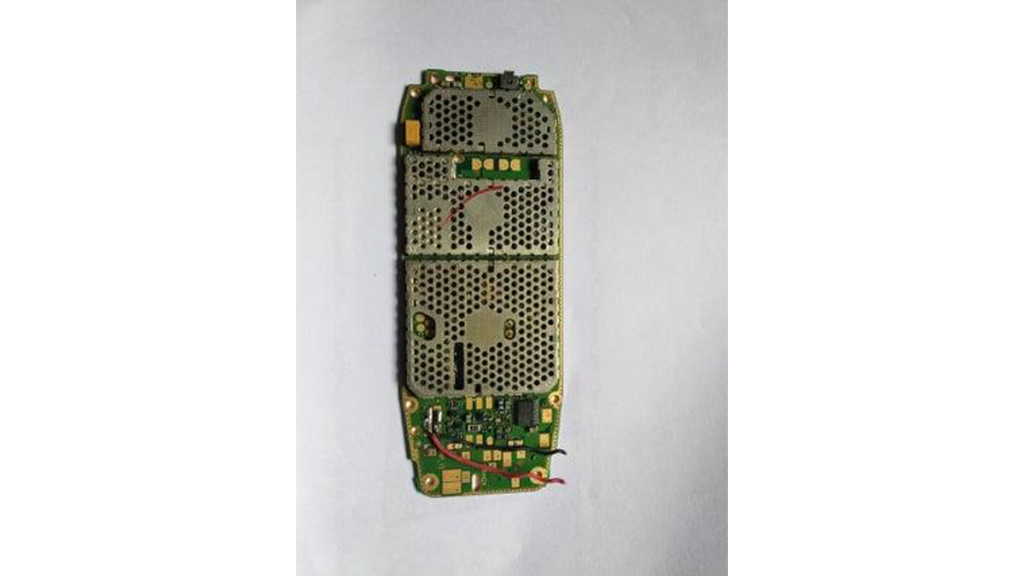
Now you need to disassemble your old phone so that you will have access to the vibration motor connections.
I have attached a video of disassembly of Nokia 3310. But the procedure will be same for almost all basic phones.
Open one by one till you reach the main PCB. There you can see a vibration motor inside.
Step 3: Vibration Motors Inside
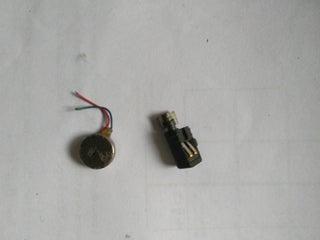
Vibration motor: It is used to provide haptic feedback to the user when a message or call comes. In vibration motors, there are two types,
1. Coreless motor with an unbalanced weight on the shaft. This results in change in moment of inertia resulting in wobbling and hence the vibration.
2. Coin cell type vibration motor which is sealed.
We have to find the connection points of vibration motors.
And solder these points with 2 wires for extending it. Pretty much every basic phone has a vibration motor either of two types.
Step 4: Connecting It to Arduino
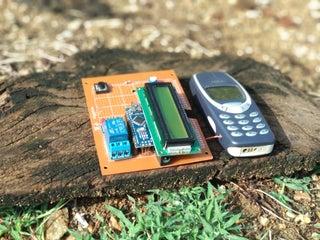
Connect these wires to one of the GPIOs of Arduino. Here I’m using pin number A0. And negative pin to ground. LCD connections are as usual.
Relay module signal pin to pin number 4 and VCC, GND to Arduino’s VCC and GND. You can use jumper wires for the connection here I have made a perf board circuit by soldering all components.
Step 5: Upload the Code.
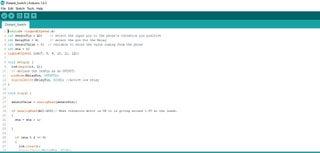
Here I will read the analog port and look for a high signal. And switch the pins accordingly. I have written everything in comments and code is self-explanatory. Whenever it reads a certain voltage at analog pin it activates the switch. This switch can be deactivated by again calling or by sending an SMS.
Step 6: Working Video.
Here I have attached a working video how the whole process works. I hope you enjoy recycling your old phone for a good purpose.
Applications of this project are following:
1. Actuation of a pump set in an agricultural land
2. Switching your room heater before going home.
3. Switching your water heater for bathing
4. Turning off the main switch of your home remotely.
And many more. Let me know if you guys find out anything else.
The best part is you can trigger these switches from any part of the world where there is network access.
Thanks a lot for reading.
Don’t forget to vote in contests.
Source: Convert Your Old Phone to a Remote Switch
-
What is the main purpose of this project?
The project aims to convert an old basic phone into a remote switch to control devices like pump sets or heaters from anywhere with network access. -
How does the system get triggered remotely?
The system is activated by receiving a call or sending an SMS to the phone, which triggers the internal vibration motor connections. -
Which component connects the phone to the Arduino?
The wires soldered to the vibration motor connection points are connected to a GPIO pin on the Arduino. -
Can I use a microcontroller other than the Arduino Nano?
Yes, the article states that any microcontroller is fine as long as it can interface with the circuit. -
What happens when the analog port reads a high signal?
When the code reads a certain voltage at the analog pin, it activates the switch connected to the relay module. -
How do you deactivate the switch after activation?
The switch can be deactivated by calling the phone again or by sending another SMS. -
Are there specific types of vibration motors found in these phones?
Yes, the two types are coreless motors with unbalanced weights and sealed coin cell type vibration motors. -
Where does the relay module connect on the Arduino?
The relay module signal pin connects to pin number 4, while VCC and GND connect to the Arduino's respective power pins.
