
Summary of Binary/ Analog Clock
This article details the construction of a hybrid Binary/Analog clock by an amateur maker. The project combines digital binary representation with analog servo-driven hands to display time, including AM/PM status. Despite minor accuracy variations of up to one minute, the creator aims to fill a niche for rare servo clocks. The build involves assembling a wooden and plexiglas case, mounting two servo motors, and integrating LEDs for binary data display, all controlled by an Arduino microcontroller.
Parts used in the Binary/Analog Clock:
- Wood piece (28cm x 11.5cm x 1cm)
- Plexiglas pieces (various dimensions)
- Two small hinge pairs
- Screws
- Ruler with metric units
- Sharpie
- Two sewing needles (1.75 inches long)
- Thin copper wire
- Arduino (mini or nano preferred)
- Insulated wire
- Scissors
- Card stock paper
- Protractor image file
- Five 100 ohm resistors
- Four same color LEDs and one different color LED
- Two small servo motors
- Glue gun
- Clippers
I was inspired by the digital/ analog clock to make my own special clock as my second instructable. I browsed the internet and found that servo clocks are rare and binary are common. So i decided to combine the two and this is what I made. I know it looks crappy but I’m an amateur and its decently accurate the worst I’ve seen it is a minute forward or behind. It even tells if its am or pm. I hope you all enjoy this. If you have any question please feel free to comment. I’m on instructables daily.
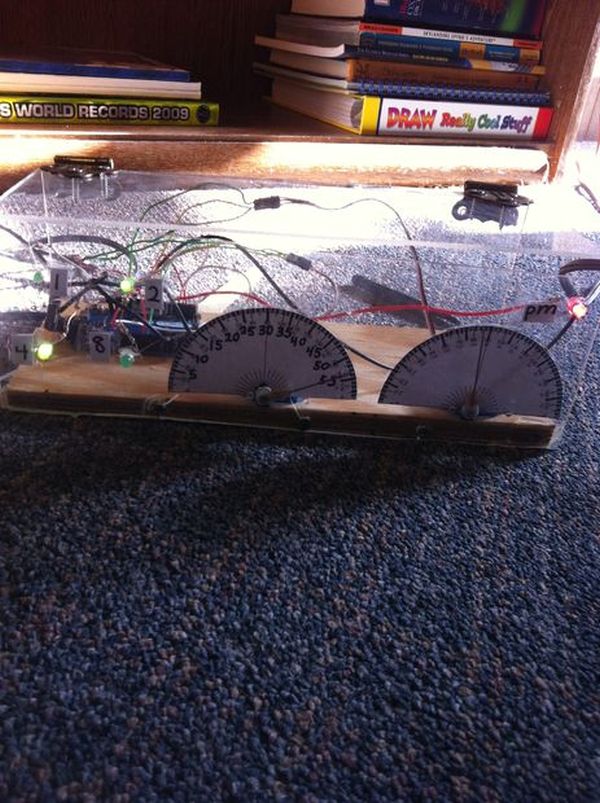
Step 1: Supplies
28cmx11.5cmx1cm piece of of wood. 28cmx9cm(2),11.5cmx9cm(2), and 28cmx11.5cm(1) Plexiglas. two small hinge pairs. Screws. Ruler with metric units. Sharpie. Two sewing needles 1.75 in long. Thin copper wire. Arduino(preferably mini or nano, doesn’t really matter). Insolated wire. Scissors. Card stock paper. Protractor image file(included). 5 100 ohm resistors. 4 same color and 1 different color LEDs. 2 small servo motors http://www.jameco.com/webapp/wcs/stores/servlet/Product_10001_10001_2150416_-1. glue gun. Clippers.
Step 2: The Body
Cut out a piece of wood and 5 Plexiglas pieces that fit the dimensions from the supplies list. On the long sided Plexiglas panels drill 3 holes across the bottom. On one of those two panes make two pairs of holes to fit the hinges. On the other drill holes as shown in the photo. On the short sided Plexiglas panels drill two holes at the bottom. On the top piece Plexiglas panel drill two pairs of holes to fit the hinges. The holes on the bottom of the side panels will screw to the wooden base. Pre drill where the holes will so that its easier to screw in the screws. Use sharpie to mark where holes will be.
Step 3: Servo Holes And Protractor Displays
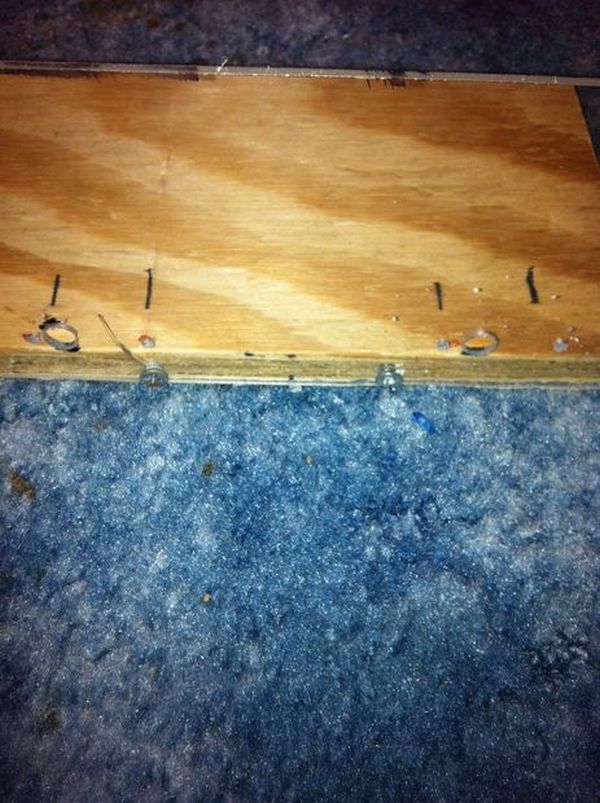
Screw in the front panel and starting from the right end line up a protractor cut out. Mark where it ends measure another 1cm and line up the other and mark where it ends. With the two protractors lined up take the servos and line up the attachment wheel with the cut out semicircle on each protractor. Mark on the glass where that is. From where you marked keep the servos in place and trace the key hole shape of each servo on the the other side of the plexiglas. On a table take the protractors and line up the semicircle with the attachment wheel and trace half of the key hole on the protractor and cut it out. Might want to look at photo for reference. Glue servos in place with wire connecting facing left. Use sharpie to make second marks every 3 degrees as shown. Attach protractors with tape.
Step 4: Clock Hands
Take 4 in of copper wire and thread them as shown.
Step 5: LEDS
Put the different colored led in the the corner hole. Put the other 4 same color led into the holes to the right of the protractors. Attach a resistor to each cathode by solder or twisting and glue them in place
For more detail: Binary/ Analog Clock
- What inspired the creation of this clock?
The author was inspired by digital and analog clocks but found servo clocks rare on the internet. - How accurate is the clock?
The clock is decently accurate with the worst deviation being a minute forward or behind. - Can the clock tell if it is am or pm?
Yes, the clock indicates whether the current time is am or pm. - Which microcontroller is recommended for this project?
An Arduino is required, preferably a mini or nano model. - How are the servos mounted in the project?
Servos are glued in place with wires connecting facing left after marking key hole shapes on the plexiglas. - What materials are used to make the clock body?
The body consists of a wood base and five pieces of plexiglas cut to specific dimensions. - How many LEDs are used in the design?
The design uses five LEDs total: four of the same color and one different color. - What tool is used to mark holes before drilling?
A Sharpie marker is used to mark where holes will be drilled. - What is the purpose of the protractors in Step 3?
Protractors are used to align the servo attachment wheels and mark positions every 3 degrees.
