
Summary of Beekeeping With Arduino
Beekeeping involves maintaining honey bee colonies for products like honey and pollination. This project automates the process using an Arduino to monitor hive conditions. The system tracks temperature, humidity, honey quality, and weight via sensors, displaying data on an LCD and sending it to the cloud for informed harvesting decisions.
Parts used in the Automated Beekeeping System:
- Arduino board
- DHT humidity and temperature sensor
- LCD display
- HX711 amplifier with scale
- Load scale sensor from a weight scale
Beekeeping (or apiculture, from Latin: apis “bee”) is the maintenance of honey bee colonies, commonly in hives, by humans.
Things used in this project
Story
Beekeeping (or apiculture, from Latin: apis “bee”) is the maintenance of honey bee colonies, commonly in hives, by humans. A beekeeper (or apiarist) keeps bees in order to collect their honey and other products that the hive produces (including beeswax, propolis, pollen, and royal jelly), to pollinate crops, or to produce bees for sale to other beekeepers. A location where bees are kept is called an apiary or “bee yard”.
Depictions of humans collecting honey from wild bees date to 15,000 years ago. Beekeeping in pottery vessels began about 9,000 years ago in North Africa.[2] Domestication is shown in Egyptian art from around 4,500 years ago. Simple hives and smoke were used and honey was stored in jars, some of which were found in the tombs of pharaohs such as Tutankhamun. It wasn’t until the 18th century that European understanding of the colonies and biology of bees allowed the construction of the movable comb hive so that honey could be harvested without destroying the entire colony.
This is one of my hobbies. My job is electronic engineer so, I decided to automate the beekeeping process, sort of.
It very important when harvesting to have the right information like temperature, humidity, honey quality and weight chart, to make the decision to stay or move on to a different zone.
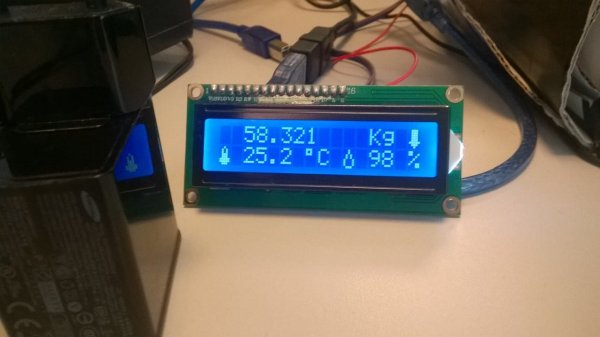
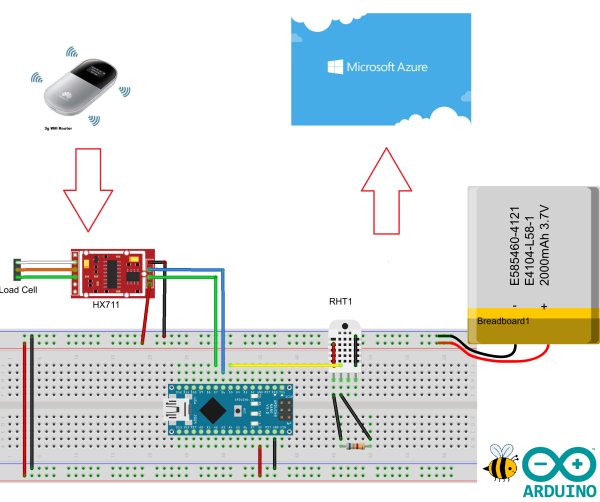
My system is based on Arduino. Arduino board is connected to DHT humidity and temperature sensor, LCD display and HX711 amplifier with scale, reads the values and print it to the LCD display and to Serial port. Next step is to store the files in the cloud.
DHT sensor is used for outdoors and will be mounted outside the projects case. The load scale sensor is from a a weight scale, already has a frame, and will be mounted at the bottom of a beehive.
Read more: Beekeeping with Arduino
- What is the primary purpose of this automated system?
To collect information like temperature, humidity, honey quality, and weight chart to decide when to harvest. - How does the system determine if it should stay or move to a different zone?
By analyzing real-time data on temperature, humidity, honey quality, and weight provided by the sensors. - Which microcontroller is used as the base for this project?
The system is based on an Arduino board. - Where is the DHT sensor mounted in relation to the project case?
The DHT sensor is mounted outside the project case for outdoor readings. - How is the load scale sensor positioned within the beehive setup?
The load scale sensor is mounted at the bottom of a beehive. - What components receive the sensor values printed from the system?
The values are printed to the LCD display and the Serial port. - What is the next step after reading and printing the sensor values?
The next step is to store the files in the cloud.
