
Summary of A BUZZING, FLASHING PHONE RINGER FOR THE ELDERLY
Giovanni built an auxiliary wireless ringer for cordless landline phones to help hard-of-hearing or elderly users. Instead of tapping signaling, he microphones the phone base and sends a Wi-Fi alert from one ESP8266 Wemos D1 mini to another, which drives a loud piezo buzzer and LEDs in a 3D-printed enclosure. Schematics, code, and STL files are provided for replication.
Parts used in the A BUZZING, FLASHING PHONE RINGER FOR THE ELDERLY:
- ESP8266 Wemos D1 mini (transmitter)
- ESP8266 Wemos D1 mini (receiver)
- Arduino sound sensor module
- Piezo buzzer
- Green LED
- Red LEDs
- 3D printed enclosures (STL files provided)
- Wires and connectors
- Power supply for Wemos D1 minis
For a lonely person, elderly or otherwise, the sound of a ringing phone can be music to the ears, unless of course it’s another spam call. But what good is a phone when you can’t hear it well enough to answer?
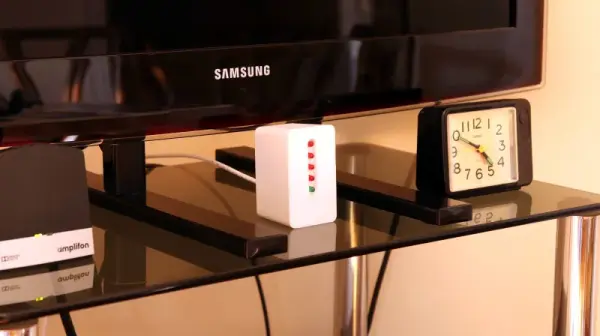
At the heart of this build is a pair of ESP8266 Wemos D1 minis and an Arduino sound sensor module inside a pair of really nice-looking 3D printed boxen that may or may not have been inspired by an IKEA air quality sensor. On the receiving side, a green LED indicates the system is working, and the red LEDs flash as soon as a call comes in.
All the code, schematics, and STL files are available for this build, and between the Instructable and the build video after the break, you should have no trouble replicating it for the hard-of-hearing in your life.
Source: A BUZZING, FLASHING PHONE RINGER FOR THE ELDERLY
- How does the system detect an incoming call?
The system uses an Arduino sound sensor module mic'd to the phone base to detect the ring sound. - How is the alert transmitted to the secondary ringer?
The transmitter Wemos D1 mini sends a signal over Wi-Fi to the receiver Wemos D1 mini. - What does the receiver do when a call is detected?
The receiver activates a piezo buzzer and flashes red LEDs; a green LED indicates the system is working. - Do I need to modify the phone wiring or intercept signals?
No, the design microphones the phone base instead of intercepting phone signals. - Are design files and code available to replicate the project?
Yes, all code, schematics, and STL files are available from the author. - What microcontroller platform is used in the build?
The build uses ESP8266 Wemos D1 mini boards. - Is the enclosure custom made?
Yes, the project uses 3D printed enclosures with provided STL files. - Can this setup help someone who is hard of hearing?
Yes, it provides louder and visual alerts to help the hard of hearing or elderly notice phone calls.
