
Summary of Micro-spectrometer Sensor Will Let You Check Air Quality Or Blood Sugar – Using Smartphone
This article describes a new, smartphone-attachable spectrometer sensor developed at Eindhoven University of Technology. It achieves lab-grade precision using photonic crystal cavities and MEMS technology to adjust membrane gaps for frequency scanning. The device enables diverse applications like air quality monitoring, food freshness checks, and blood sugar measurement by analyzing light absorption footprints.
Parts used in the Smartphone Spectrometer Project:
- Spectrometer sensor
- Smartphone
- Photonic crystal cavity
- Membrane
- MEMS or micro-electromechanical system
Now you can use your smartphone to check how clean the air is, measure the freshness of food or even the level of your blood sugar. This has never been so easy. All credit goes to the new spectrometer sensor which is developed at the Eindhoven University of Technology and can be easily attached to a mobile phone. The little sensor is just as precise as the normal tabletop models used in scientific labs. The researchers published their invention on 20th December in the popular journal Nature Communications.
Spectrometry is the analysis of the light spectrum. It has an enormous range of applications. Every organic and inorganic substance has its own unique ‘footprint‘ in terms of light absorption and reflection. Thus it can be recognized by spectrometry. But precise spectrometers are bulky and costly since they split up the light into different colors (frequencies), which are then measured separately.
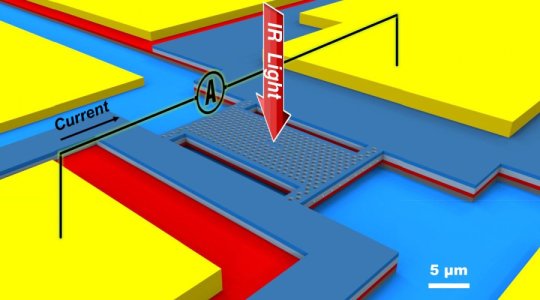
The intelligent sensor developed by Eindhoven researchers is able to make such accurate measurements in an entirely different way. It uses a special photonic crystal cavity that acts as a ‘trap’ of just a few micrometers into which the light falls and cannot escape. This trap is situated in a membrane. In the membrane, the captured light generates a tiny electrical current which can be measured accurately. The accurate working cavity design is made by Žarko Zobenica, a doctoral candidate.
The sensor can measure only a narrow range of light frequencies. To increase the frequency range, the researchers placed two of these membranes above each other closely. The two membranes affect each other. Changing the separation gap between them by a tiny amount also changes the light frequency that the sensor recognizes. To understand this the researchers, supervised by professor Andrea Fiore and associate professor Rob van der Heijden, included a MEMS or micro-electromechanical system.
This mechanism can change the measured frequency by changing the separation between the membranes. In this way, the sensor is able to cover a range of about thirty nanometers. Within which the spectrometer can recognize some hundred thousand frequencies with an exceptional precision. The research team demonstrated several applications like an extremely precise motion sensor and a gas sensor. All made possible by the clever use of the tiny membranes.
Read more: Micro-spectrometer Sensor Will Let You Check Air Quality Or Blood Sugar – Using Smartphone
- What is the primary function of the new sensor?
The sensor analyzes the light spectrum to measure air cleanliness, food freshness, and blood sugar levels. - How does the sensor achieve high precision without being bulky?
It uses a special photonic crystal cavity that traps light in a few micrometers to generate a measurable electrical current. - Can this sensor be attached to a mobile phone?
Yes, the sensor is designed to be easily attached to a mobile phone. - How do researchers increase the frequency range of the sensor?
They place two membranes above each other closely and use a MEMS mechanism to change the separation gap between them. - What role does the MEMS play in the device?
The MEMS changes the measured frequency by adjusting the separation between the membranes. - Does the sensor cover a wide range of light frequencies?
It covers a range of about thirty nanometers within which it recognizes some hundred thousand frequencies. - Who supervised the research team?
The team was supervised by professor Andrea Fiore and associate professor Rob van der Heijden. - What journal published the invention?
The invention was published on 20th December in the journal Nature Communications. - What specific applications did the research team demonstrate?
They demonstrated an extremely precise motion sensor and a gas sensor. - Why are traditional spectrometers often considered problematic?
Traditional models are bulky and costly because they split light into different colors to measure them separately.
