
Summary of Current Source For LED Microscope Illuminator Provides Full-Spectrum Light
### Article Summary The author designed a modern, reliable LED replacement for a failed incandescent microscope light source. Using a 1-W white LED (SEOUL X42182), the circuit provides full-spectrum illumination with minimal heat. A current source drives the LED to enable full-range brightness adjustment suitable for magnifications from 40× to 1000×. The design utilizes a shunt voltage regulator and resistors to set a stable reference voltage for dimming control.
Parts used in the LED Microscope Illuminator:
- Olympus microscope
- 1-W white LED (SEOUL X42182)
- Shunt voltage regulator Q2
- Resistor R1
- Resistor R2
- Potentiometer
- Operational amplifier U1
When the built-in incandescent light source of my venerable Olympus microscope failed after many years of use, I decided to design a reliable modern replacement. A 1-W white LED (SEOUL X42182, 350 mA max, Vf = 3.25 V) was the obvious choice to provide high brightness and full-spectrum light without the heat of incandescent or xenon arc lamps. The microscope lamp brightness needs to be adjustable, however, to accommodate the different objective lenses, which offer magnifications from 40× to 1000×.
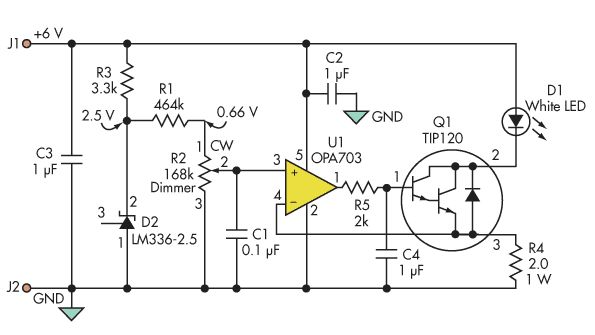
This simple circuit allows full-range dimming by driving the LED with a stable current source while generating little heat (see the figure). Shunt voltage regulator Q2 sets a stable 2.5-V reference that is divided by R1 and R2 to give a maximum voltage of 0.66 V at the top of R2. Different values of R1 and R2 may be used as long as the sum of their values is greater than 20 kΩ, to keep Q2 in regulation.
As the nominal end-to-end resistance of potentiometers may have wide tolerances, measure the value of R2 that you are using and then calculate R1 to provide the 0.66-V maximum voltage at the non-inverting input of U1.
For more detail: Current Source For LED Microscope Illuminator Provides Full-Spectrum Light
- Why was a white LED chosen for the replacement?
A 1-W white LED provides high brightness and full-spectrum light without generating the heat associated with incandescent or xenon arc lamps. - How is the microscope lamp brightness adjusted?
Brightness is adjusted via a simple circuit that drives the LED with a stable current source while generating little heat. - What is the purpose of the shunt voltage regulator Q2?
Q2 sets a stable 2.5-V reference that is divided by R1 and R2 to achieve a maximum voltage of 0.66 V. - Can different values be used for R1 and R2?
Yes, as long as the sum of their values is greater than 20 kΩ to keep Q2 in regulation. - Why must R2 be measured before calculating R1?
Nominal end-to-end resistance of potentiometers may have wide tolerances, so measuring R2 ensures accurate calculation for the required 0.66-V maximum voltage. - What voltage is present at the top of R2?
The circuit is designed to provide a maximum voltage of 0.66 V at the top of R2. - Does this circuit generate significant heat?
No, the circuit generates little heat compared to traditional incandescent or xenon arc lamps.
