
Summary of CogniVue, Fraunhofer debut supersmall camera at Electronica
Researchers from Fraunhofer IZM and CogniVue developed a 16x16x12mm microcamera for ADAS, integrating an image sensor, optics, Freescale SCP2200 processor, and various passive/active components onto a single PCB. This module reduces size by 50% compared to current standards while ensuring low power consumption and vibration resistance through direct encapsulation on glass fiber and epoxy resin boards.
Parts used in the Microcamera Module:
- Image sensor
- Optics
- Freescale SCP2200 image cognition processor
- CogniVue CV2201 Image Cognition Processing SoC IP
- LEDs
- DC-to-DC converters
- Memory chip
- 72 passive components
- Printed circuit board made of glass fiber and epoxy resin
As automotive electronics takes center stage at Electronica this week in Munich, a “microcamera” module recently designed by researchers at the Fraunhofer Institute for driver-assistance applications is expected to enjoy the spotlight.
The Ottawa embedded vision IP vendor CogniVue and Berlin’s Fraunhofer Institute revealed Tuesday that they have collaborated on development of the microcamera. It uses CogniVue’s image processing technology and a Freescale Semiconductor image cognition processor based on CogniVue’s IP.
The new camera module — an image sensor with optics mounted on a printed circuit board — measures 16x16x12 cubic millimeters. It is visibly smaller than current-generation driver-assist cameras, whose edge lengths are “20x20x20 cubic millimeters (without optics),” according to a Fraunhofer press release.
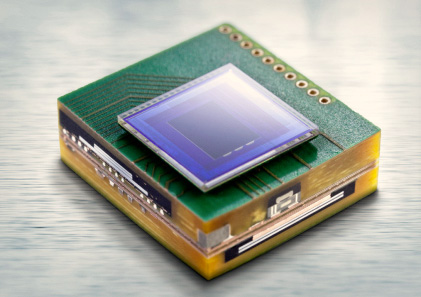
Clearly, the German institute’s assembly and interconnection technology played an integral role in winning the size battle. However, size isn’t the only prerequisite in meeting the automotive industry’s growing demands for Advanced Driver Assistance System (ADAS) cameras. Others include accuracy, speed, power consumption, and cost, Tom Wilson, vice president of product management at CogniVue, told us recently.
The trend among Tier 1s and carmakers designing ADAS cameras is to use a camera module already integrated with an image processing core. Rather than sending captured images to a chip located elsewhere for processing, they prefer a camera module with “a purpose-built processor for running embedded image and vision algorithms,” Wilson said.
It’s bad enough that complex in-camera image processing tends to make the module run hot. Worse is that ADAS cameras designed for reading traffic signs or collision avoidance must be mounted on the front — near a rearview mirror — inside a car. This is a poor location, especially under direct sunlight, he said, because it makes an already hot module even warmer. Hence, one of the big challenges for driver-assist cameras is “an image processor that can fit it into a very low number of watts.”
CogniVue takes pride in its Apex image-cognitive processor technology. Wilson said its performance per area per power for vision processing tends to be significantly better than conventional processor architecture. The Apex core is designed for efficient pipelining of embedded image and vision processing algorithms.
CogniVue has licensed its own CV2201 Image Cognition Processing SoC to Freescale for automotive applications. Freescale’s SCP2200 image cognition processor enables embedded vision processing for ADAS applications at unprecedented low power inside Fraunhofer’s microcamera.
To perfect the miniaturization, researchers at the Fraunhofer Institute for Reliability and Microintegration IZM in Berlin crammed 72 passive and 13 active components (such as LEDs, DC-to-DC converters, memory chip, image sensor, and image processor) into the module. “the volume of the camera was reduced to 3 cubic centimeters with the optics, and 1.2 cubic centimeters without the optics,” according to Fraunhofer.
All the components on the new module are integrated directly into the PC board from glass fiber and epoxy resin. “By encapsulating the electronic components, the microcamera is now impervious to vibrations on uneven street surfaces,” according to the Fraunhofer research team.
For more detail: CogniVue, Fraunhofer debut supersmall camera at Electronica
- What is the size of the new microcamera module?
The module measures 16x16x12 cubic millimeters with a volume of 3 cubic centimeters including optics. - How does this camera compare to current-generation driver-assist cameras?
It is visibly smaller than current models which measure 20x20x20 cubic millimeters without optics. - Why is low power consumption critical for this application?
ADAS cameras are mounted near the rearview mirror where direct sunlight makes heat management difficult. - Which technology enables efficient embedded vision processing?
CogniVue's Apex image-cognitive processor technology offers significantly better performance per area per power. - What components were integrated into the module?
Researchers crammed 72 passive and 13 active components like LEDs, memory chips, and processors into the unit. - How does the design protect against vibrations?
All electronic components are integrated directly into the PC board and encapsulated to be impervious to vibrations. - Who collaborated on the development of this microcamera?
Fraunhofer Institute for Reliability and Microintegration IZM and Ottawa-based CogniVue collaborated on the project. - What material is the printed circuit board made of?
The board is constructed from glass fiber and epoxy resin to support direct component integration.
