
Summary of ADI claims lowest power accelerometer
The ADXL362 is an ultralow-power 3-axis MEMS accelerometer providing 12-bit outputs (also 8-bit format), ±2/±4/±8 g ranges, 1 mg/LSB resolution (±2 g), and selectable low-noise modes down to 175 μg/√Hz. It samples full bandwidth at all data rates, consumes as little as 1.8–3.0 μA at typical ODRs, 270–300 nA in motion wake-up, and 10 nA standby. Features include deep FIFO, micropower temperature sensor, adjustable activity thresholds with wake/sleep modes, an activity output pin, and external clock/control options—suitable for long-life battery applications and wireless sensors.
Parts used in the ADXL362 Project:
- ADXL362 3-axis MEMS accelerometer IC
- Coin cell battery (for low-power operation)
- External switch (optional, controlled by activity output pin)
- Microcontroller or processor (for data readout and control)
- Optional external clock source (for external timing control)
- PCB and supporting passive components (decoupling capacitors, resistors)
Description
The ADXL362 is an ultralow power, 3-axis MEMS accelerometer that consumes less than 2 μA at a 100 Hz output data rate and 270 nA when in motion triggered wake-up mode. Unlike accelerometers that use power duty cycling to achieve low power consumption, the ADXL362 does not alias input signals by undersampling; it samples the full bandwidth of the sensor at all data rates.
The ADXL362 always provides 12-bit output resolution; 8-bit formatted data is also provided for more efficient single-byte transfers when a lower resolution is sufficient. Measurement ranges of ±2 g, ±4 g, and ±8 g are available, with a resolution of 1 mg/LSB on the ±2 g range. For applications where a noise level lower than the normal 550 μg/√Hz of the ADXL362 is desired, either of two lower noise modes (down to 175 μg/√Hz typical) can be selected at minimal increase in supply current.
In addition to its ultralow power consumption, the ADXL362 has many features to enable true system level power reduction. It includes a deep multimode output FIFO, a built-in micropower temperature sensor, and several activity detection modes including adjustable threshold sleep and wake-up operation that can run as low as 270 nA at a 6 Hz (approximate) measurement rate. A pin output is provided to directly control an external switch when activity is detected, if desired. In addition, the ADXL362 has provisions for external control of sampling time and/or an external clock.
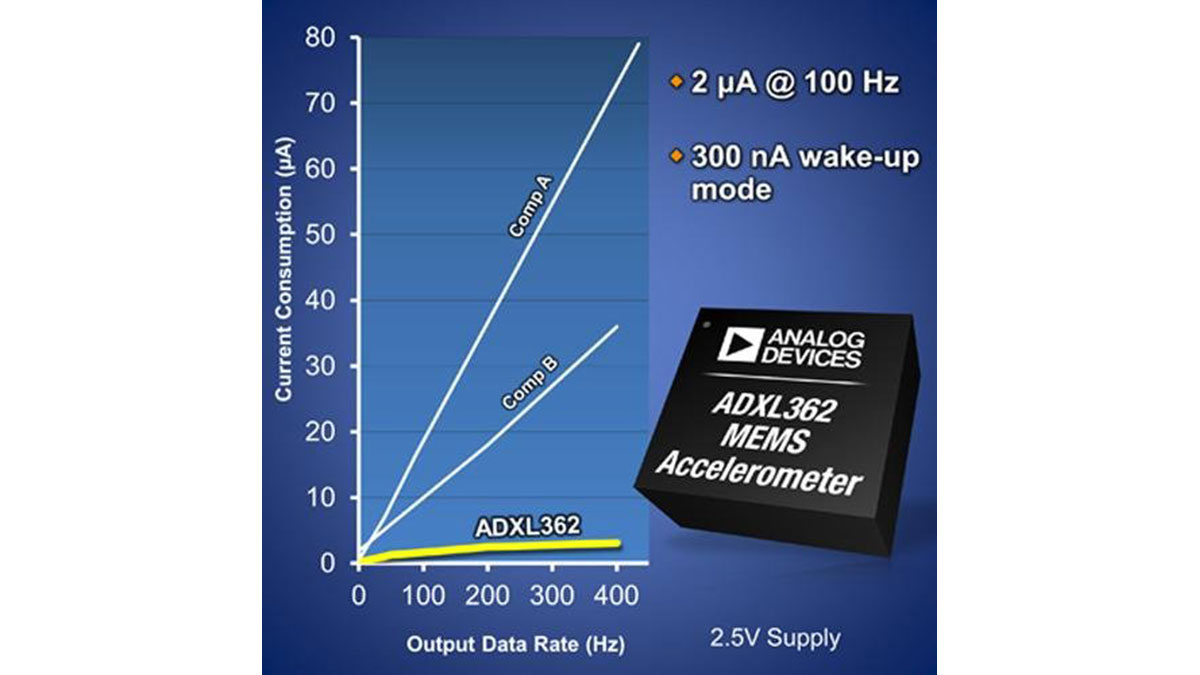
FEATURES and BENEFITS
Ultralow power
— Power can be derived from coin cell battery
— 1.8 μA @ 100 Hz ODR,
2.0 V supply
— 3.0 μA @ 400 Hz ODR,
2.0 V supply
— 270 nA motion activated wake-up mode
— 10 nA standby current
High resolution: 1 mg/LSB
Built-in features for system-level power savings:
— Adjustable threshold sleep/wake modes for motion activation
— See data sheet for additional features
Low noise down to
175 μg/√Hz
Wide supply and I/O voltage ranges:
1.6 V to 3.5 V
— Operates off 1.8 V to 3.3 V rails
Analog Devices has revealed a 2?A three-axis MEMS accelerometer, claiming it to be the lowest powered yet.
2µA is for operation at 100Hz update rate, while ‘motion sensing wake-up’ mode requites only 300nA, and there is a 10nA standby.
The chip has been dubbed ADXL362, and applications are expected in wireless sensor networks and wearable motion detectors.
“This low power consumption allows the ADXL362 to be used in applications that require battery life expectancy of months or years, and where battery replacement can be impractical or dangerous to the equipment or operator,” said ADI.
To save false wake-ups, on-chip circuits distinguish between different kinds of motion. and an internal FIFO memory “allows system designers to record data and stream long data sets, reducing processor load and saving additional system power”, claimed ADI.
For more read: ADI claims lowest power accelerometer
- What is the power consumption of the ADXL362 at 100 Hz?
The ADXL362 consumes about 1.8 μA at a 100 Hz output data rate with a 2.0 V supply. - Can the ADXL362 run from a coin cell battery?
Yes. Its ultralow power consumption allows operation from a coin cell battery. - Does the ADXL362 provide a motion wake-up mode?
Yes. It provides a motion-activated wake-up mode that can run as low as 270 nA (approximate) measurement rate and is listed as 270–300 nA. - What output resolutions does the ADXL362 offer?
The ADXL362 always provides 12-bit output resolution and also offers 8-bit formatted data for efficient single-byte transfers. - What measurement ranges are available on the ADXL362?
The device offers measurement ranges of ±2 g, ±4 g, and ±8 g. - How low can the noise of the ADXL362 be?
Selectable low-noise modes can reduce noise down to 175 μg/√Hz typical. - Does the ADXL362 include onboard memory?
Yes. It includes a deep multimode output FIFO for recording and streaming data. - Can the ADXL362 help reduce system-level power consumption?
Yes. Features like adjustable threshold sleep/wake modes, FIFO, activity output pin, and micropower temperature sensor enable system-level power savings. - What supply and I/O voltage ranges does the ADXL362 support?
It supports wide supply and I/O voltage ranges from 1.6 V to 3.5 V and operates off 1.8 V to 3.3 V rails.
