
Summary of Adafruit Triple-axis Magnetometer sensor board now available
Adafruit has released a Triple-axis Magnetometer breakout board based on the ST LIS2MDL sensor. It offers a wide sensing range of ±50 gauss without range-setting, supports update rates up to 150 Hz, and features both I2C and SPI interfaces. The board includes STEMMA QT/Qwiic connectors for solder-free connection and supports 3.3V or 5V logic levels, making it compatible with platforms like Raspberry Pi, Arduino, and Feather.
Parts used in the Adafruit Triple-axis Magnetometer Board:
- ST LIS2MDL sensor
- Breakout PCB
- Support circuitry
- STEMMA QT connectors
- Qwiic compatible connectors
Adafruit have announced the availability of its new Triple-axis Magnetometer offering a sensor capable of sensing ranges from +-50 gauss (+- 5000 uTesla!) with no range-setting required. For high resolution, you can read at 100 Hz update rate, and if you were not too concerned about a slight loss of precision the sensor can output at 150 Hz. Adafruit explains a little more about the Triple-axis Magnetometer, LIS2MDL, STEMMA QT / Qwiic board which is now available to purchase priced at $5.95.
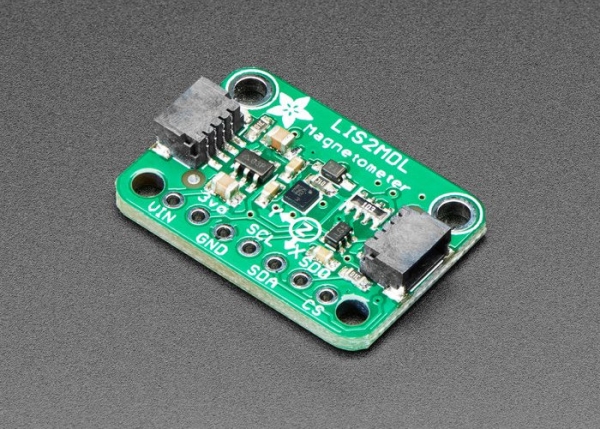
“We based this breakout on ST’s LIS2MDL, a great general purpose magnetometer with a very wide range and bot I2C and SPI interfaces. This compact sensor uses I2C to communicate and it’s very easy to use. Simply download our library and connect the SCL pin to your I2C clock pin, and SDA pin to your I2C data pin and upload our test program to read out magnetic field data. If you’d like, you can also use SPI to receive data (we just happen to prefer I2C here)
To make life easier so you can focus on your important work, we’ve taken the LIS2MDL and put it onto a breakout PCB along with support circuitry to let you use this little wonder with 3.3V (Feather/Raspberry Pi) or 5V (Arduino/ Metro328) logic levels. Additionally, since it speaks I2C you can easily connect it up with two wires (plus power and ground!). We’ve even included SparkFun qwiic compatible STEMMA QT connectors for the I2C bus so you don’t even need to solder! Just wire up to your favorite micro and you can use our CircuitPython/Python or Arduino drivers to easily interface with the LIS2MDL and get magnetic measurements ASAP.”
Source: Adafruit Triple-axis Magnetometer sensor board now available
- What is the maximum update rate of the sensor?
The sensor can output at 150 Hz if a slight loss of precision is acceptable. - Can this sensor be used without soldering?
Yes, it includes SparkFun qwiic compatible STEMMA QT connectors for easy connection. - Does the sensor require manual range setting?
No, it offers a sensing range of ±50 gauss with no range-setting required. - What communication interfaces does the board support?
The board supports both I2C and SPI interfaces. - Is the board compatible with 5V logic levels?
Yes, it supports 5V logic levels for devices like Arduino and Metro328. - How many wires are needed for an I2C connection?
You only need two wires plus power and ground to connect via I2C. - What programming drivers are available for this sensor?
Users can use CircuitPython/Python or Arduino drivers to interface with the sensor. - What is the price of the Adafruit Triple-axis Magnetometer board?
The board is priced at $5.95.
