
Summary of Getting your Nokia 5110 LCD up and running on an Arduino
This article details the setup of an 84×84 Nokia 5110 LCD display with an Arduino. It highlights the screen's low cost, blue backlight, and compatibility with the PCD8544 controller. The guide provides connection instructions, emphasizing a 3.3V supply requirement, and lists necessary software libraries. Users are instructed to rename library folders to fix loading issues in the Arduino IDE before wiring the module via a breadboard and running example sketches for text and animation.
Parts used in the Nokia 5110 LCD on Arduino:
- Arduino
- Nokia 5110 LCD Display Module
- Adafruit Graphics Library
- Adafruit PCD8544 Library
- Breadboard
We purchased one of these very cheap, very cool 84×84 LCD backlit screens off of eBay a couple of weeks ago.
It’s a very nice product for adding visual elements to your projects at a very low price. We paid £3.89 for the screen and it was delivered a few days later.
Take a look below for connection instructions and example code from Adafruit on how to get this up and running with your Arduino.
So What do I need?
- An Arduino
- Nokia 5110 LCD Display Module
- Adafruit Graphics Library
- Adafruit PCD8544 Library
LCD Specifications
- Controller: PCD8544
- Supply: 2.7V to 3.3V
- Interface levels: 2.7V to 5V
- Backlight Colour: Blue
- Backlight supply: 3.3V Max
- Module size: W 43.6mm x H 43.1mm
- Working current: < 200uA (Backlight off)
Notice that the module only needs 3.3v from the Arduino. More information can be found on the Datasheet located here.
Download the above libraries and rename the dash ( – ) to an underscore ( _ ) in the folder names so that the Arduino IDE can load the library correctly; you’ll know if you haven’t done this as the IDE will show a popup message saying it can’t load the library.
Once you have done that; you’re all ready to hook up the LCD to the Arduino, we used a small cheap breadboard for this task as the LCD module came with male pins already attached. As we are using the Adafruit example to get you up and running connect the Pins as follows, example code to come:
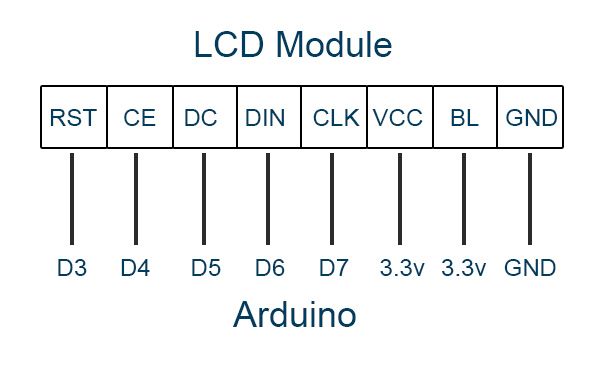
That should be everything you need to connect up. The BL is the back light for the LCD module and it is a optional connection.
Once you have everything wired up; fire up the Arduino IDE and load the Adafruit Example Sketch. I’ve posted it below for reference. There are various features such as displaying text, font-sizes, bitmaps and even making basic animations on the LCD.
For more detail: Getting your Nokia 5110 LCD up and running on an Arduino
- How much did the authors pay for the screen?
The authors paid £3.89 for the screen. - What is the maximum backlight supply voltage?
The backlight supply requires a maximum of 3.3V. - Can I use 5V logic levels with this module?
Yes, the interface levels support 2.7V to 5V. - What should I do if the Arduino IDE cannot load the library?
Rename the dash to an underscore in the folder names. - Is the back light connection mandatory?
No, the BL connection is optional. - What features does the Adafruit Example Sketch offer?
It offers displaying text, font-sizes, bitmaps, and basic animations. - Where can I find more detailed information?
More detail is available at the link Getting your Nokia 5110 LCD up and running on an Arduino. - Does the LCD module come with pins attached?
Yes, the module came with male pins already attached.
