
Summary of Bismuth Oxyiodide (BiOI)—A Non-toxic Alternative To Solar Cells
This article discusses the development of non-toxic, cost-effective solar cells using bismuth-based compounds like Bismuth Oxyiodide (BiOI). Researchers from the University of Cambridge and the US demonstrated that bismuth offers high defect tolerance and efficiency comparable to lead-based perovskites, without environmental risks. Unlike energy-intensive silicon production, these materials allow for cheaper manufacturing while achieving conversion efficiencies up to 22%.
Parts used in the Bismuth-Based Solar Cell Project:
- Bismuth
- Lead (Pb)
- Bismuth Oxyiodide (BiOI)
- Silicon (Si)
- Hybrid lead halide perovskites
- Theoretical methods
- Experimental methods
Bismuth is considered as a “green-element” and bismuth-based compounds are gaining attention as potentially non-toxic and defect-tolerant solar absorbers. The researchers of the University of Cambridge and the United States developed theoretical and experimental methods to show that bismuth, which sits next to lead (Pb) on the periodic table, can be used to make inexpensive solar cells.
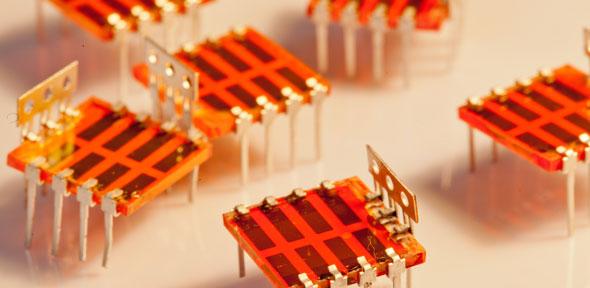
The study suggests that solar cells including bismuth can have all the exceptional properties of lead-based solar cells but without any worries about toxicity. Another study by a different group discovered that bismuth-based solar cells have the ability to achieve a conversion efficiency of 22% which is comparable to the conversion efficiency of most advanced solar cell available in the market.
Many of the new materials recently investigated show limited photovoltaic performance. Bismuth Oxyiodide (BiOI) is one such compound and it is explored in detail through theory and experiment. Most of the solar cells commercially and domestically used are made from silicon (Si) which is efficient enough but has very low defect tolerance compared to bismuth oxyiodide. Low defect tolerance in silicon implies that the silicon needs to have very high levels of purity, making the production process energy-intensive.
Over the past several years researchers have been looking for an alternative to silicon for making solar cells cost effectively. The most promising group of these new materials are called hybrid lead halide perovskites. Unlike silicon, they don’t need such high purity levels. Hence, production is cheaper. But, the lead contained within perovskite solar cells represents a definite risk to all living beings and the environment. So, scientists are searching for non-toxic alternatives without compromising the performance.
Dr. Robert Hoye of Cambridge’s Cavendish Laboratory and Department of Materials Science & Metallurgy said,
Read more: Bismuth Oxyiodide (BiOI)—A Non-toxic Alternative To Solar Cells
- What makes bismuth a green element?
Bismuth is considered a green element because it is non-toxic and can be used to make inexpensive solar cells without worrying about toxicity. - Can bismuth-based solar cells achieve high efficiency?
Yes, studies show they can achieve a conversion efficiency of 22%, which is comparable to most advanced solar cells available in the market. - How does bismuth compare to silicon regarding defect tolerance?
Bismuth oxyiodide has high defect tolerance, whereas silicon has very low defect tolerance requiring high purity levels. - Why is silicon production considered energy-intensive?
Silicon needs very high levels of purity due to low defect tolerance, making its production process energy-intensive. - What are hybrid lead halide perovskites?
They are a promising group of new materials that do not need high purity levels, making production cheaper than silicon. - Does lead in perovskite solar cells pose a risk?
Yes, the lead contained within perovskite solar cells represents a definite risk to all living beings and the environment. - What did researchers from the University of Cambridge develop?
They developed theoretical and experimental methods to show that bismuth can be used to make inexpensive solar cells.
