
Summary of Arduino Cookbook by Michael Margolis E-Book
This cookbook provides over 200 Arduino recipes for building interactive devices—covering basics to advanced topics like sensors, displays, motors, audio, networking, wireless, I2C/SPI, and low-level controller use. Updated for Arduino 1.0, it guides beginners and experienced makers through sketches, serial communication, timing, libraries, troubleshooting, and electronics references for rapid prototyping.
Parts used in the Arduino Cookbook:
- Arduino board
- Digital input devices (switches, buttons)
- Analog sensors
- Various sensors (temperature, light, position, sound)
- Visual displays (LEDs, LCDs, graphical displays)
- Motors (DC motors, servos, stepper motors)
- Audio output components (speakers, buzzers)
- Remote control interfaces (IR receivers, transmitters)
- I2C and SPI devices
- Wireless modules (RF, Bluetooth, Wi-Fi)
- Ethernet networking hardware
- Electronic components (resistors, capacitors, transistors)
- Wiring and prototyping tools (breadboards, wires)
- Controller chips and supporting circuitry
Book Description:
Want to create devices that interact with the physical world? This cookbook is perfect for anyone who wants to experiment with the popular Arduino microcontroller and programming environment. You’ll find more than 200 tips and techniques for building a variety of objects and prototypes such as toys, detectors, robots, and interactive clothing that can sense and respond to touch, sound, position, heat, and light.
You don’t need to have mastered Arduino or programming to get started. Updated for the Arduino 1.0 release, the recipes in this second edition include practical examples and guidance to help you begin, expand, and enhance your projects right away—whether you’re an artist, designer, hobbyist, student, or engineer.
- Get up to speed on the Arduino board and essential software concepts quickly
- Learn basic techniques for reading digital and analog signals
- Use Arduino with a variety of popular input devices and sensors
- Drive visual displays, generate sound, and control several types of motors
- Interact with devices that use remote controls, including TVs and appliances
- Learn techniques for handling time delays and time measurement
- Apply advanced coding and memory handling techniques
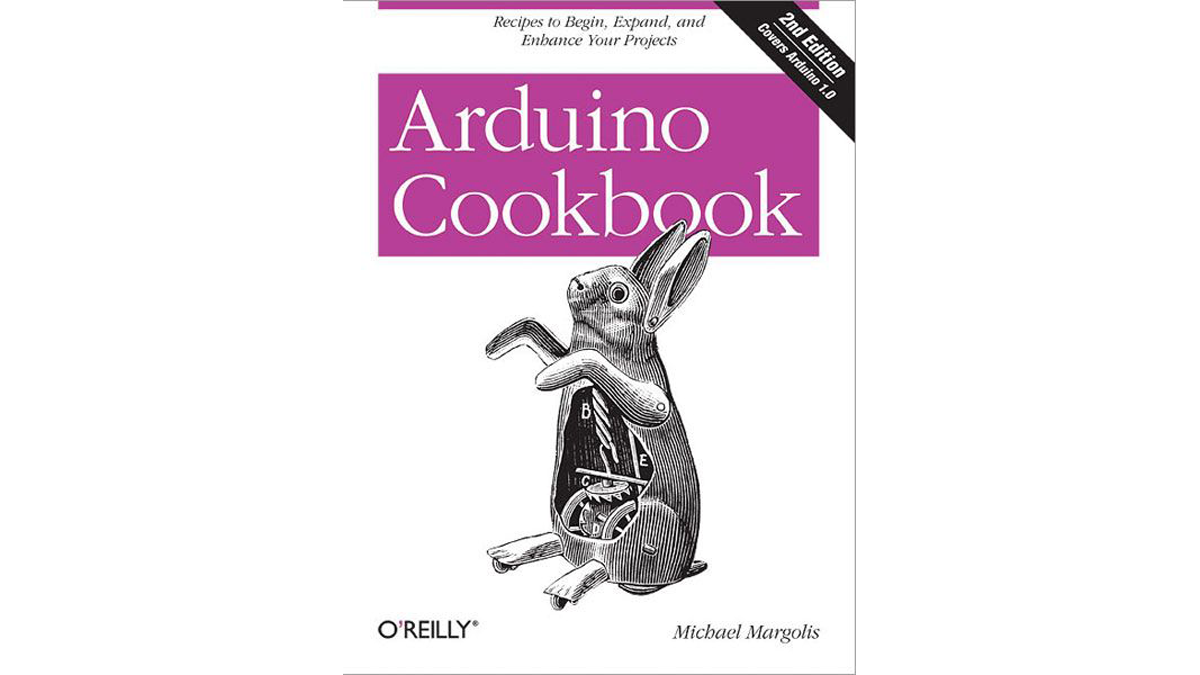
Table of Contents:
Chapter 1. Getting Started
Chapter 2. Making the Sketch Do Your Bidding
Chapter 3. Using Mathematical Operators
Chapter 4. Serial Communications
Chapter 5. Simple Digital and Analog Input
Chapter 6. Getting Input from Sensors
Chapter 7. Visual Output
Chapter 8. Physical Output
Chapter 9. Audio Output
Chapter 10. Remotely Controlling External Devices
Chapter 11. Using Displays
Chapter 12. Using Time and Dates
Chapter 13. Communicating Using I2C and SPI
Chapter 14. Wireless Communication
Chapter 15. Ethernet and Networking
Chapter 16. Using, Modifying, and Creating Libraries
Chapter 17. Advanced Coding and Memory Handling
Chapter 18. Using the Controller Chip Hardware
Appendix A. Electronic Components
Appendix B. Using Schematic Diagrams and Data Sheets
Appendix C. Building and Connecting the Circuit
Appendix D. Tips on Troubleshooting Software Problems
Appendix E. Tips on Troubleshooting Hardware Problems
Book Details |
|
| Publisher: | O’Reilly Media |
| By: | Michael Margolis |
| ISBN: | 978-0-596-80247-9 |
| Year: | 2011 |
| Pages: | 662 |
| Language: | English |
| File size: | 7.48 MB |
| File format: | |
Paper Book |
|
| Buy: | Arduino Cookbook by Michael Margolis E-Book |
Online Book |
|
| Read: | Arduino Cookbook |
Purchase Michael Margolis E-Book
- Who is the Arduino Cookbook suitable for?
It is suitable for beginners through experienced makers including artists, designers, hobbyists, students, and engineers. - How many recipes does the book provide?
It provides more than 200 tips and techniques or recipes. - Does the book cover wireless communication?
Yes, it includes a chapter on wireless communication. - What hardware topics are included?
Hardware topics include sensors, motors, audio, displays, controller chip hardware, and electronics components. - Does the book address networking?
Yes, it includes chapters on Ethernet and networking and on wireless communication. - Can beginners get started with this book?
Yes, the book provides guidance to get up to speed on the Arduino board and essential software concepts quickly. - Does it cover communication protocols like I2C and SPI?
Yes, there is a chapter dedicated to communicating using I2C and SPI. - Are troubleshooting resources included?
Yes, the appendices include tips on troubleshooting software and hardware problems. - Does the book include information on creating libraries?
Yes, it covers using, modifying, and creating libraries. - What edition and Arduino version is the book updated for?
The second edition is updated for the Arduino 1.0 release.
